What does camp mean in fashion? It’s not a trend, a color, or a specific silhouette. It’s a sensibility built on deliberate exaggeration, irony, and artifice, and it’s been hiding in plain sight for decades.
Susan Sontag gave it real cultural weight back in 1964 with her essay “Notes on ‘Camp,’” but most people didn’t clock the word until the Met’s Costume Institute built its entire 2019 exhibition and gala around it.
I remember scrolling that red carpet and thinking, wait, is Katy Perry dressed as a chandelier? That’s the exact moment I went down the rabbit hole myself.
What is Camp in Fashion?
Camp isn’t a trend or a color palette. It’s a sensibility, and it has a specific definition worth pinning down.
Camp, in one line: A style so deliberately artificial, exaggerated, or over the top that it becomes its own form of art, close to how Merriam-Webster defines the term.
At its core, camp is about deliberate exaggeration and artifice, favoring anything loud and constructed over anything that reads as natural or effortless.
It leans into irony and theatricality, treating self-aware “bad taste” as a legitimate art form rather than something to hide, which is really the whole engine behind the camp aesthetic.
Camp fashion also blurs the line between high fashion and kitsch, borrowing freely from pop culture, junk food, memes, or everyday household objects and turning them into runway concepts.
And there’s a strange kind of humor baked into it too: camp takes seriousness so far, so intentionally, that it loops back around into something funny, whether that’s the designer’s plan or just how the audience reads it.
That definition didn’t appear out of nowhere. The word itself has a traceable, oddly theatrical history.
Where Does the Word Camp Come From?
Long before Sontag, before the Met, camp already had a life of its own.
- French court era: Costume Institute curator Andrew Bolton has traced the word to the French verb “se camper” (to strike an exaggerated pose), linking it to the flamboyant court of Louis XIV and his brother, Philippe I, Duc d’Orléans, who was known for his theatrical, effeminate presentation.
- 1868: One of the earliest documented uses of the word appears in a letter written by Frederick William Park, half of the Victorian cross-dressing duo known as “Fanny and Stella,” describing his own “campish undertakings.” The letter later surfaced as evidence in the Boulton and Park case, a scandal that pushed queer slang like “camp” into wider circulation after the pair’s arrest in 1870 and trial in 1871.
- 1909: The word gets its first documented print use in J. Redding Ware’s Passing English of the Victorian Era, which defines it simply as actions and gestures of exaggerated emphasis, marking its formal entry into the Oxford English Dictionary.
- 1964: Susan Sontag’s essay, “Notes on ‘Camp,'” gives the term real cultural weight.
- 1965: Andy Warhol releases the film Camp, made in direct response to Sontag’s essay.
Of everything on that timeline, one essay did more to define camp than anything before or since.
Susan Sontag’s “Notes on Camp”: The Essay That Defined the Term
Sontag, an American writer and cultural critic, is the reason fashion still borrows this language when it wants to describe something as camp.
| Sontag’s Idea | What It Means |
|---|---|
| Love of the unnatural | Camp prizes artifice over anything that looks organic or effortless |
| Failure is part of the appeal | Something becomes camp when it aims high and misses in an interesting way |
| Camp neutralizes moral judgment | It replaces seriousness with playfulness |
| Everything in quotation marks | A camp object isn’t just itself; it’s a performance of itself |
Sontag described a sensibility. Fashion turned it into a working method.
How is Camp Used in Fashion?
Once camp left the essay and entered the runway, it split into a few distinct applications.
Camp as a Design Philosophy
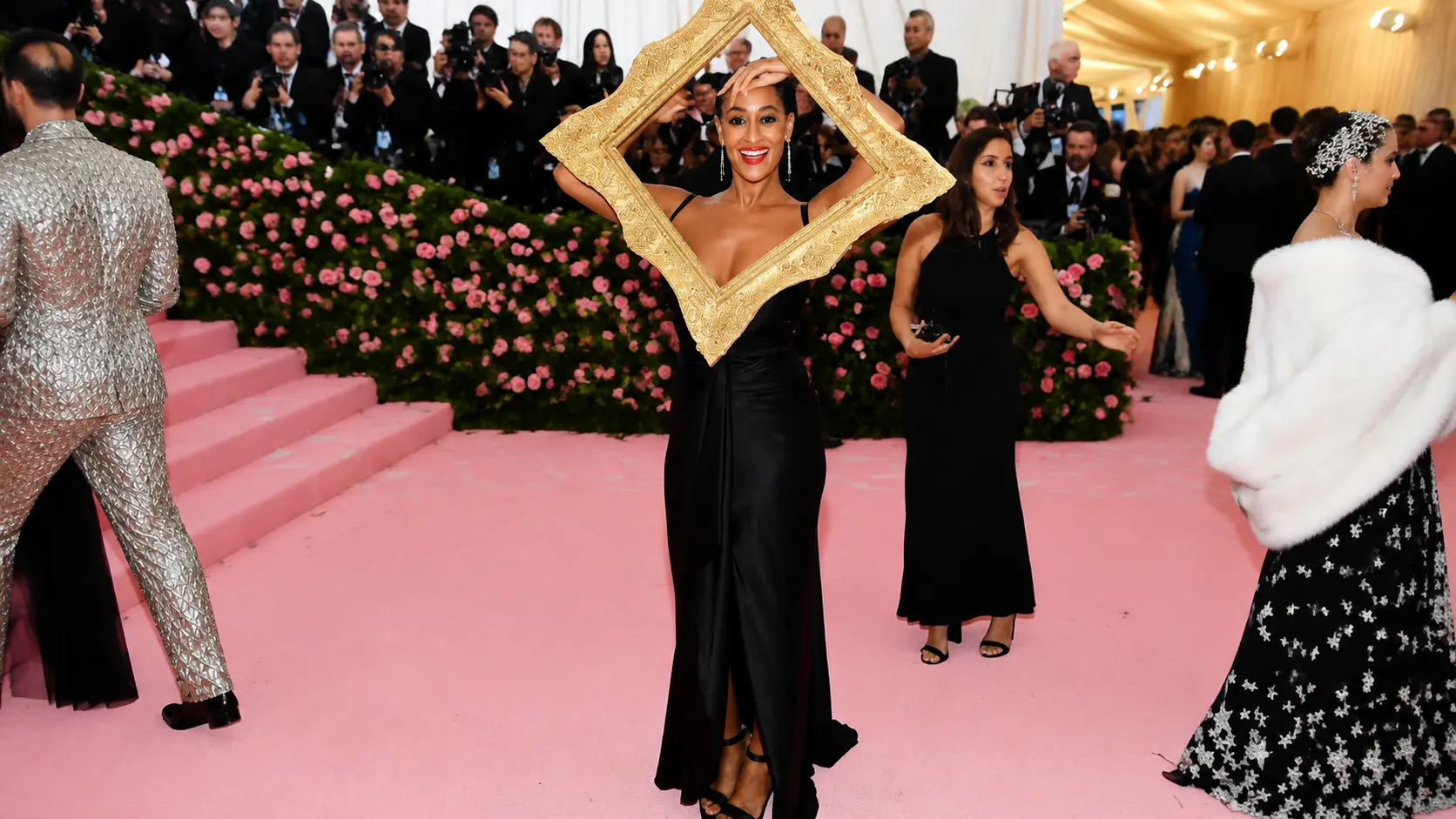
Image Credits: Red Carpet Fashion Awards
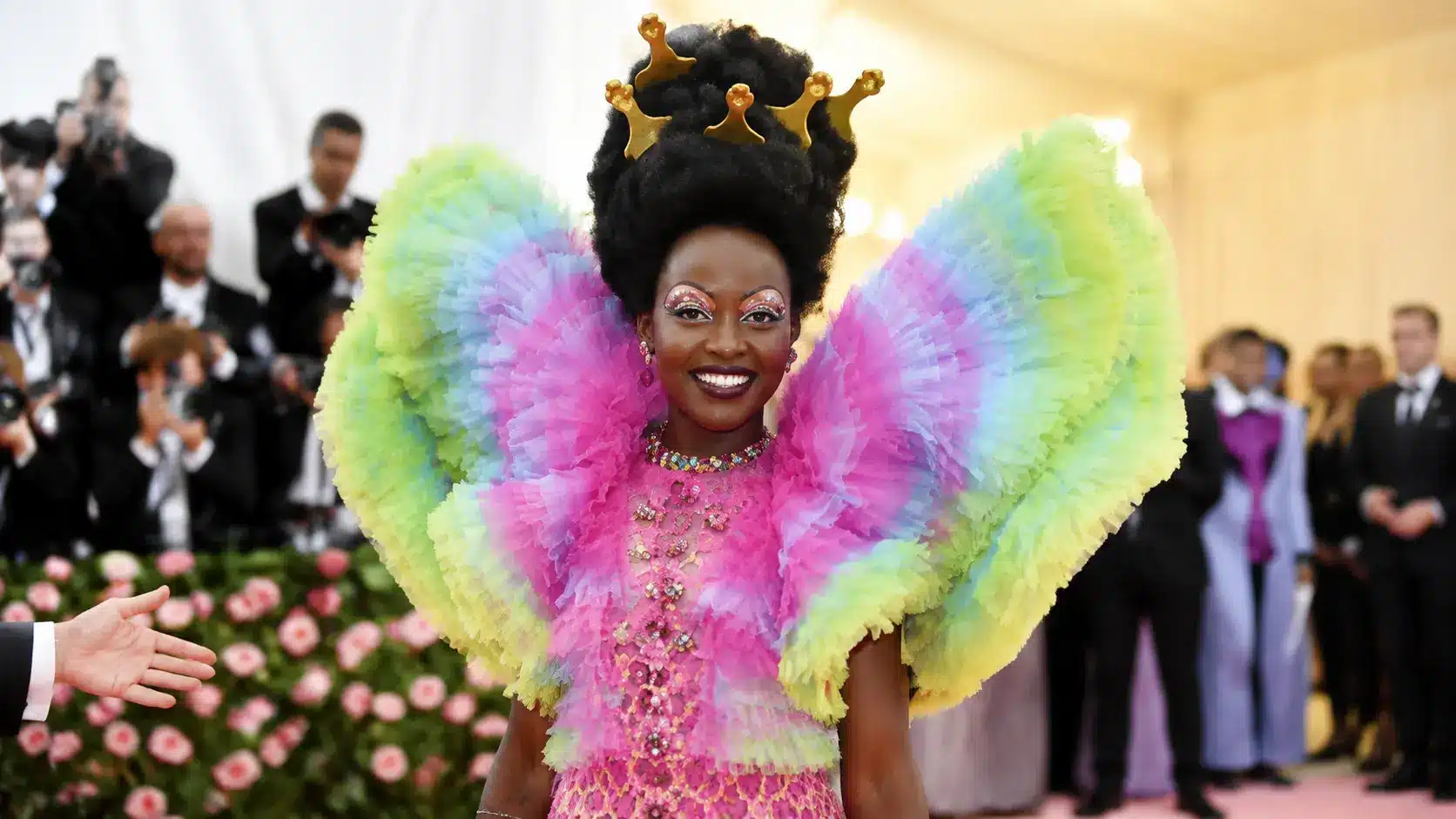
This is where camp does its heaviest lifting, turning cheap or overlooked materials into full-blown couture statements.
- Kitsch materials (plastic, feathers, foam) turned into couture pieces
- Exaggerated proportions and silhouettes
- Mixing luxury fashion with junk food, memes, or household objects, the way Moschino’s Jeremy Scott has built entire collections around a hamburger costume or a Barbie theme
Camp as Styling and Presentation
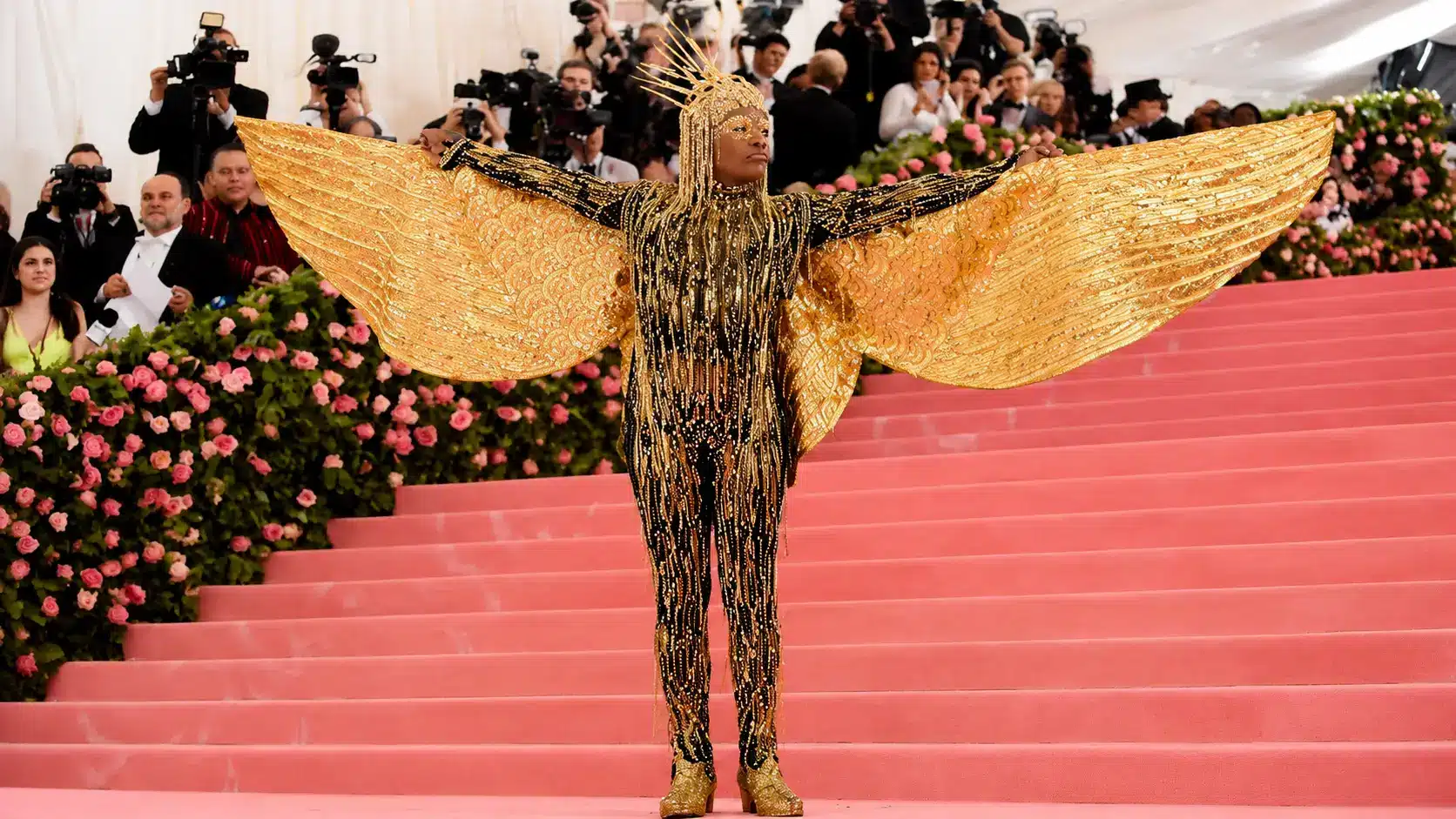
Image Credits: CNN
Camp doesn’t stop at the garment itself. How a look gets revealed and worn matters just as much as what’s on the hanger.
- Theatrical entrances built into the “reveal” of the outfit
- Accessories designed to upstage the garment itself
- Performance treated as part of the look, not separate from it
Camp as Everyday Slang
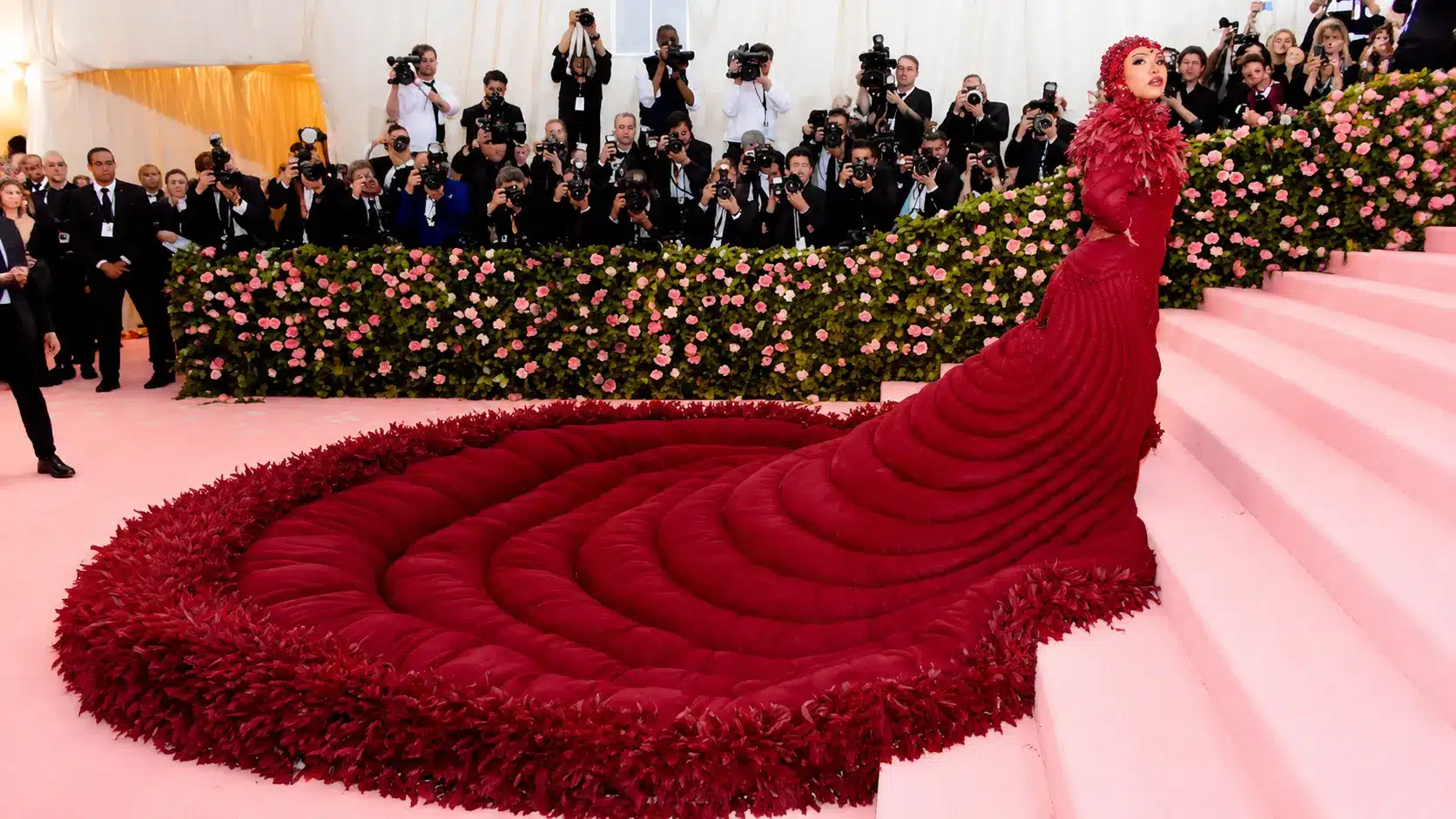
Image Credits: Vogue
Off the runway, camp picked up a second life online, where it works less like a design term and more like a compliment with an edge.
- Gen Z shorthand for something try-hard, over the top, or “so bad it’s good”
- Used to describe an outfit, a movie, or a personality, not just clothing
- Closely tied to drag and LGBTQ+ online culture, where exaggeration has long doubled as a form of self-expression.
This performance-driven, exaggerated instinct didn’t start in fashion. It has deep roots in queer culture.
Camp and Queer Culture
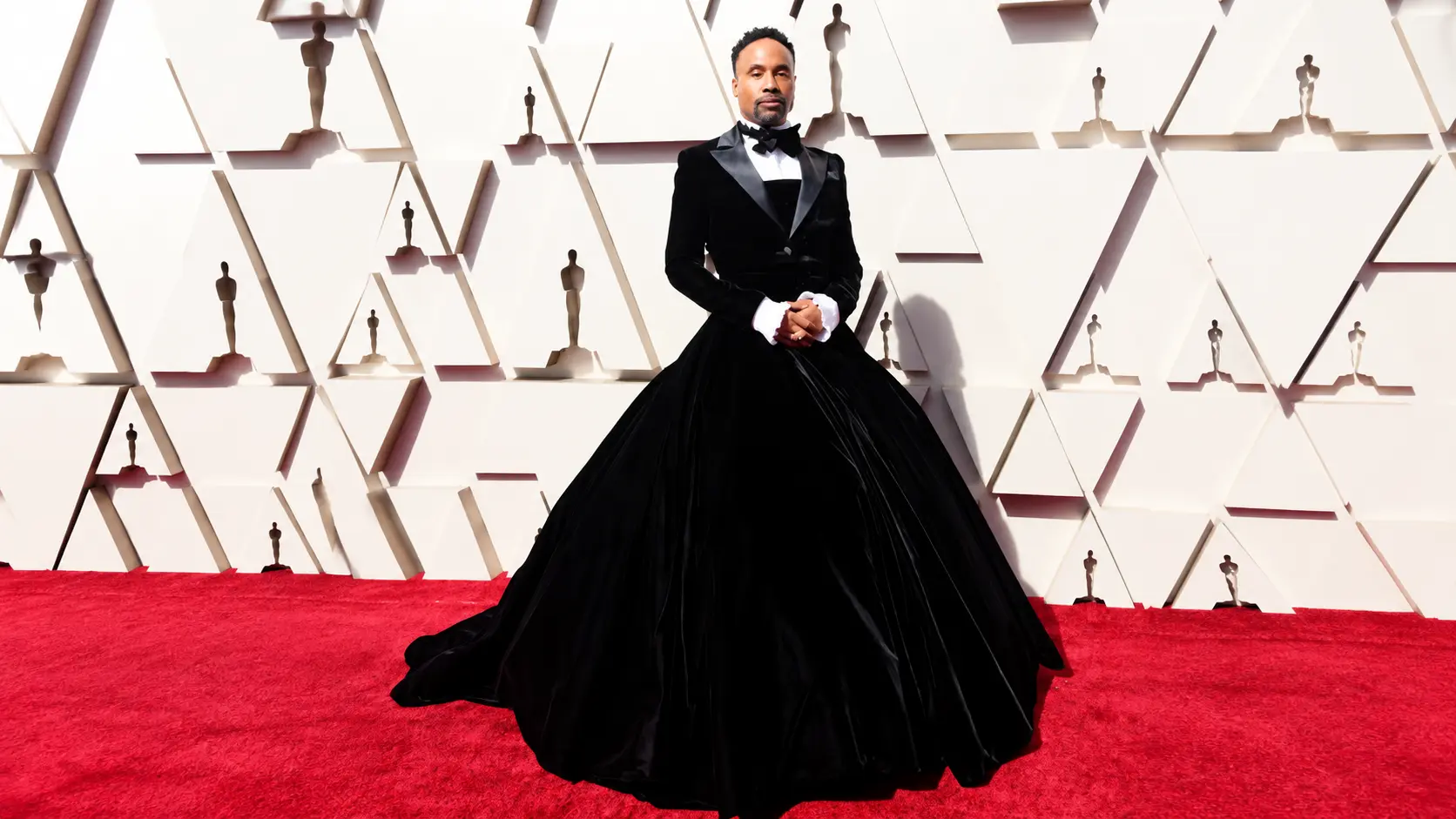
Image Credits: Vogue
Camp’s ties to queerness go back long before the runway. Oscar Wilde embraced artifice and theatricality decades before Susan Sontag defined camp, and the style remained closely linked to gay male subculture throughout the 20th century.
Black and Latino ballroom and drag cultures expanded camp into a language of performance, bringing it into wider view after the Stonewall era.
Kareem Khubchandani, a Tufts University professor who studies queer nightlife and drag, describes camp as treating serious or sacred things with irreverence rather than solemnity.
That idea helped shape the rise of shows like RuPaul’s Drag Race, which brought camp’s exaggerated performance and gender play into mainstream culture.
In fashion, camp works the same way: it turns serious ideas into playful, theatrical statements.
Camp vs. Kitsch vs. Tacky: What’s the Difference?
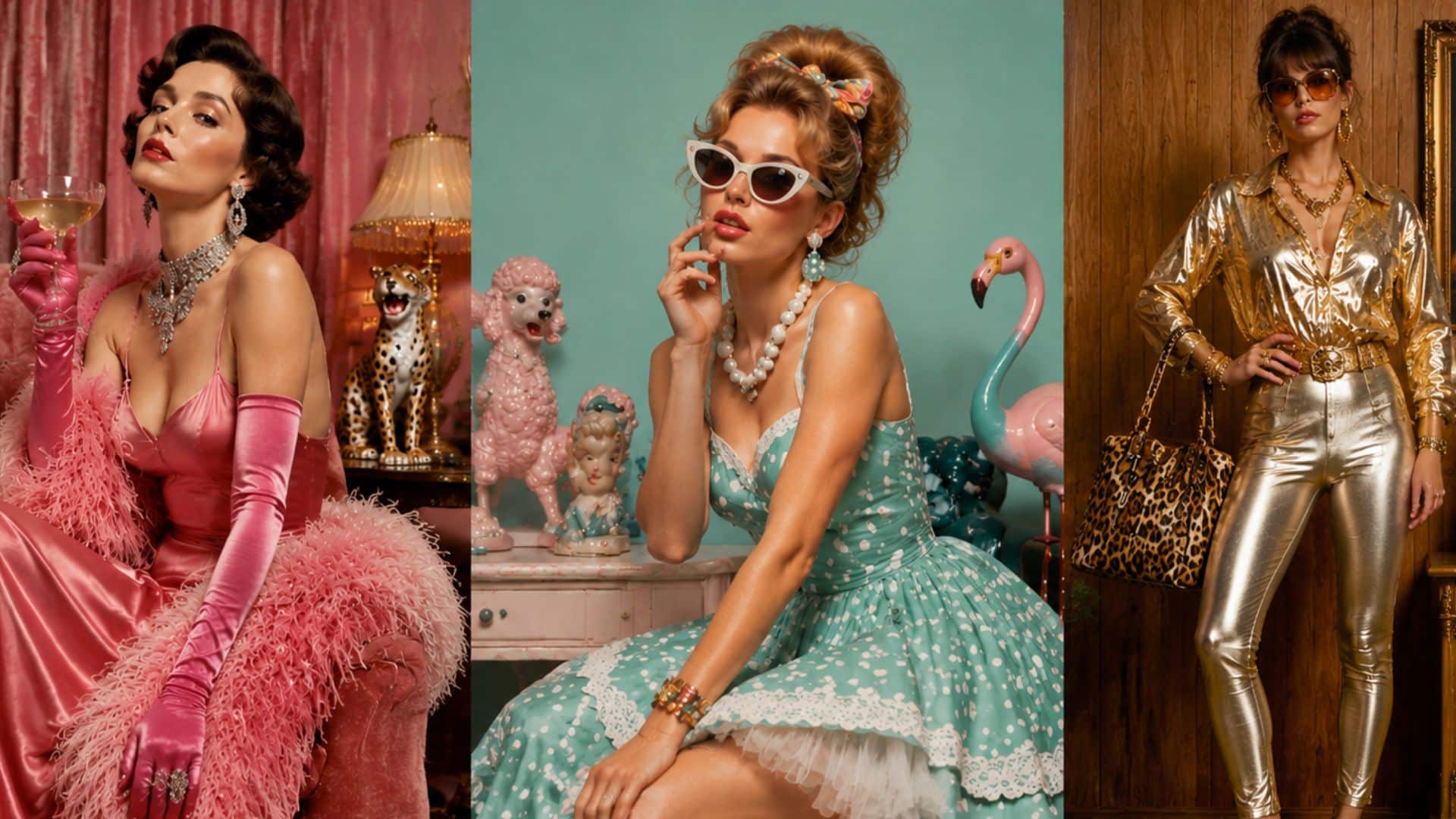
These three words get used interchangeably, but they aren’t the same thing, and the difference comes down to intent.
| Term | Intent | Key Traits | Simple Example |
|---|---|---|---|
| Tacky | Usually unintentional | Poor taste, clashing choices, little self-awareness | A badly coordinated outfit that looks overdone by accident |
| Kitsch | Mostly sincere | Cheesy, sentimental, nostalgic, mass-produced | Porcelain figurines, novelty décor, retro souvenirs |
| Camp | Deliberately exaggerated | Theatrical, ironic, self-aware, proudly over-the-top | A designer gown that intentionally turns kitschy motifs into high fashion |
A grandmother’s porcelain figurine collection is kitsch. A poorly fitted, mismatched outfit worn without any self-awareness is tacky.
A designer building an entire gown out of that same porcelain aesthetic, on purpose, for a red carpet, is camp. The line is thin, but it’s real: camp always knows exactly what it’s doing.
Camp in Film, Music and Art
Camp shows up wherever performance and excess meet, and fashion borrowed just as much from camp’s screen and music history as it fed back into it.
| Medium | Icon or Work | Why It’s Camp |
|---|---|---|
| Film | John Waters ( Pink Flamingos, Hairspray ) | Deliberately outrageous, low-budget theatricality |
| TV | Batman (1966), starring Adam West | Sincere delivery of an absurd premise |
| Music | Lady Gaga’s 2010 meat dress; Cher and Bette Midler’s stage personas | Shock and spectacle used as artistic statement |
| Art | Andy Warhol’s Camp (1965) | Pop art that literalizes Sontag’s essay |
Nowhere did all of this collide more visibly than on one red carpet in 2019.
The 2019 Met Gala: Camp, Notes on Fashion
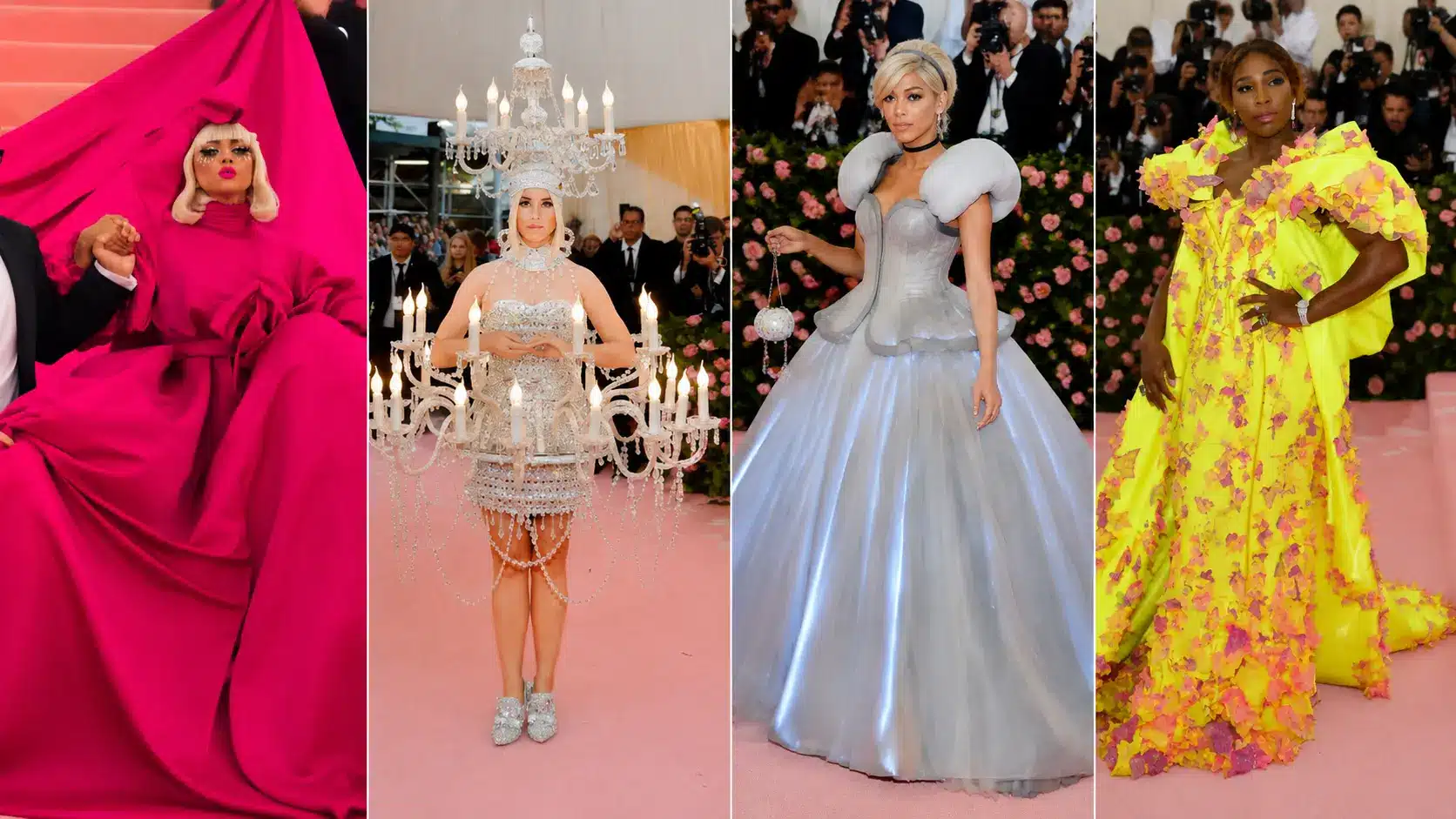
Curator Andrew Bolton built the Costume Institute’s exhibition around Sontag’s essay, and the red carpet became the ultimate camp demonstration.
Billy Porter, in The Blonds: carried onto the carpet on a velvet-draped litter by six bearers, dressed as a gold sun deity with a 10-foot wingspan built into his catsuit.
Lady Gaga, in Brandon Maxwell: four separate outfit reveals, performed live on the pink carpet.
Katy Perry, in Moschino by Jeremy Scott: arrived as a literal, illuminated chandelier, candlesticks and all.
Cardi B, in Thom Browne: a hand-embroidered gown decorated with roughly 30,000 burned and dyed feathers, which reportedly took 35 people more than 2,000 hours to build.
Zendaya, in Tommy Hilfiger: a light-up Cinderella gown that transformed from grey to blue mid-entrance, with stylist Law Roach playing her fairy godmother, wand and all.
Serena Williams, co-host: a neon yellow Versace gown with floral appliqués, paired with matching Off-White x Nike sneakers.
That single night pushed camp from an art-world reference into a household term, and its influence hasn’t slowed down since.
Examples of Camp Fashion: Icons Then and Now
Some names are shorthand for camp itself.
| Icon | Era | Signature Camp Trait |
|---|---|---|
| Oscar Wilde | 19th century | Camp as personal wit and performance |
| Bette Midler | 1970s to present | Self-aware, over-the-top stage persona |
| Joan Collins | 1980s (Dynasty) | Glamour played at maximum volume |
| Billy Porter | 2019 to present | Theatrical, gender-expansive red carpet entrances |
| Katy Perry | 2010s to present | Literal costume concepts (chandelier, hamburger) |
These names set the template. What camp does with that template now is a different story.
How to Wear Camp Fashion Today
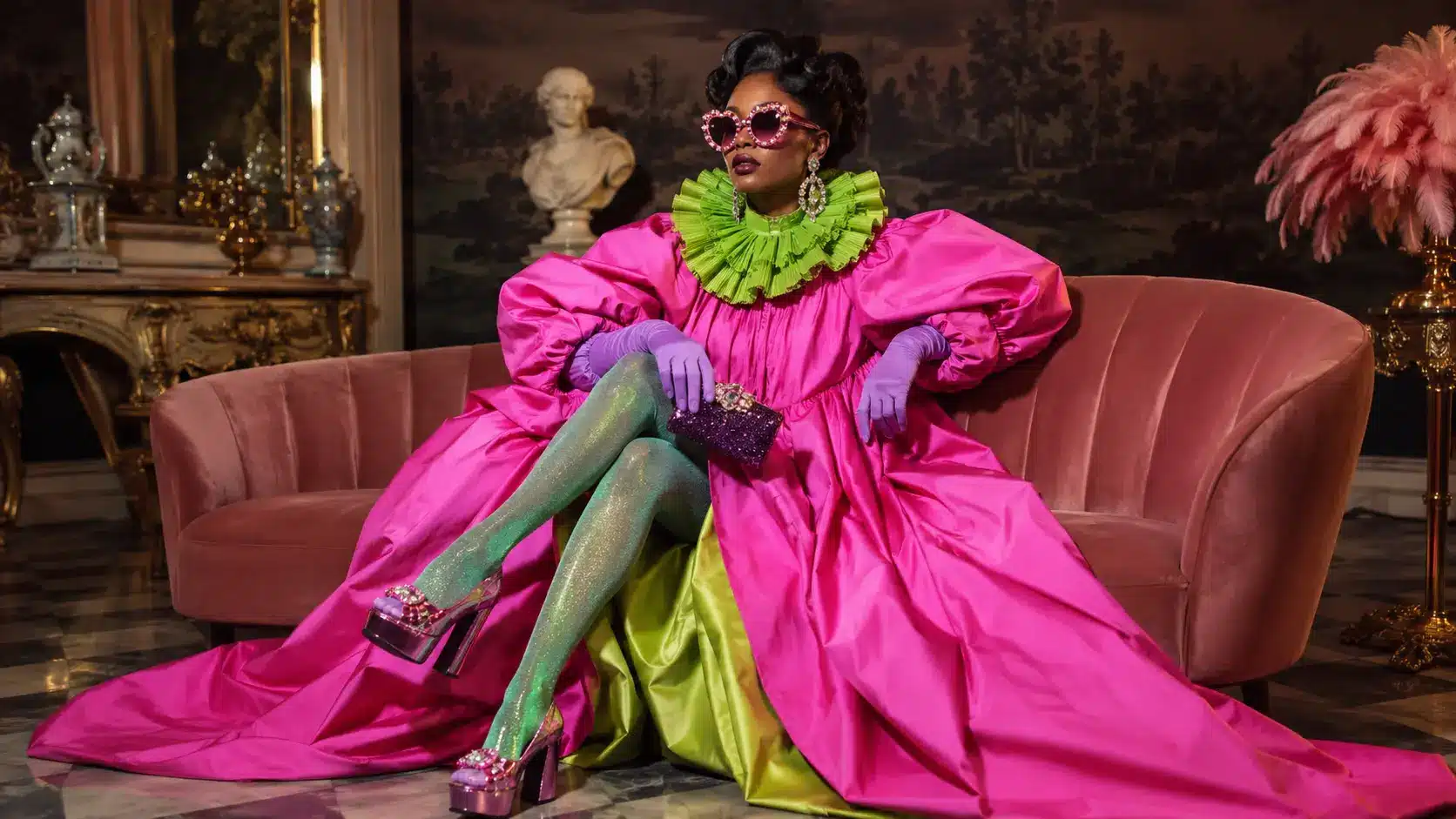
You don’t need a Met Gala invitation to try camp on for yourself. It shows up in smaller, wearable doses every day, once you know what to look for.
- Pick one exaggerated piece and let it lead the outfit: an oversized bow, a sculptural shoulder, or a platform shoe with real height
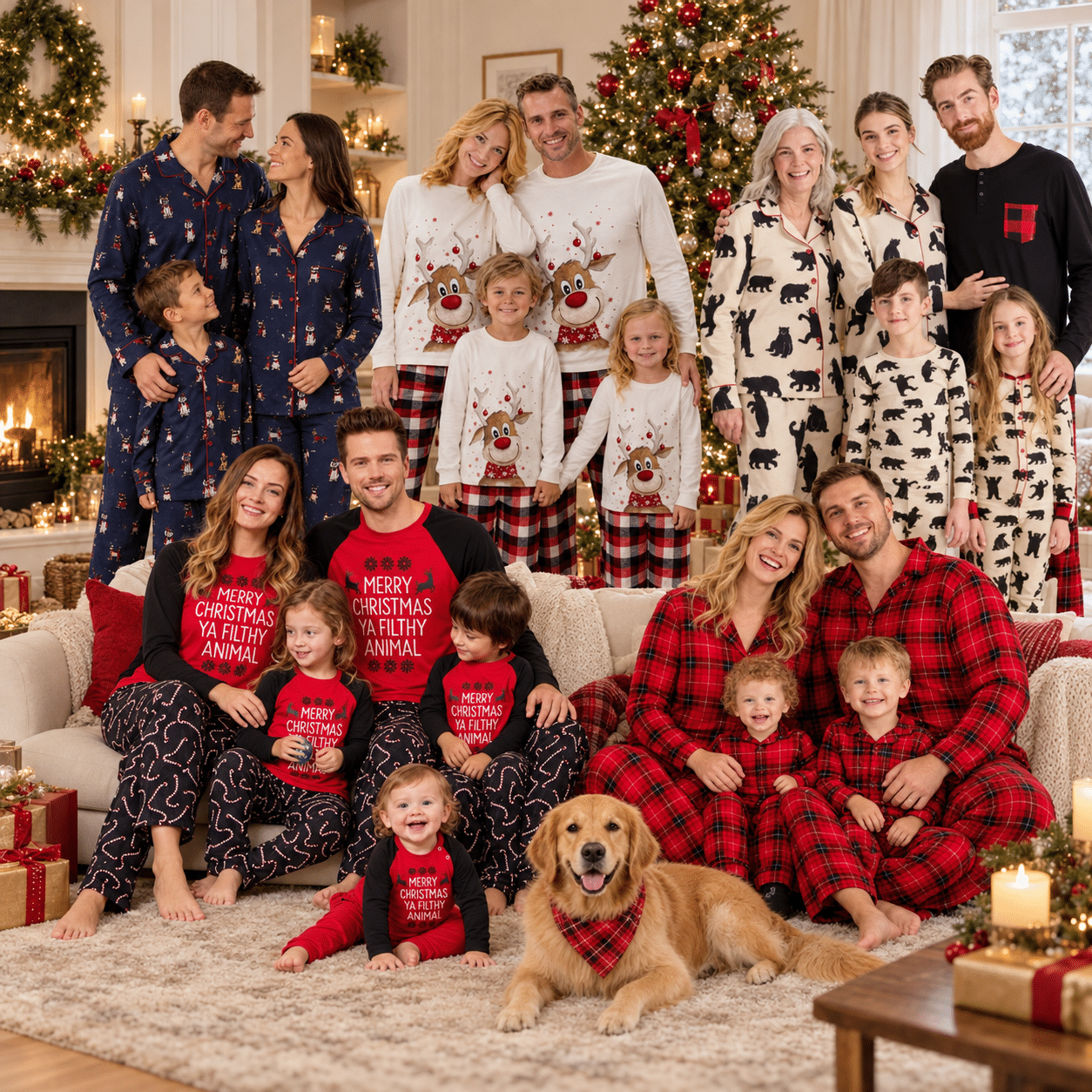
- Wear a graphic tee or print with a slogan that’s a little too loud, and own it instead of second-guessing it
- Layer costume jewelry the way you’d layer real gold; more is the point, not a compromise
- Mix a genuinely nice piece with something deliberately cheap or plastic; that clash is where camp lives
- Treat getting dressed like a small performance, even if the only audience is your mirror
What camp does not ask for is restraint. If a piece makes you pause and think that’s a lot, that’s usually the one to wear. What camp does with that template now is a different story.
|
Camp’s Influence on Culture Today
|
Wear It Like You Mean It
So now you must be well-versed in what camp means in fashion. More than just a fashion trend, it’s a permission. Permission to be too much, too loud, too obviously constructed, and call that a style choice instead of a mistake.
I remember scrolling through that 2019 red carpet and thinking, wait, is Katy Perry dressed as a chandelier? That’s the exact moment I went down the rabbit hole myself, and it’s still the moment I point to whenever someone asks me to explain camp in one sentence.
You don’t need 30,000 feathers or a spot on the Met Gala carpet to try it. Just pick one piece that feels a little ridiculous, wear it as you meant it, and let it be fabulous instead of serious.
Frequently Asked Questions
What Did Camp Mean in the 1970s?
In the 1970s, camp thrived through disco, glam rock, and drag balls, prizing theatrical excess over restrained, “tasteful” dressing.
What is the Camp Aesthetic?
Think saturated colors, exaggerated shapes, and shiny or synthetic textures, all styled to look intentional rather than accidental.
What is Camp Style Clothing?
Sequins, feathers, platform shoes, and oversized silhouettes count, especially when styled to look self-aware rather than costume-y.
What Does Camp Mean on TikTok?
On TikTok, “camp” often tags exaggerated makeup, thrifted outfits, or dramatic transformations meant to entertain, not just impress.