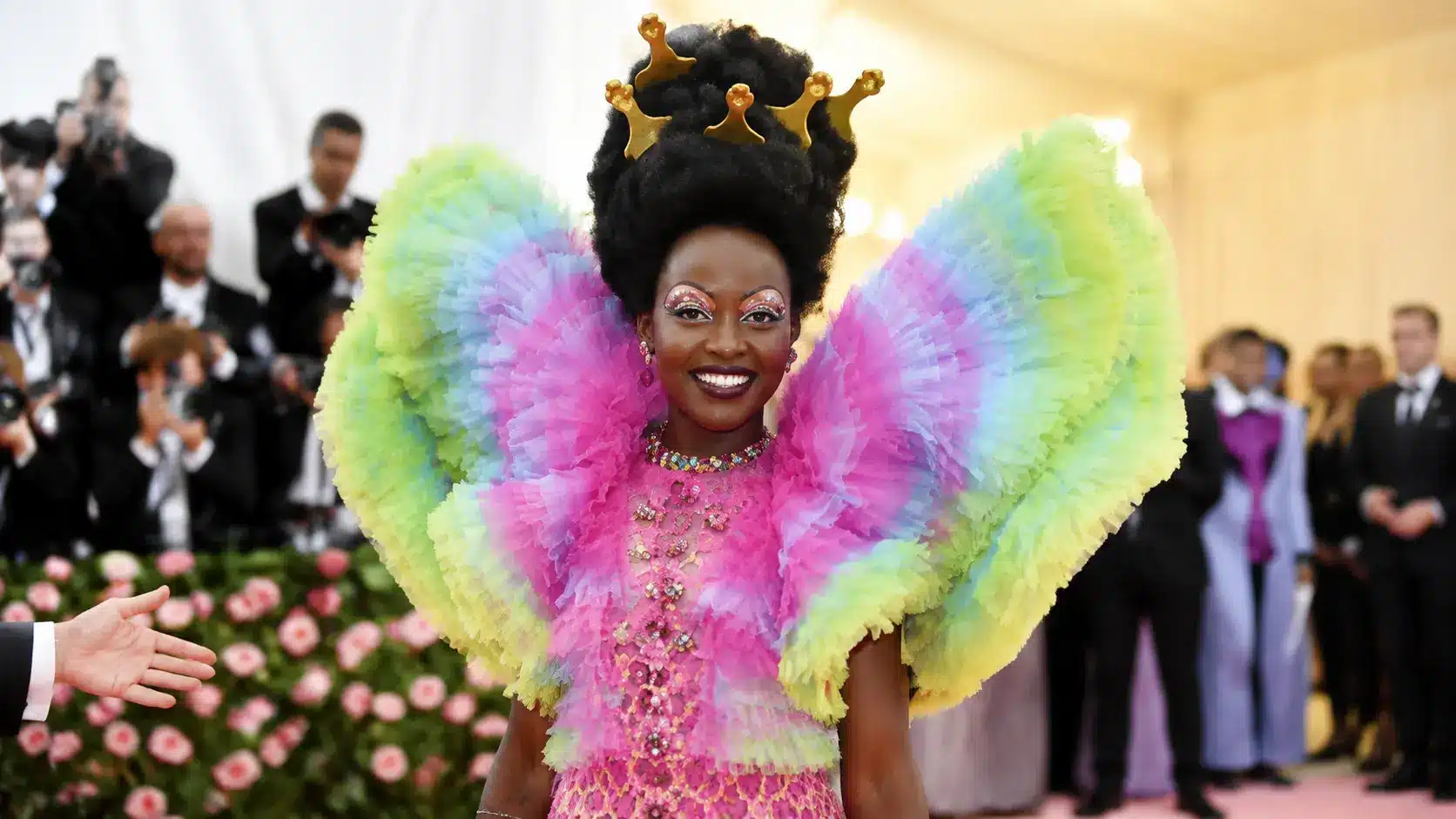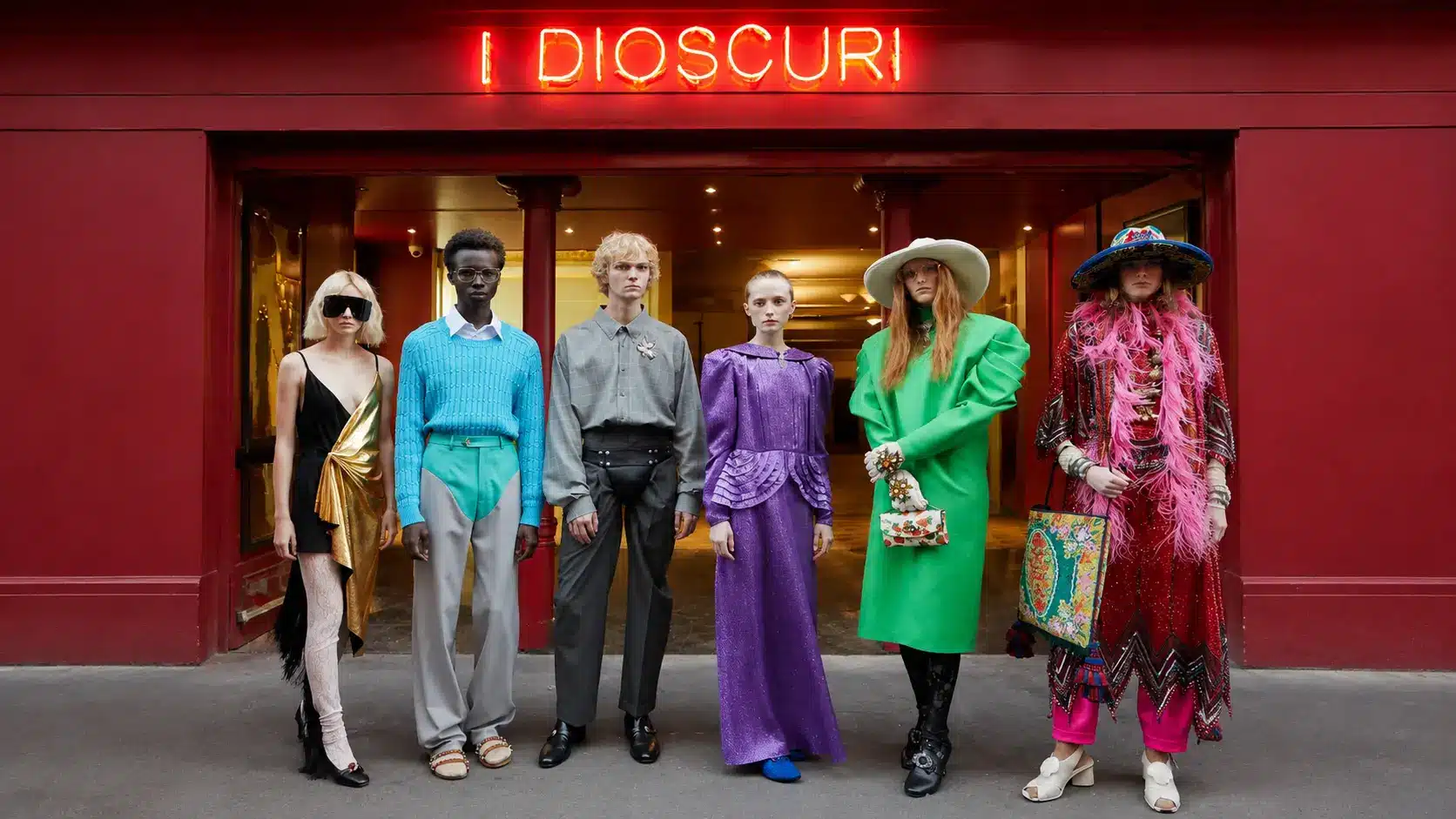
Camp aesthetic is the art of turning exaggeration, irony, and artifice into something genuinely pleasurable to look at.
It’s what happens when bad taste is executed with such conviction that it loops back into brilliance.
The term entered the cultural bloodstream in 1964, when critic Susan Sontag published her essay “Notes on ‘Camp’” and put a name to a sensibility that had been hiding in plain sight for centuries.
It resurfaced hard in 2019, when the Met Gala built an entire red carpet around “Camp: Notes on Fashion,” sending Lady Gaga through four outfit changes and Katy Perry down the stairs as a walking chandelier.
Here’s where camp came from, how to spot it in fashion, art, film, and music, and why it still won’t sit still.
What is Camp Aesthetic? A Definition Beyond “So Bad It’s Good”
Camp aesthetic is a style sensibility built on exaggeration, artifice, and irony, where something usually seen as tacky or over the top gets appreciated as a deliberate performance rather than a mistake.
Camp is easier to spot than to define, but a few consistent traits separate it from ordinary bad taste.
At its core, camp values style over content. It treats seriousness playfully and turns whatever is exaggerated, artificial, or slightly off into something worth admiring rather than avoiding. Sontag described camp less as a rulebook and more as a sensibility, a way of seeing rather than a checklist.
She argued that camp treats life as theater: objects and people get appreciated as performances of themselves rather than as sincere expressions.
|
In Sontag’s words, camp “sees everything in quotation marks.” As she put it in the essay itself, it’s not a lamp, but a “lamp”; not a woman, but a “woman,” each one performing itself with a wink. |
Sontag dedicated the essay’s 58 numbered notes to Oscar Wilde, whose aestheticism she treated as camp’s spiritual blueprint.
The word’s own history is murky. Language historians trace it to the French verb se camper (to pose or strut exaggeratedly). However, the exact line from French to English slang is still debated (Etymonline).
It first appeared in the Oxford English Dictionary in 1909, already tied to gay and theatrical subcultures that used it as private shorthand decades before Sontag brought it into wide circulation.
None of this happened overnight: the sensibility took roughly three centuries to take shape before anyone named it.
The History of Camp Aesthetic: From 18th-Century Excess to the Met Gala
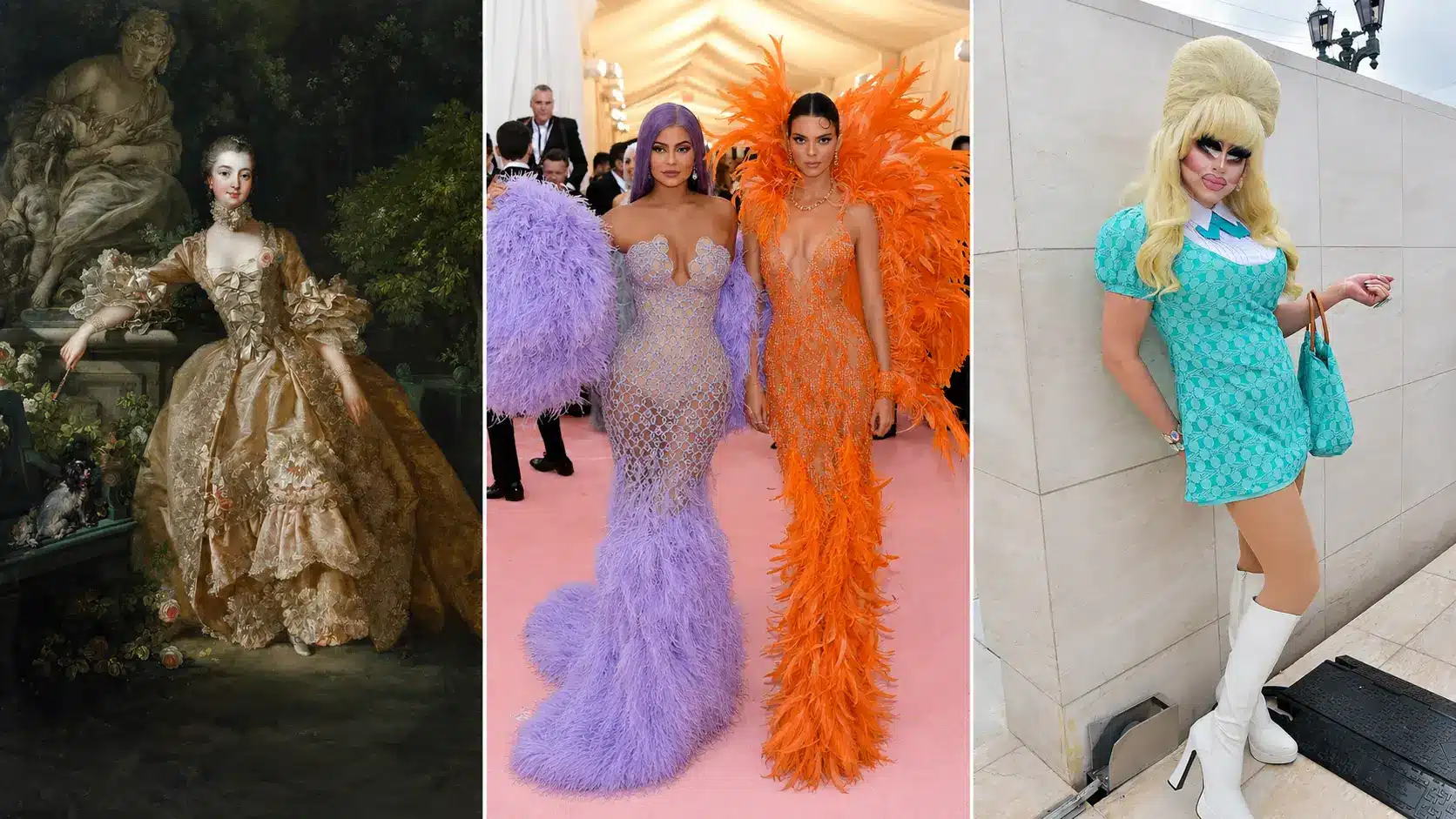
Camp’s timeline runs from Louis XIV’s court to a red carpet in 2019, with a few pivotal texts along the way.
- Late 1600s to early 1700s. Sontag traced camp’s aesthetic roots to the court of Louis XIV, Gothic novels, Chinoiserie, and a growing fascination with ruins and artifice.
- 1909. The word “camp” appeared in the Oxford English Dictionary, already linked to gay and theatrical subcultures.
- 1954. Novelist Christopher Isherwood split the idea into “low camp” (drag, cross-dressing) and “high camp” (ballet, Baroque art) in his novel The World in the Evening, a decade before Sontag’s essay.
- 1964. Susan Sontag published “Notes on ‘Camp’” in Partisan Review, pulling the sensibility out of subculture and into mainstream conversation.
- 1972. John Waters’Pink Flamingos, starring drag performer Divine, became a defining camp film and locked the aesthetic into cinema history.
- 2019. The Met Gala’s Costume Institute, under curator Andrew Bolton, built its exhibition and red carpet around “Camp: Notes on Fashion,” pulling the aesthetic firmly into mainstream fashion conversation.
Knowing where camp came from is one thing. Recognizing it at a glance is another, so here’s what to actually look for.
Key Visual Hallmarks of Camp Aesthetic
Camp announces itself through a specific set of visual and tonal signals, whether it shows up in a painting, a dress, or a drag performance.
| Hallmark | What It Looks Like | Where You’ll See It |
|---|---|---|
| Exaggeration | Oversized proportions, dramatic silhouettes, extreme color | Rococo painting, red carpet fashion |
| Artifice | Deliberate fakeness over realism, decoration over function | Art Nouveau lamps shaped like women |
| Irony and self-awareness | Winking at its own excess instead of taking itself seriously | Andy Warhol’s Pop Art |
| Theatricality | Life staged as performance, “being as playing a role” | Drag, opera, camp cinema |
| Style over substance | Surface, texture, and form matter more than meaning | Jeff Koons sculpture |
| Nostalgia and pastiche | Borrowing kitsch or outdated forms and re-presenting them with fondness | Retro-inspired fashion collections |
Quick Tip: If you’re trying to decide whether something is camp or just poorly made, ask one question: does it seem to know exactly how ridiculous it is? Self-awareness is the line.
Fashion has arguably done more than any other medium to put these hallmarks on public display.
Camp Moments on the Red Carpet
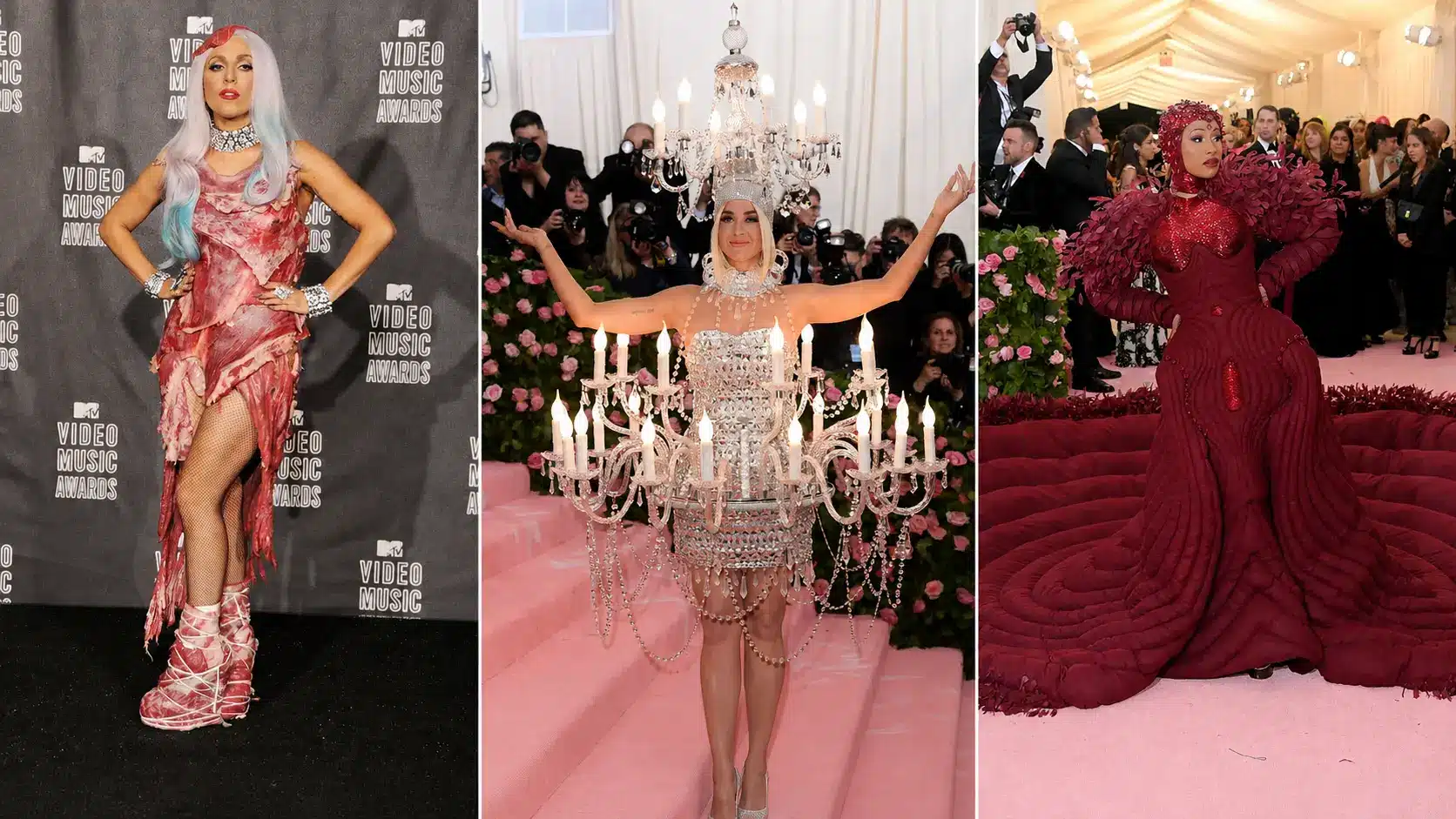
Image Credits: The Independent
The 2010 MTV Video Music Awards gave the world Lady Gaga’s raw meat dress, designed by Franc Fernandez and styled by Nicola Formichetti.
Gaga later said the look protested the U.S. military’s “Don’t Ask, Don’t Tell” policy, and Time magazine named it the top fashion statement of that year.
Nine years later, the 2019 Met Gala turned into a full camp showcase. Katy Perry arrived as a literal chandelier, a custom Moschino gown by Jeremy Scott, complete with working lights.
Billy Porter was carried down the carpet on a litter by shirtless attendants, dressed as a gold Egyptian sun deity in a piece by the design duo the Blonds (a separate, equally theatrical moment from the black velvet tuxedo gown Porter wore to the Oscars that same year, designed by Christian Siriano).
Cardi B wore a Thom Browne gown trimmed in roughly 30,000 feathers that took a team of 35 people reportedly more than 2,000 hours to make, and Zendaya walked the stairs in a glowing Tommy Hilfiger dress styled as a real-time Cinderella reveal that lit up step by step as she climbed the stairs.
Fashion borrowed heavily from fine art’s own long flirtation with camp, which stretches back further than most people expect.
Camp Aesthetic in Art: From Mannerism to Pop Art
Long before camp had a name, painters and sculptors were already exaggerating reality for effect.
Early Camp Sensibilities
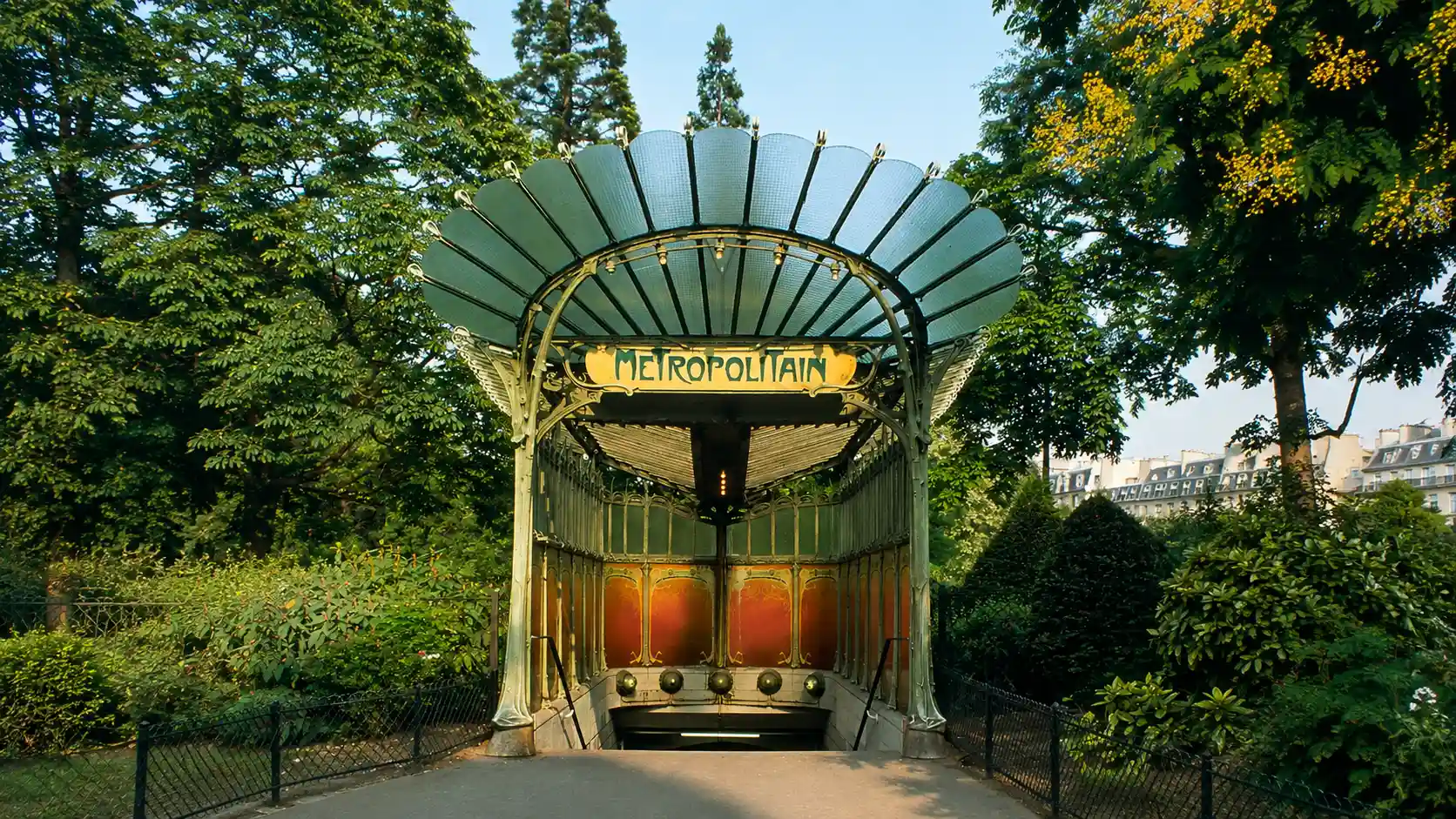
Mannerist painters like Rosso Fiorentino and Pontormo distorted proportion and drama ahead of their time, favoring stretched figures and unstable compositions over classical balance.
Centuries later, Sontag pointed to Hector Guimard’s cast-iron Paris Métro entrances, built starting in 1900, as camp’s most fully developed style: ordinary transit infrastructure turned into ornamental fantasy.
Pop Art’s Camp Icons
Andy Warhol’s 1965 film Camp, shot at his Factory studio, was a direct response to Sontag’s essay, staged as a mock talent show in which performers like Mario Montez and Jack Smith each acted out their own idea of “camping”.
Claes Oldenburg’s Bedroom Ensemble (1963) recreated an entire domestic room in fake materials, an ironic send-up of interior design.
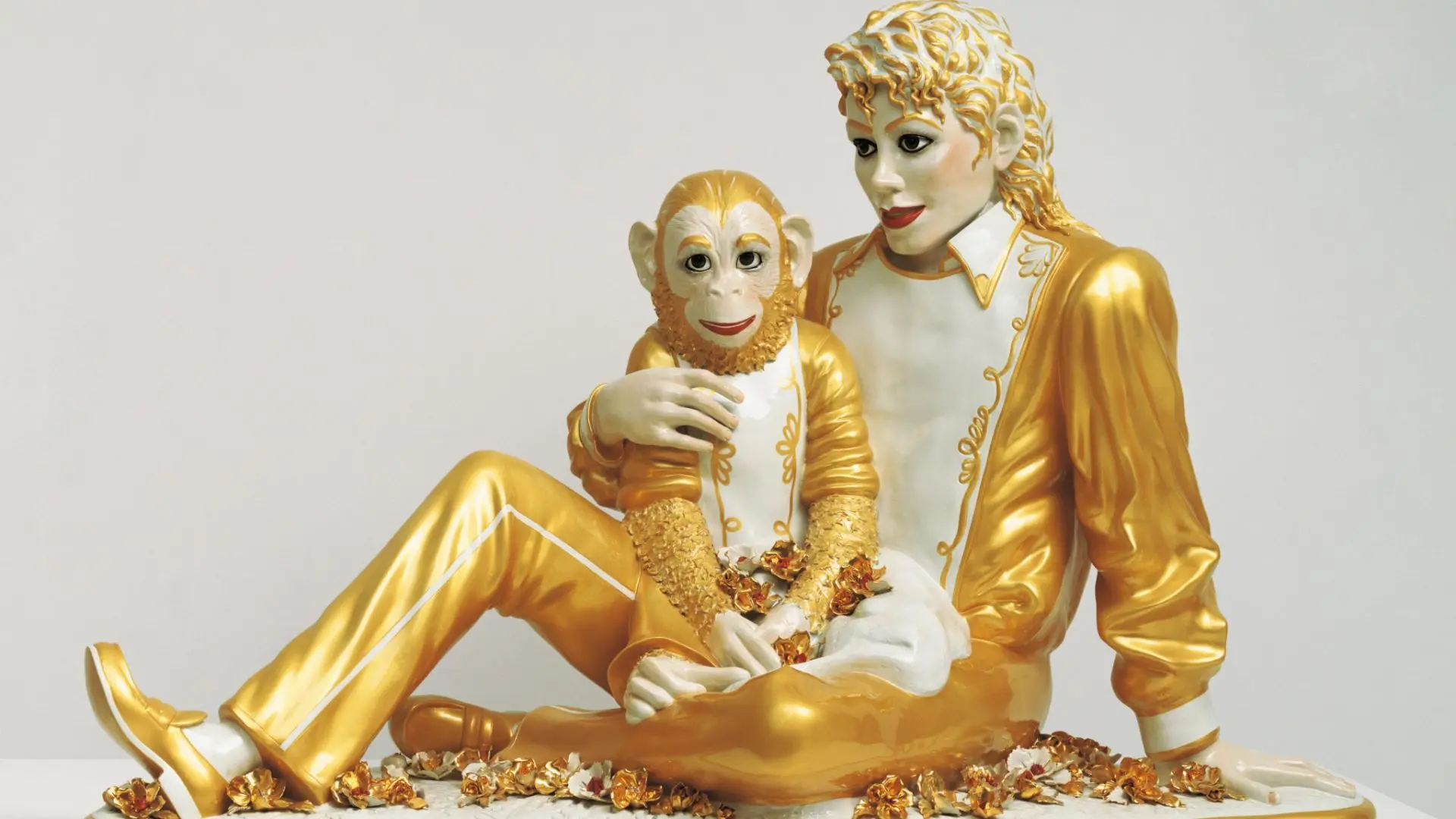
And Jeff Koons’ porcelain-and-gold-leaf sculpture Michael Jackson and Bubbles (1988), part of his Banality series, treats celebrity like religious iconography, right down to a pose that echoes Michelangelo’s Pietà.
Screens amplified camp faster than any gallery could, turning it into a full cinematic and musical tradition.
Camp Aesthetic in Film, TV, and Music
These touchstones trace how camp moved from cult cinema into mainstream music and reality television.
- Johnny Guitar (1954). Joan Crawford’s flamboyant, over-the-top performance in a Western that took itself just seriously enough.
- What Ever Happened to Baby Jane? (1962). Bette Davis and Joan Crawford’s real-life rivalry fueled a gloriously melodramatic thriller.
- Pink Flamingos (1972). John Waters and drag performer Divine pushed tastelessness into a cult classic.
- Showgirls (1995). Paul Verhoeven’s box-office flop, later reclaimed for its over-the-top style.
- RuPaul’s rise. The 1992 single “Supermodel (You Better Work)” and later RuPaul’s Drag Race carried ballroom-rooted camp onto mainstream television.
- Music theatrics. Prince’s ruffled, high-heeled stage persona, David Bowie’s Ziggy Stardust alter ego, Dolly Parton’s exaggerated glamour, and Madonna’s 1990 “Vogue,” which drew directly from Harlem’s Black and Latino ballroom scene.
- Camp royalty. Cher’s decades-long partnership with costume designer Bob Mackie, all rhinestones and towering headdresses, earned her a nickname that’s stuck for fifty years: the Queen of Camp.
All these examples raise an obvious question: if camp overlaps so heavily with bad taste, how is it different from plain kitsch?
Camp vs. Kitsch: Where the Line Actually Falls
The two terms get used interchangeably, but one ingredient separates them: awareness.
| Aspect | Camp | Kitsch |
|---|---|---|
| Self-awareness | Knowing, performed, “in on the joke” | Often sincere and unintentional |
| Relationship to taste | Turns bad taste into a style choice | Simply mass-produced or sentimental |
| Intent | Can be deliberate, or unintentional but read as camp later | Rarely meant as irony |
| Example | Jeff Koons’ Banality series, self-aware kitsch-as-art | A souvenir snow globe |
Keep in Mind: The line between camp and kitsch is not fixed. Plenty of objects start life as sincere kitsch and get reclaimed as camp decades later, once enough distance makes the sincerity look funny.
This kind of self-awareness didn’t develop in a vacuum; it grew directly out of communities who used performance as a survival strategy.
How to Wear Camp Aesthetic in Everyday Style
Nobody needs a meat dress or a working chandelier headpiece to try camp. The trick is to pick one element and push it past the point of good taste, on purpose.
- Start with one loud piece, not ten. A single novelty bag, a clashing print blazer, or an oversized statement accessory reads as intentional. Five loud pieces at once just read as cluttered.
- Play with scale. Oversized collars, exaggerated sleeves, or a bag shaped like an everyday object (a snack, a phone, a fruit) push a normal silhouette into camp territory without needing a costume budget.
- Mix eras on purpose. Pairing a vintage-shaped piece, like a 1980s power shoulder or a 1960s babydoll shape, with something current signals that the reference is deliberate rather than accidental.
- Let texture do the talking. Sequins, faux fur, vinyl, and high-shine metallics carry camp’s love of artifice even in a simple silhouette.
Quick Tip: If an outfit needs an explanation to make sense, it’s probably still camp. Camp doesn’t apologize for itself, it performs itself.
Why Camp Aesthetic Is Rooted in Queer Culture
Before camp became a Met Gala theme, it was a coded language for communities who couldn’t be openly themselves.
Drag balls are often traced to Harlem’s Hamilton Lodge Ball, first held in 1869, giving the Black LGBTQ+ community a rare space to gather and perform without immediate danger.
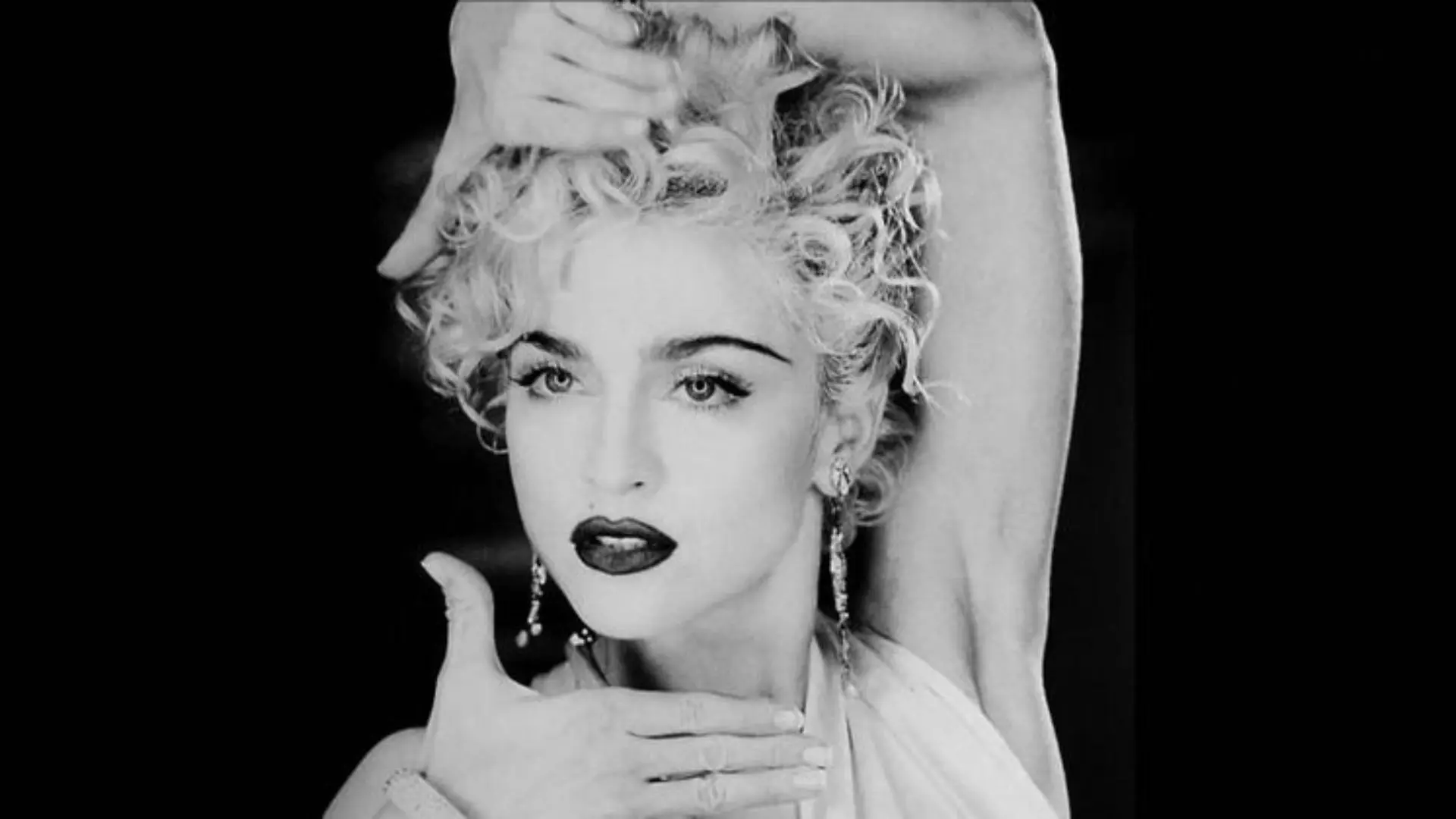
That scene gained national visibility through the 1990 documentary Paris Is Burning and Madonna’s “Vogue” video, both released the same year and featuring performers like Pepper LaBeija, Willi Ninja, and José Xtravaganza.
Camp functioned as a form of coded identity during decades when homosexuality was criminalized in much of the country, letting style communicate what speech couldn’t say out loud. RuPaul became one of the first drag performers to carry that lineage into the mainstream, starting in the 1990s.
This framing explains why a religion-themed gala can feel campy one year and a fashion-themed one the next: the mechanism is the same regardless of subject.
That queer lineage is exactly why camp still feels alive and argued-over rather than settled into a museum piece.
How to Spot Camp Aesthetic Today
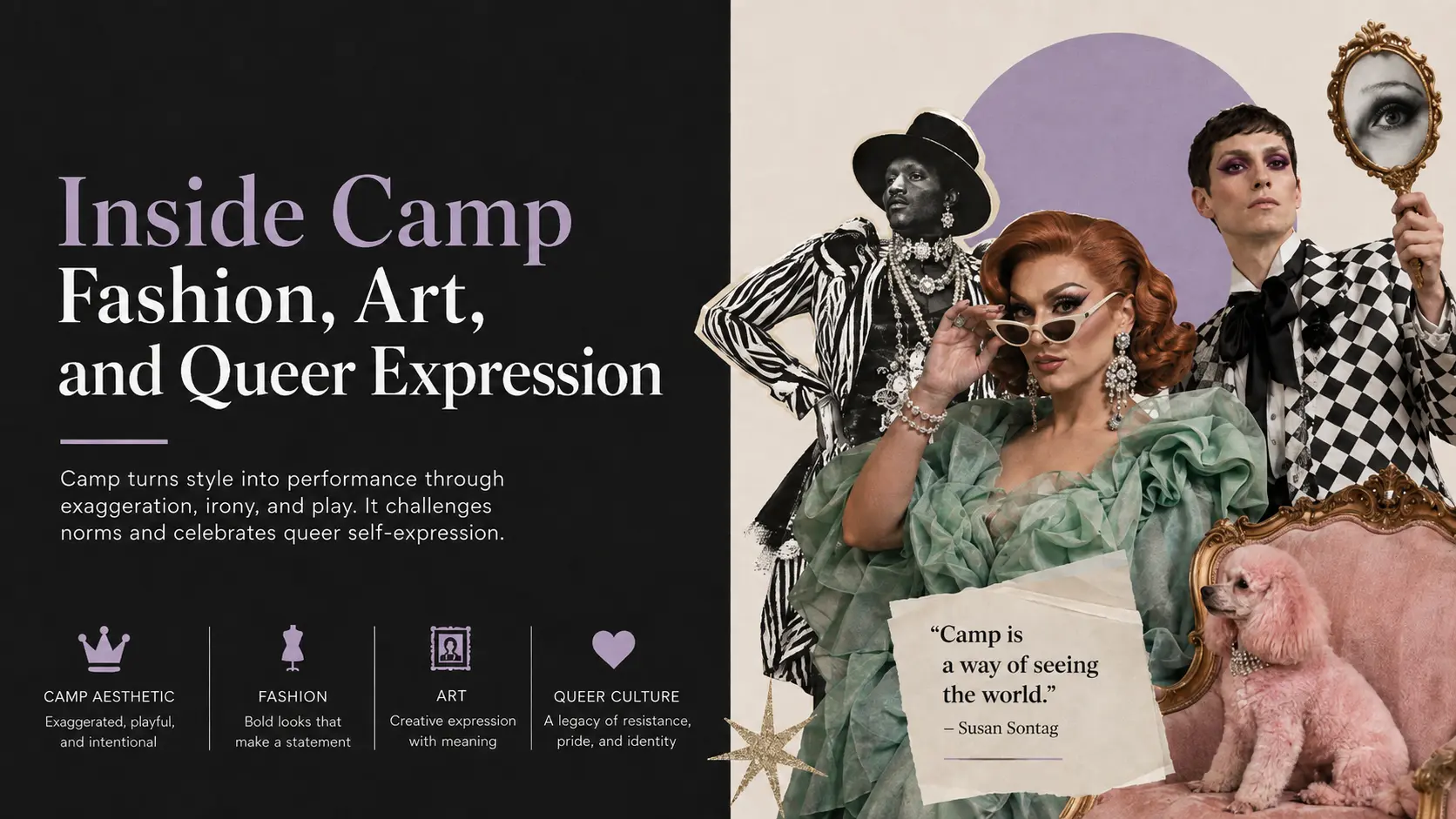
Camp never went away. It just keeps finding new surfaces to exaggerate.
Camp Aesthetic Checklist, 2026 Edition
- Maximalist, clashing prints and textures showing up in everyday streetwear.
- Ironic nostalgia for past decades, including Y2K revivals and retro logos worn half-sincerely.
- Drag-influenced beauty trends on social platforms, from exaggerated contouring to theatrical wigs.
- Award-show fashion built to dominate next-day headlines rather than aim for quiet restraint.
- Self-aware celebrity personas that lean into excess instead of downplaying it.
Once someone knows what to look for, camp aesthetic stops looking chaotic and starts looking deliberate.
Conclusion
Camp aesthetic keeps circling back to one idea: style, irony, and exaggeration treated as pleasure rather than a flaw.
Its arc runs from Louis XIV’s court and Baroque artifice, through Sontag’s 1964 essay, through decades of queer ballroom culture, and onto the Met Gala’s pink carpet in 2019.
What keeps it relevant is that it never fully resolves.
Every generation gets to argue over where good taste ends and camp begins, and that argument is the whole point. Camp isn’t confused. It’s committed.
Frequently Asked Questions
What Colors and Patterns Define Camp Aesthetic Style?
Camp favors clashing brights, metallics, and animal prints over neutrals, since restraint works against camp’s love of excess.
Is Camp Excess the Same as Maximalism?
Not exactly. Maximalism is about sheer volume of stuff, while camp specifically requires ironic self-awareness behind the excess.
How Can Someone Dress in Camp Aesthetic Style?
Pick one exaggerated element, like an oversized silhouette or clashing print, and commit to it with obvious confidence.
Did Anyone Struggle to Understand the 2019 Met Gala Theme?
Yes. Even curator Andrew Bolton said guests kept asking him what camp meant before the event.
Is Every Drag Performance Automatically Considered Camp?
Not always. Drag becomes camp specifically when it leans into exaggeration and irony rather than realistic impersonation.