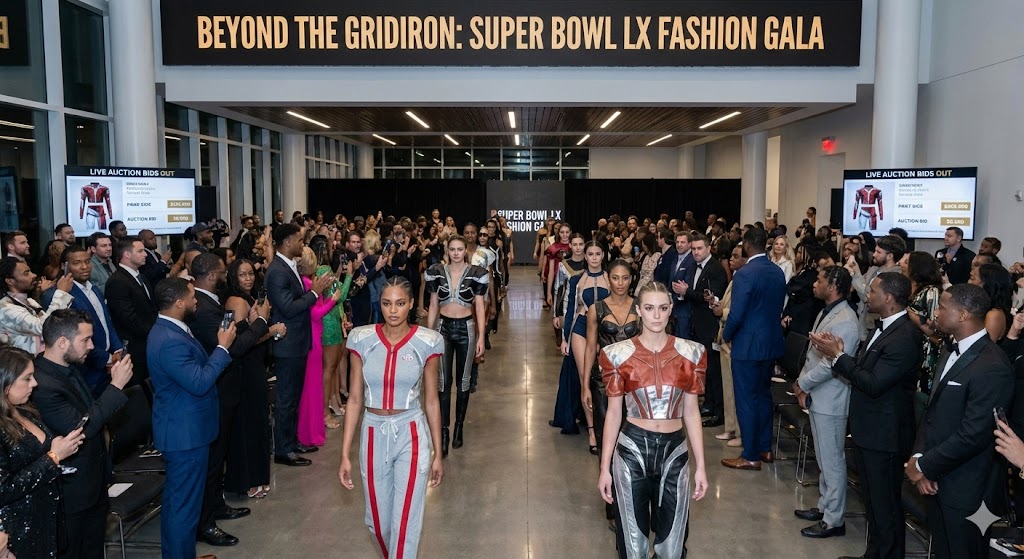
By Super Bowl LX in 2026, it no longer be just a championship football game. It has now become an international fashion conference, a Convergence of Couture and Connectivity, in which the actual aisles of Levi’s Stadium challenge the runways of Milan and Paris.
As sports reporters and Las Vegas betting experts are obsessed with the Super Bowl Odds about the game’s end score, another form of high-stakes competition is being conducted even prior to the kickoff.
This is the struggle of supremacy of cultures, not in the form of touchdown, but in the form of textiles, tailoring, and technology. Since the establishment of the so-called Tunnel Walk as an institutional procedure for political pronouncements of the Halftime Show, the fashion ecosystem aroundthe NFL became a strict and profit-making mechanism.
This conclusive discussion examines the fact that Super Bowl LX is a paradigm shift in sports management and fashion economics and breaks down the major players, tendencies, and technologies that make up this new period.
The Tunnel Walk: The NFL’s New Luxury Runway
The rebranding of the pre-game entry, also known as the Tunnel Walk, into a luxury global marketing platform is possibly the most remarkable change in the modern sphere of sports media. This trend has ceased being an organic trend in social media to a calculated operational strategy by 2026.
The Architect: Kyle Smith and the “Helmet-Off” Era
The breakthrough to this development was the selection of Kyle Smith as the first Fashion Editor in the history of the NFL in September of 2024.
This was not a PR stunt; it was a strategic business maneuver designed to humanize athletes whose faces are obscured during play. Based on his experience as both an Art History major and a cultural anthropologist, Smith considers any piece of clothing worn by a player a historical document.
The three-pillar strategy of the business is Consumer Products, which focuses on moving the mass-market to higher levels through the merchandise; Social Content, which focuses on the services of the music giants like Atlantic Records to soundtrack the fashion montages; and Player Support, which is what serves the athletes in the high-fashion world as a concierge.
Through its assistance in hosting the Met Gala and Paris Fashion Week, the league has sent the message to luxury brands that the NFL is a refined collaboration.
The Economics of Authenticity
What is the reason why luxury brands are rushing to the tunnel? Media Impact Value (MIV) is the answer. NFL players provide it with authenticity as opposed to traditional influencers whose market deals are usually met with suspicion by consumers.
When a star quarterback puts on a particular sweater, the viewers would think that it was an authentic aesthetic decision. This vision is the currency of the tunnel.
Data validates this shift. One week of NFL brand association with companies such as Abercrombie and Fitch drove $1.2 million of MIV. The personal appearances, such as that of Joe Burrow in Paris Fashion Week, have earned the brand over $22 million in media value.
The 18-week season is now perceived as an ongoing runway show with the brands framing the entire fiscal quarter around the NFL schedule. Although the Tunnel Fashion ROI is a sure-footed profit generator for luxury houses, odds on the Super Bowl can change depending on player injuries.
Player Archetypes: From “Quiet Luxury” to “Streetwear Igniters”
By 2025-2026, the drip has become diversified. Now we can classify the elite in the league into separate archetypes of fashion:
- The Quiet Luxury Icon: This archetype, embodied by Joe Burrow and Jalen Hurts, prefers structural and minimalistic items. The case of Burrow walking down the runway at Vogue World Paris is an example of this change. His collaboration with Alo Yoga is focused on the combination of wellness and luxury, and Hurts relies on sharp tailoring to create the image of a CEO.
- The Streetwear Igniter: Such athletes as Travis Kelce and Odell Beckham Jr. have still been fueling the so-called hype cycles. They are not just the mannequins but the trend setters. Kelce is not merely riding a trend when he puts on an Amiri suit that looks like it is from the 70s; he is starting a fire, making it kind of sport-pop culture collide.
- The Conceptual Avant-Garde: Personalities such as Russell Westbrook are taking it to extremes with hyper-dramatic, gender-fluid content, making a statement on how masculinity has always been perceived in sports and making a viral visual experience about the sport itself.
Halftime Aesthetic: Bad Bunny and the Politics of Costume
The “Freestyle” Vision
The decision to choose Bad Bunny (Benito Antonio Martínez Ocasio) as the main headliner of the Super Bowl LX Halftime Show creates a complex interplay of cultural celebration and anti-political demonstration.
Being the first solo Latino and Spanish-speaking headliner, his appearance is expected to become a breakthrough in the politics of costume.
The aesthetic of Bad Bunny is selected by his long-time stylist, Storm Pablo. Their cooperation is characterized as the so-called freestyle, denying the polished and homogenous look of pop star performances in favor of chaotic and personal curation.
In Super Bowl LX, observers anticipate a costume design that incorporates the color theme of the event (CMYK) by incorporating a tropical theme to reinvent the color of the Caribbean.
It is rumored that they have partnered with more avant-garde brands, such as Maison Margiela or Jean Paul Gaultier. Since Pablo has a record of going to extremes, e.g., coating a jacket with 13,000 Swarovski stones, the images will be texture-crowded and intricate in structure.
Fashion as Resistance
The fashion of Bad Bunny is political in nature; he uses clothes as armor. There have been continuous speculations that he will put on a dress at the halftime performance, an ode to Puerto Rican queer superheroes and a drag past.
This would be an act of rebellion and strength in the NFL setting, which has been a conservative institution.
Moreover, the costumes should include the attributes of jibaro culture, such as traditional straw hats (pavas) and machete accessories.
This visual language is a direct reference to the Puerto Rican identity, and it is a message to his fanbase that, at the huge commercial level, he has not thinned out his cultural background. In the same way, pundits can use Super Bowl Odds to estimate the result of the game; cultural critics are using these sartorial decisions to estimate the social effects of the act.
The “WAG” Effect: The Renaissance of Spectator Style
By 2026, the power of the so-called WAGs (Wives and Girlfriends) has ceased to be a tabloid fascination and shifted to an economic force. The Taylor Swift Effect of the past years was only the catalyst; the trend has now grown into a multi-faceted ecosystem of custom design and vintage revival.
Kristin Juszczyk and the Disruption of Licensing
The key figure of this revolution is the wife of a fullback of the 49ers, Kristin Juszczyk. She essentially changed the licensing echelon of the NFL by tearing down the traditional, square jerseys and rebranding them as a high-fashion heritage corset, puffer jacket, and custom-fitted skirts.
After the viral design success of Taylor Swift and Simone Biles, the NFL offered Juszczyk an official licensing deal. This action legalized the reworked fan gear market.
In the case of Super Bowl LX, fans are not merely ordering jerseys, but are commissioning tailor-made merchandise and are taking their game-day outfits as seriously as they would an appearance on the red carpet.
The Vintage Revival
In line with the custom trend is an influx in the demand for vintage NFL merchandise because of the influence of influencers such as Hailey Bieber and Alix Earle.
Bieber, wearing a vintage Saint Laurent faux fur coat in his viral moment, started an influencer trend that led to an increase in the price of leather bombers of the 90s in resale marketplaces.
Canadian heritage brand Roots also seized this opportunity by releasing a Super Bowl LX capsule that is limited. The collection retails up to $998 and is the luxury build of the vintage appearance with modern luxury construction, which justifies the trend of heritage among affluent customers who desire the style but not the hunting and gathering that goes into thrifting.
Merchandise and the “CMYK” Design Language
The aesthetics of the official merchandise have been predetermined by the visual identity of Super Bowl LX. CMYK color scheme has spilled into clothing design; the logo has given the NFL items a unique visual designation every year.
Glitch Aesthetics and Deconstructed Color
Super Bowl 2026 apparel has so-called separation layers, which imitate the screen-printing technique of colors being slightly misaligned. This produces a glitch aesthetic that is attractive to a younger demographic, who are more digital natives.
Registration marks and color bars, which traditionally are concealed features of designs, are visible fashion motifs used in designs.
The Streetwear Takeover: Kith and Supreme
High-end street wear collaborations have overshadowed the times of generic Super Bowl champion t-shirts.
Kith under Ronnie Fieg issued and released the collection of “Road to Victory” in honor of the 35th anniversary of the New York Giants’ 1990 run. In this line, there is a particular nostalgia among the millennials with satin bombers and heavy fleece in high quality.
In the meantime, the rumors of Supreme being involved in Super Bowl-related drops lead to one possible option of a slightly different version of a box logo variant that would use hype to generate scarcity.
The collections of Off-White FW25/26 are also based on the CMYK theme; they are a reflection of the idea of the print separation with their trademark deconstructionist approach to collections.
Tech Wearables: The Silicon Valley Influence
The Super Bowl LX is going to take place at Levi stadium which is the center of Silicon Valley, and this makes the use of technology in fashion play a major part. The stadium is a large platform of connected experiences and can be called a connected runway.
Levi’s Stadium as a Digital Interface
The bandwidth of high-density digital interactions is covered by infrastructure upgrades such as Cisco Wi-Fi 6 and 5G Distributed Antenna Systems.
It is an invisible infrastructure that allows Augmented Reality (AR) areas where fans can virtually test digital equipment or read jerseys to access dynamic statistics. The fashion experience has changed to the textile, physical, and digital overlay.
Meta and the Smart Glass Push
One of the main marketing platforms that has been used by Meta to promote its Ray-Ban Meta smart glasses is the Super Bowl. The 2026 campaign does not present these glasses as technological devices but makes them compulsory fashion items.
Focusing on smooth design and content-free capture, Meta tries to make face hardware a normal aspect of the game-day uniform. It is not about what you wear but how you capture the moment.
The Apple Vision Pro Factor
The Apple Vision Pro provides an alternate type of integration to the fans at home. The virtual worlds enable the users to view the game whilst sitting on the moon or in Joshua Tree.
Although these gadgets may be socially awkward in other places, the availability of these devices in watch parties provides a fresh and bulky component to the social fashion scene that disrupts appearance and interaction norms.