The hair shaft is a complex structure with three distinct layers: the medulla at the center, the cortex that contains most of the fiber mass and gives hair its strength and color, and the cuticle, a protective layer of dead, overlapping cells that surrounds the cortex.
The cuticle comprises flat overlapping cells arranged in a scale-like formation covering the hair shaft, much like shingles on a roof.
This cuticle layer is of considerable cosmetic importance as it gives the hair an untangled appearance and shape.
When the cuticle scales lie flat and intact, they perform several essential functions that determine how your hair looks and behaves.
They create a smooth, reflective surface that produces the shine associated with healthy hair.
They seal moisture into the cortex beneath, preventing dehydration and maintaining elasticity.
They protect the structural proteins in the cortex from mechanical stress, environmental exposure, and chemical damage.
And they create the manageable, soft texture that makes hair easy to comb and style.
Heat styling changes this structure at the molecular level, with keratin protein denaturation occurring at temperatures around 230 to 237 degrees Celsius. When a flat iron, curling wand, or blow dryer applies heat to the hair shaft, several simultaneous processes begin.
Water is an integral part of the keratin structure and plays an important role in the mechanical properties of hair, with the water content remaining in equilibrium with the relative humidity of the ambient environment.
Under heat exposure, the water molecules inside the cortex and cuticle expand rapidly, creating internal pressure that forces the tightly arranged cuticle scales to lift away from the shaft.
High temperatures disrupt the disulfide bonds in hair keratin, causing keratin denaturation. The hydrogen bonds that maintain the structural integrity of keratin proteins break, allowing the normally rigid cuticle scales to warp, crack, and separate from their neighbors.
What this produces from the outside is a cascade of visible and tactile changes.
High temperatures and strong winds generated by blow-drying damage the structure of the cuticle scales themselves, and once damaged, the cuticle scales are no longer effective in protecting the hair.
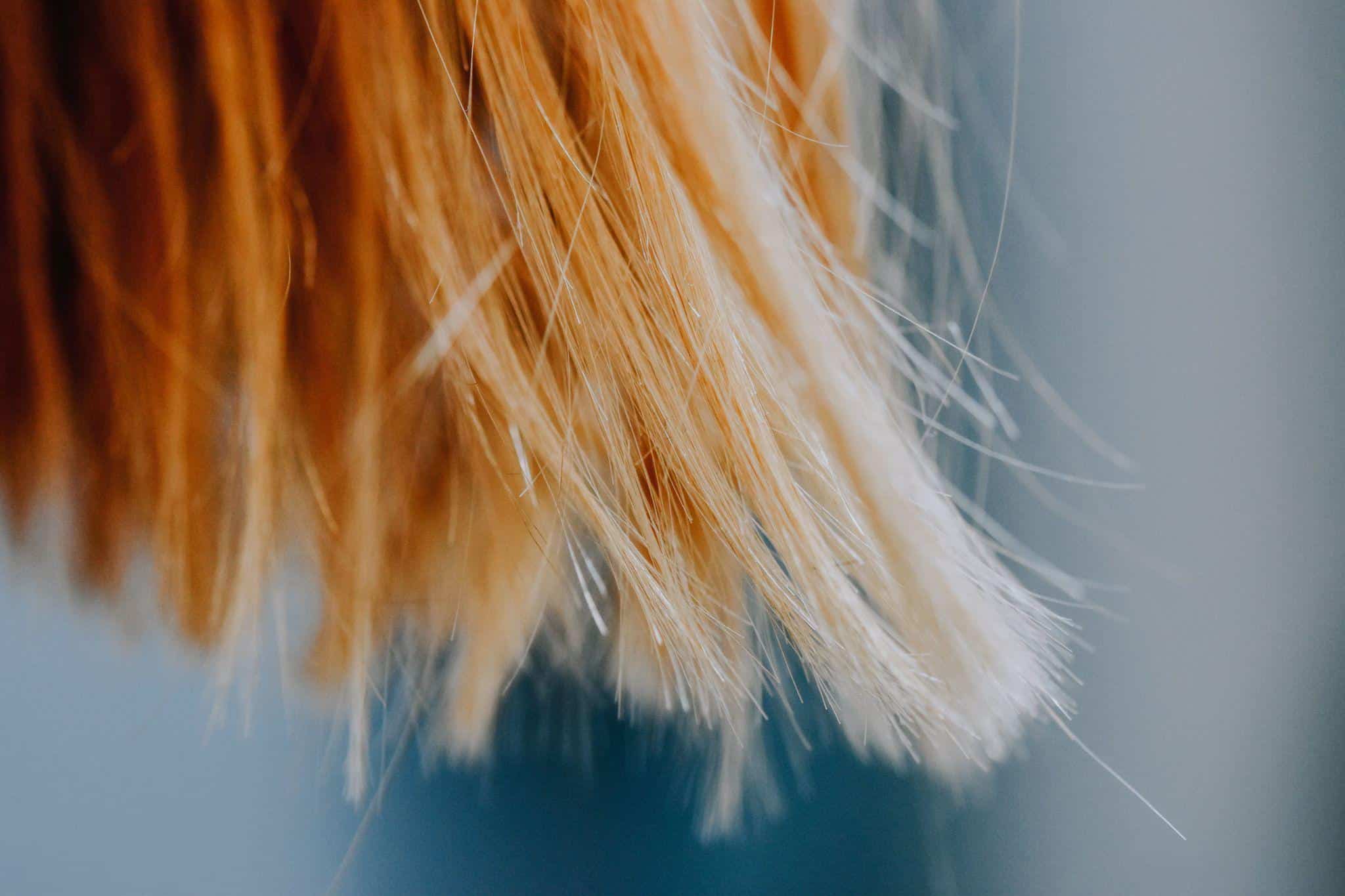
Frizz appears when lifted cuticle scales catch light and moisture unevenly rather than reflecting it uniformly. Rough texture replaces smoothness because the scales no longer lie flat against the shaft. Dullness overtakes shine as the damaged cuticle surface scatters rather than reflects light. Split ends begin at the cuticle layer and work their way up the shaft as weakened scales break away entirely.
As hair is exposed to increasing temperatures near or above its denaturation temperature via blow dryers, flat irons, or curling irons, the peptides begin to degrade and the disulfide bonds begin to decouple, leading to a weakened hair fiber that is more susceptible to breakage and mechanical damage.
As hair is continually exposed to repeated heat treatments and high temperatures, this degradation is further exacerbated. A single heat styling session at moderate temperature does not produce catastrophic structural failure, but the partial lifting and protein denaturation that occurs each time accumulates across weeks and months.
During the heating process, the cuticles undergo repeated expansion and contraction from heating and cooling cycles, leading to edge lifting and even delamination, with physical disruption directly damaging the critical hydrophobic lipid layer anchored to the cuticle surface, shifting hair from a hydrophobic to a hydrophilic state and thereby compromising its natural barrier function.
Most heat styling users eventually notice these compounded changes and attribute the frizz, breakage, and texture shift to aging, humidity, or product failure rather than recognizing the cumulative thermal stress applied to the cuticle layer over time.
The Mechanism of Thermal Protection and What Matters in a Formulation
Heat protectants function by intervening in the thermal damage pathway before it reaches the cuticle structure.
FTIR imaging spectroscopy of hair cross sections provides spatially resolved molecular information, and this approach has been used to monitor thermally induced modification of hair protein, including the conversion of alpha-helix to beta-sheet and protein degradation.
A properly formulated thermal barrier works through several complementary mechanisms: it forms a film over the hair shaft that distributes heat more evenly across the surface rather than allowing it to concentrate at specific vulnerable points, it reduces the rate at which moisture is driven out of the hair shaft during styling which slows the expansion that lifts cuticle scales, and in formulations that include film-forming polymers and silicone-based ingredients, it creates a physical barrier between the heat source and the cuticle that absorbs some of the thermal energy before it reaches the keratin structure.
Beyond the presence of a thermal barrier, what matters in a heat protectant formulation is the heat threshold the product is rated to protect against relative to the temperatures the styling tools in question actually reach, the hydration dimension and whether the formula supports the hair’s moisture balance rather than simply coating it, the ingredient profile and whether it includes keratin-supporting or cuticle-conditioning actives alongside the thermal barrier component, and the residue question whether the formula applies cleanly and rinses out without accumulation that can itself affect cuticle health over time.
Davines Canada’s heat protectant collection approaches thermal protection from a formulation philosophy that prioritizes cuticle conditioning alongside barrier function, with products developed without parabens and formulated with the ingredient transparency that the Italian B Corp brand applies across its haircare lines, which matters for people who are applying a product to their hair every time they style and want to know that the protective layer they are adding is not introducing its own set of ingredient trade-offs.
DVS of thermally treated hair shows reduced water regain and lower water retention compared to non-thermally treated hair, which might be attributed to protein conformation changes due to heat damage, while the protection of native protein structure associated with selected polymer pretreatments leads to improved moisture restoration and water retention of hair.
Conventional heat protectant formulations and newer approaches that treat thermal protection as part of a broader hair health philosophy differ in meaningful ways.
Where older-generation sprays focused solely on creating a silicone film to deflect heat, contemporary formulations from brands committed to hair science recognize that genuine cuticle protection during thermal styling requires maintaining moisture equilibrium, reinforcing the protein matrix, and preventing the lipid layer disruption that turns a temporary styling session into permanent structural compromise.
Application Technique and the Coverage Imperative
The way a heat protectant is applied is as consequential as whether one is used at all. Even distribution across the entire hair shaft determines whether protection is uniform or leaves vulnerable sections exposed to full thermal stress.
Concentrating product at the ends while neglecting the mid-shaft and roots creates an inconsistent barrier that allows heat damage to occur unevenly along the length of each strand. For different hair densities and lengths, the right amount means enough coverage to form a continuous film without weighing hair down or creating buildup that interferes with styling or requires harsh clarifying to remove.
Timing affects how effectively the product bonds to the cuticle surface before heat is applied. Applying a heat protectant to already-damp hair versus slightly damp versus dry hair changes how the product distributes and how well it adheres to the cuticle layer. On very wet hair, the product may dilute and slide off before bonding.
On completely dry hair, it may not penetrate the cuticle layer enough to offer internal reinforcement. The optimal application window for most formulations is when hair is about 70 percent dry, allowing the protectant to spread evenly and bond to the cuticle without being washed away by residual water.
The temperature setting used in conjunction with the heat protectant’s rated protection threshold creates a margin that determines actual safety. Using a protectant rated to 230 degrees Celsius while styling at 230 degrees leaves zero cushion for tool temperature variation or prolonged contact. Using it while styling at 180 degrees creates a meaningful buffer that reduces the likelihood of protein denaturation even if a section receives slightly longer exposure than intended.
Professional stylists adjust heat settings based on hair condition, texture, and the specific thermal protection product in use, recognizing that the margin matters more than simply staying below the maximum rated temperature.
Heat Styling Modalities and Their Distinct Cuticle Stress Profiles
Different heat styling tools create different patterns of cuticle damage based on their temperature range, contact method, and duration. Blow dryer heat operates at lower temperatures than flat irons but involves longer cumulative exposure across the entire drying session.
The moving airflow distributes heat more diffusely, but the extended duration means the cuticle remains in an elevated temperature state for minutes rather than seconds.
During styling procedures the temperatures can exceed 200 degrees Celsius, imparting significant damage to the hair keratin. Ideally, a heat protectant’s distribution for blow drying should focus on providing sustained moisture retention rather than just peak temperature deflection.
Flat iron heat involves higher temperatures and direct metal-to-cuticle contact, creating concentrated thermal stress at the point of pressure. The clamping mechanism compresses the hair shaft while simultaneously heating it, which intensifies both the mechanical and thermal damage to cuticle scales.
Each pass of a flat iron subjects a section of hair to temperatures that can easily exceed the keratin denaturation threshold if the tool is set too high or moved too slowly. Heat protectants designed for flat iron use need to form a robust physical barrier that remains stable under direct contact and prevents the metal plates from making unprotected contact with the cuticle surface.
Curling wand heat involves sustained contact at multiple points as the hair wraps around a heated barrel, with each curl requiring the hair to remain in contact with the heat source for several seconds to set the shape.
This prolonged localized exposure can create cumulative damage in the wrapped sections if the protectant film breaks down or is unevenly applied. Curling wand users benefit most from heat protectants that maintain their barrier function under sustained heat rather than formulas that evaporate or degrade quickly once temperatures rise.
The Limits of Repair and Why Prevention Compounds Differently
The cuticle does not regenerate. Once keratin scales are broken, cracked, or lost from the shaft, that portion of the hair must grow out and be trimmed away before the strand can return to its original structural integrity.
DSC measurements of thermally treated hair demonstrate degradation of hair keratin. What conditioning treatments accomplish is the temporary smoothing and re-adhesion of lifted scales, creating a cosmetic improvement in texture and shine without restoring the underlying structure. What bond-building treatments accomplish is strengthening the cortex beneath a damaged cuticle, improving tensile strength and reducing breakage, but they do not rebuild the cuticle layer itself.
This biological reality explains why consistent heat protectant use produces better long-term hair condition than any amount of post-damage repair treatment.
Prevention keeps the cuticle intact in the first place, maintaining the natural moisture seal, light-reflecting surface, and protective barrier that no topical product can fully replicate once it has been lost.
Repair treatments manage damage that has already occurred, but they are addressing a structural deficit rather than restoring original function. For users who heat style regularly, the difference between protecting before heat exposure and attempting to repair afterward becomes compoundingly visible over a six to twelve month period.
Recognizing Cuticle Damage Stages and Calibrating Intervention
Hair at different stages of cuticle damage looks and feels distinctly different, and recognizing where your hair currently sits on that continuum helps calibrate both your heat styling approach and your expectations for recovery.
Early-stage cuticle damage manifests as subtle changes that most people dismiss as seasonal or environmental: slightly increased frizz in the same humidity conditions that previously did not affect the hair, a minor loss of shine that seems attributable to product buildup, and ends that feel slightly rougher than the mid-lengths even with regular conditioning.
At this stage, the cuticle scales are beginning to lift but have not yet fractured, and consistent heat protectant use combined with reduced styling frequency can stabilize the damage and prevent progression.
Intermediate-stage cuticle damage produces consistent, visible texture changes that no longer respond fully to conditioning or smoothing treatments. Frizz becomes persistent rather than occasional, appearing even in low-humidity environments.
The hair feels noticeably rougher to the touch, particularly along the lengths and ends. Shine diminishes across the entire head rather than just at the tips, and the hair tangles more easily during combing.
At this stage, a significant portion of the cuticle scales have lifted or partially fractured, and while they have not yet broken away entirely, the cumulative damage has compromised the cuticle’s protective and cosmetic functions. Thermal protection becomes essential to prevent further degradation, but visible improvement requires growing out the damaged sections.
Advanced-stage cuticle damage presents as chronic breakage, split ends that recur rapidly after trimming, and a marked loss of elasticity that makes hair feel brittle and straw-like.
The cuticle layer has been substantially eroded, exposing the cortex to mechanical and environmental stress that accelerates breakage.
Hair at this stage often shows uneven porosity, with some sections absorbing water and product excessively while others remain coated and unresponsive. Recovery at this level requires cutting away the damaged length, committing to a zero-heat or minimal-heat routine, and using intensive protein and moisture treatments to support the cortex while new, undamaged hair grows in.
Building a Genuinely Protective Heat Styling Routine
A genuinely protective heat styling routine is not a product list but a sequence of habits executed consistently enough that they become reflexive rather than optional. It begins with assessing whether heat is necessary for the desired style or whether air-drying, braiding, or setting techniques could achieve a similar result without thermal stress.
When heat is required, it continues with applying a properly formulated heat protectant to slightly damp hair, distributing it evenly from roots to ends, and allowing it to bond to the cuticle surface before introducing heat.
It includes selecting the lowest effective temperature setting on the styling tool rather than defaulting to maximum heat, sectioning hair into manageable portions to ensure even exposure without prolonged contact, and finishing each section before moving to the next rather than repeatedly reheating areas that have already been styled.
The routine extends beyond the styling session itself to include conditioning treatments that support cuticle health, regular trims that remove damaged ends before splits travel up the shaft, and periodic assessment of whether the hair’s texture and behavior indicate that cumulative damage is occurring despite protective measures.
For someone who flat irons twice weekly, the protective routine might mean limiting sessions to once weekly and using a lower temperature. For someone who blow-dries daily, it might mean allowing hair to air-dry halfway before applying heat and using an ionic dryer that reduces drying time.
The compounding return on consistent heat protection becomes most visible over a six to twelve month horizon when hair that has been consistently protected retains its original texture, shine, and strength while hair that has been repeatedly exposed without protection shows progressive roughness, dullness, and breakage.
The two or three minutes of preparation that heat protectant application requires each styling session accumulates into hours of prevented damage and months of better hair condition, a return that becomes obvious only when viewed across the long arc of cumulative thermal exposure rather than the immediate aftermath of a single blow-dry.