The conversation around weight loss has shifted.
For years, the narrative was binary: you either “disciplined” yourself into a smaller size with kale or cardio.
There was no in-between.
Then came the injections; the GLP-1 agonists like Ozempic and Wegovy which disrupted the market. They also brought their own baggage, from “Ozempic face” to the realization that you might be tethered to a needle for life.
But quietly, a third option has emerged, sitting confidently in the middle of the spectrum.
Endoscopic Sleeve Gastroplasty (ESG), a procedure that involves no external cutting, no visible scars, and a recovery time that allows many women to be back at their desks (or date nights) within a week.
For the modern woman who wants significant results without the permanence of surgery or the lifelong subscription of medication, ESG is becoming the empowered choice. In fact, it is rapidly gaining a reputation as one of the best non surgical weight loss procedures for women available today.
Here is why this “accordion procedure” is redefining the middle ground of modern weight loss.
Lets’ understand the gap
To understand why ESG is gaining traction, we have to look at the frustration gap.
On one side, we have lifestyle changes. We know the drill: calorie deficits and HIIT classes. For many, especially those with a BMI over 30, the body’s metabolic set point fights back, making long-term maintenance statistically rare.
On the far other side is bariatric surgery (like the gastric sleeve or bypass). These are incredibly effective but invasive. They involve removing parts of the stomach, stapling tissue, and permanent scarring. For someone who wants to lose 40 or 50 pounds, rather than 100+, major surgery often feels like using a sledgehammer to crack a nut.
ESG fills this void. It is not a pill, but it isn’t “surgery” in the traditional sense either. It bridges the gap for women who feel too heavy for standard dieting to work, but “not heavy enough” to justify organ removal.
What exactly is endoscopic sleeve gastroplasty?
Think of ESG as stomach remodeling rather than stomach removal.
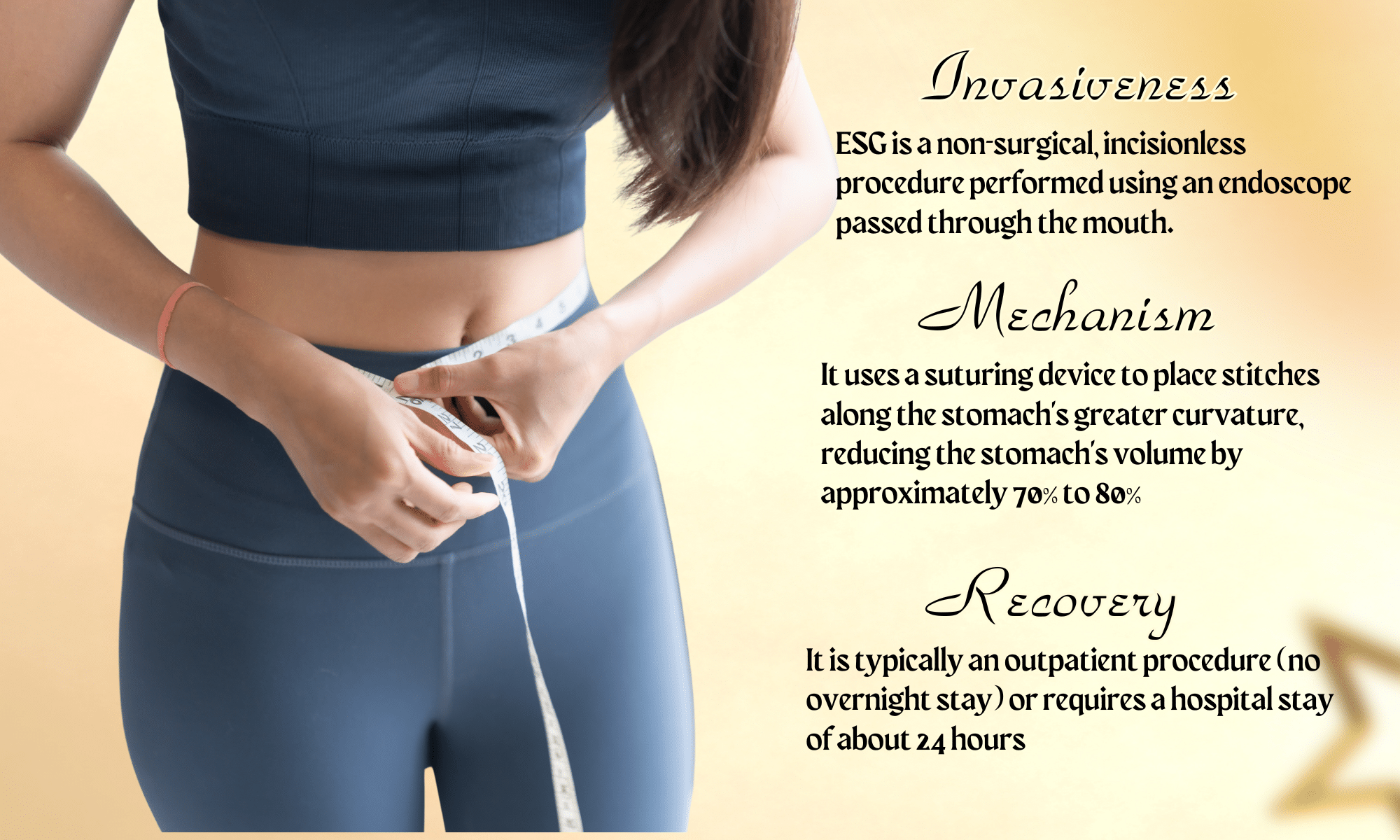
In a traditional gastric sleeve, a surgeon cuts through the abdomen to remove about 80% of the stomach. In ESG, a gastroenterologist goes in through the mouth (endoscopically) while you are under anesthesia. According to the Mayo Clinic, the doctor uses a specialized suturing device to stitch the stomach internally, folding it in on itself like an accordion or a pleated skirt.
Using a specialized suturing device, they stitch the stomach internally, folding it in on itself like an accordion or a pleated skirt.
The result is a stomach that is roughly 70-80% smaller, shaped like a narrow tube or a banana. Because the stomach volume is reduced, you feel full after eating a very small portion. But unlike the surgical sleeve, your blood supply, nerves, and stomach tissue remain intact. Nothing is removed; it is simply resized.
The beauty appeal: No external scars
We talk about confidence, presentation, and feeling good in our skin. One of the most significant psychological barriers to bariatric surgery is the scarring, typically five small incision marks across the abdomen.
ESG leaves zero external scars. Because the entire procedure is performed through the throat, you wake up with your abdominal skin exactly as it was when you went to sleep. For women who are conscious about bikini lines or crop tops, this “stealth” aspect is a massive selling point. You don’t have to explain your medical history to anyone who sees you at the beach.
Note: While ESG handles the weight, rapid changes in body size can sometimes impact skin elasticity. Many patients pair their weight loss journey with non-invasive treatments like Radio Frequency Skin Tightening to ensure their skin snaps back as the pounds drop.
Why modern women are choosing the non-surgical route
Beyond the lack of scars, the “modern” appeal of ESG is the respect for time. We live fast-paced lives. Taking six weeks off for surgical recovery is simply not an option for many career-driven women or busy mothers.
The ESG is often called a “weekend procedure.”
While that’s a slight exaggeration, you won’t be running a marathon on Monday, the downtime is minimal compared to surgery. Most patients go home the same day. The acute recovery phase is usually 3 to 5 days. You can have the procedure on a Thursday and likely be back to light office work by Tuesday.
Preserving the option for the future
Another layer of the “middle ground” argument is reversibility. While ESG is intended to be permanent, it is theoretically reversible (the stitches can be removed in the early stages) and it doesn’t burn bridges. If you have ESG now and need a different intervention 20 years down the line, your anatomy is still largely intact. It’s a less final decision than amputation of the stomach organ.
ESG vs. the “skinny shot” hype
You cannot discuss weight loss in 2025 without addressing the elephant in the room: GLP-1 agonists (semaglutide, tirzepatide). Why would someone undergo a procedure when they could just take a shot?
This is where the logic of the “middle ground” truly shines.
1. The “Forever” Problem: Data indicates that when you stop taking weight loss injections, the weight often comes back; rapidly. This means committing to a weekly injection potentially for the rest of your life. For many, that is a financial and psychological burden they aren’t willing to carry. ESG is a “one-and-done” intervention. Once the stitches are in, the tool is there 24/7 without you needing to visit a pharmacy.
2. Muscle Mass Preservation: There is emerging concern that rapid weight loss from injections can lead to “sarcopenia”, a loss of muscle mass that ruins your metabolism and body composition (sometimes leading to the “gaunt” look). Because ESG relies on restriction (eating less) rather than chemically altering your appetite hormones, and because the weight loss is often slightly more gradual than the most aggressive drug doses, it can be easier to prioritize protein intake and maintain muscle tone if you follow the nutritional guidelines.
3. Cost Effectiveness: While ESG is expensive upfront (often $10,000–$12,000 and rarely covered by insurance), the cumulative cost of weight loss drugs (often $1,000/month) surpasses the cost of the procedure within 12 to 18 months.
The reality of the procedure: What they don’t tell you
The “Hangover” Phase: While there is no surgical pain from incisions, the internal suturing causes significant cramping and nausea. Real-world patient reports often describe the first 24 to 48 hours as feeling like a severe stomach bug or intense menstrual cramps. You will likely be on anti-nausea medication. It is important to anticipate this so you don’t panic when you wake up feeling queasy.
The Liquid Commitment: You cannot eat solid food immediately. You will likely spend two weeks on a strict liquid diet (protein shakes, broth) followed by two weeks of soft foods (yogurt, scrambled eggs). This requires mental fortitude. The “middle ground” still requires top-tier discipline. During this phase, taking care of your skin is vital; keeping it hydrated with rich moisturizers like Cocoa or Shea Butter can help prevent stretch marks as your body changes.
The “New Normal” Sensation: Patients often report a strange sensation of “fullness” that sits higher in the chest than they are used to. Learning to listen to this new stop signal is critical. One bite too many can lead to immediate discomfort or regurgitation. It forces a mindful eating practice that many find to be a hidden blessing, but it is a steep learning curve.
Who is the ideal candidate?
ESG is generally FDA-approved for people with a BMI between 30 and 50 who have not found success with diet and exercise.
It is particularly well-suited for:
- The “Tweener” BMI: Someone with a BMI of 31 or 32 who is clinically obese but would be turned away by most bariatric surgeons (who often look for BMI 35+ or 40+).
- The Post-Pregnancy Struggle: Women who have held onto significant weight after children and need a mechanical tool to reset their baseline.
- The Professional: Someone who needs a discreet solution with minimal downtime.
If you have severe acid reflux (GERD) or a large hiatal hernia, you might not be a candidate, as ESG can sometimes exacerbate reflux symptoms. This is why a consultation with a specialized gastroenterologist is non-negotiable.
Note: If after your weight loss settles, you notice stubborn pockets of fat that ESG didn’t reach (like on the thighs or arms), treatments like Fat Freezing can be an excellent non-surgical finishing touch.
Is this the right investment for your body?
When we buy a luxury lipstick or a high-end serum, we view it as an investment in our confidence. ESG is a similar, albeit much larger, investment.
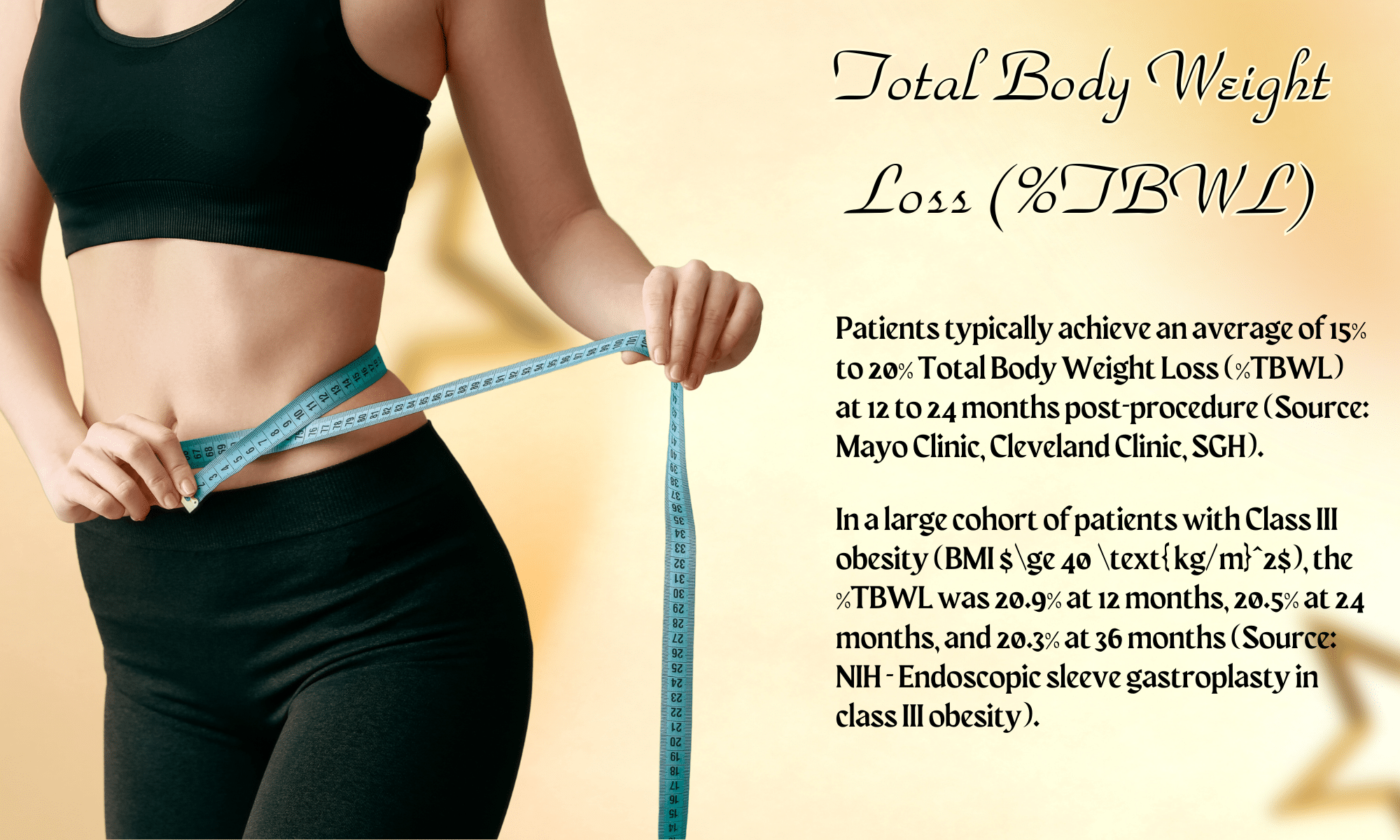
Clinical studies, such as those published in the Clinical Gastroenterology and Hepatology journal, show that patients typically lose 15% to 20% of their total body weight within 12 months. For a 200-pound woman, that is a 30 to 40-pound loss. It might not get you to a size 0, but for many, it gets them to a size where they feel healthy, active, and radiant again.
It is important to view ESG not as a cure, but as a powerful tool. It restricts how much you can eat, but you still have to choose what to eat. It quiets the physical hunger, giving you the mental space to make better choices without the white-knuckled struggle of willpower.
Final:Reclaiming confidence without the scars
The modern approach to beauty and wellness is about options. We no longer accept “one size fits all” in fashion, and we shouldn’t accept it in healthcare.
Endoscopic Sleeve Gastroplasty represents a sophisticated evolution in weight management. It respects the body’s anatomy by avoiding incisions, it respects the patient’s time by offering quick recovery, and it respects the patient’s intelligence by offering a solution that doesn’t rely on lifelong medication.
For the woman standing in the middle ground, tired of the diet roller coaster but unwilling to go under the knife, ESG might just be the modern solution that finally fits.