A practical guide to layering vitamin C in a way that supports your skin barrier.
Vitamin C has earned its reputation as one of skincare’s most effective antioxidant ingredients. Dermatologists and formulators often recommend it for brightening uneven skin tone, supporting collagen production, and helping protect the skin against environmental stressors such as pollution and UV exposure.
But despite its popularity, many people stop using vitamin C products after only a few weeks because of redness, stinging, dryness, or breakouts.
In many cases, the issue isn’t vitamin C itself. It’s how the ingredient is being used. Layering too many active ingredients, choosing the wrong formulation, or applying products in the wrong order can all make vitamin C feel harsher than it needs to. pH can also influence how well certain forms of vitamin C perform and how comfortably they sit on the skin.
The good news is that vitamin C can work well for most skin types when it’s introduced gradually and paired thoughtfully with the rest of a routine. Understanding how different forms of vitamin C behave, how pH affects absorption, and how vitamin C interacts with the rest of your skincare routine can make a major difference in both comfort and results.
A few small changes in how you choose, layer, and apply vitamin C can make the ingredient far easier to tolerate. Here’s what to know about building a routine that supports brighter-looking skin without overwhelming your barrier.
Why Vitamin C Can Sometimes Cause Irritation
The most researched form of vitamin C in skincare is L-ascorbic acid, often listed on product labels as Ascorbic Acid or LAA. It’s valued because it’s highly active and well-studied for antioxidant and brightening benefits.
However, L-ascorbic acid also works best in a fairly acidic environment. Most formulations perform best at a pH between 2.5 and 3.5, while skin naturally sits closer to a pH of 4.5 to 5.5.
For some people, especially those with sensitive or over-exfoliated skin, that shift can temporarily disrupt the skin barrier and lead to irritation.
Another challenge is stability. Vitamin C is sensitive to light, heat, and air exposure, which is why some serums gradually turn yellow or orange over time. Once oxidized, the ingredient becomes less effective.
This is also why skincare professionals often recommend introducing vitamin C slowly instead of applying a high-strength formula every day from the start.
Not All Vitamin C Formulas Work the Same Way
One of the biggest misconceptions around vitamin C is that stronger automatically means better.
In reality, different forms of vitamin C are designed for different skin concerns and tolerance levels. Here’s how the key forms compare:
| Form | Potency | Stability | pH | Irritation risk | Best for |
| L-Ascorbic Acid | ⭐⭐⭐⭐⭐ | Low | 2.5-3.5 | Medium-High | Experienced users, visible brightening |
| Ascorbyl Glucoside | ⭐⭐⭐ | High | 5-7 | Low | Beginners, reactive skin |
| Magnesium Ascorbyl Phosphate (MAP) | ⭐⭐⭐ | High | 6-7 | Very low | Sensitive, dry skin |
| Tetrahexyldecyl Ascorbate (THD) | ⭐⭐⭐⭐ | High | 5-6 | Low-Moderate | Dullness, uneven tone |
| Sodium Ascorbyl Phosphate (SAP) | ⭐⭐⭐ | High | 6-7 | Very low | Acne-prone skin |
For beginners or anyone with reactive skin, starting with a gentler derivative may feel more comfortable than immediately using a high-concentration L-ascorbic acid serum.
The Most Common Vitamin C Layering Mistakes
Skincare routines have become increasingly complicated in recent years, especially with trend-driven routines encouraging people to combine multiple active ingredients at once.
But layering too many actives together doesn’t always produce better results. It can sometimes lead to more irritation.
Some ingredients work particularly well with vitamin C, while others are often better separated into different routines.
Dermatologists often recommend simplifying active-heavy routines when persistent irritation develops.
What Pairs Well With Vitamin C?
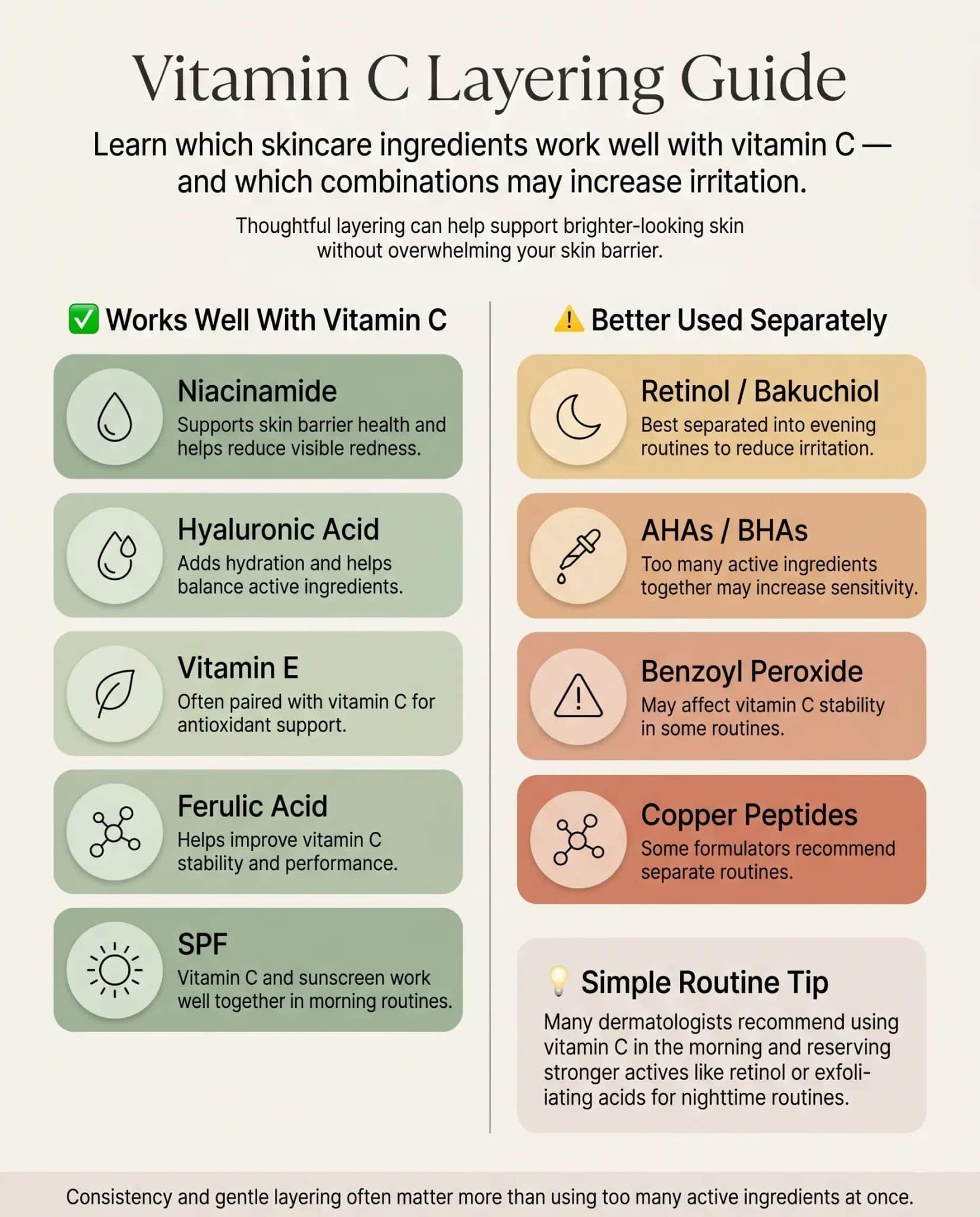
| Ingredient | Can You Use It With Vitamin C? | Why It Works |
| Niacinamide | ✅ Yes | Earlier concerns about combining niacinamide and vitamin C have largely been debunked. Many modern routines use both together successfully. |
| Vitamin E | ✅ Yes | Vitamin E is often paired with vitamin C to help support antioxidant performance and formula stability. |
| Ferulic acid | ✅ Yes | Ferulic acid is commonly used alongside vitamin C to improve stability and antioxidant support. |
| SPF | ✅ Yes | Vitamin C is frequently used in morning routines because antioxidants complement sunscreen protection. |
| Hyaluronic acid | ✅ Yes | Hyaluronic acid adds hydration and can help support the skin barrier alongside active ingredients. |
Older concerns about combining niacinamide and vitamin C have largely been debunked, and many modern formulas now use both ingredients together successfully.
Ingredients Often Best Used Separately
| Ingredient | Recommendations | Why |
| Retinol / bakuchiol | ⚠️ Separate AM/PM | Some people tolerate both together, but separating them into AM/PM routines may reduce irritation risk. Use vitamin C in AM, retinol in PM. |
| AHAs / BHAs | ⚠️ Use cautiously | Combining multiple exfoliating or active ingredients may increase sensitivity for some skin types. |
| Benzoyl peroxide | ❌ Best used separately | Benzoyl peroxide may affect vitamin C stability, so many dermatologists recommend using them in separate routines. |
| Copper peptides | ❌ Separate routines | Some formulators recommend using copper peptides separately from vitamin C, although research remains limited. |
Many dermatologists recommend using vitamin C in the morning and reserving retinoids, bakuchiol, or exfoliating acids for nighttime use instead.
Why Application Order Matters
With vitamin C, application order can influence both comfort and effectiveness.
Most formulators recommend applying vitamin C earlier in your routine, ideally after cleansing and before heavier creams or oils.
A simple application sequence looks like this:
- Cleanse with a gentle cleanser
- Apply vitamin C serum to dry or slightly damp skin
- Allow it to absorb for about 60 seconds
- Follow with hydrating products and moisturizer
- Finish with SPF during the day
Note: Applying vitamin C after thick creams or mixing it directly into moisturizer may reduce how effectively it absorbs into the skin.
Using Vitamin C Around the Eyes
The skin around the eyes is thinner and often more reactive than the rest of the face, which is why high-strength facial serums can sometimes feel uncomfortable in that area.
Instead of applying a concentrated facial serum too close to the eyes, many people prefer a vitamin C eye cream specifically formulated for delicate skin.
Some eye creams combine vitamin C derivatives with caffeine to help address both dullness and puffiness at the same time. Products like Three Ships Beauty’s First Light Eye Cream use this type of ingredient pairing in a formula designed specifically for the eye area.
When applying eye cream, gentle patting motions instead of rubbing can help minimize unnecessary friction on delicate skin. Apply from the inner corner outward along the orbital bone, but not directly on the eyelid.
How Vitamin C Fits Into a Morning and Evening Routine
One of the easiest ways to reduce irritation is to separate stronger active ingredients across AM and PM routines.
| Step | Morning (AM) | Evening (PM) |
| 1 | Gentle pH-balanced cleanser (pH 4.5-5.5) | Gentle cleanser or double cleanse (if removing makeup/SPF) |
| 2 | Vitamin C serum | Retinol, bakuchiol, or exfoliating treatment |
| 3 | Hydrating toner or serum (optional) | Hydrating toner or serum |
| 4 | Vitamin C eye cream | Eye cream or retinol alternative for PM |
| 5 | Lightweight moisturizer | Moisturizer or barrier cream |
| 6 | Broad-spectrum SPF 30+ | Optional face oil |
Bakuchiol is often used as a gentler alternative to traditional retinol because it offers similar smoothing and firming benefits with less potential for irritation in some skin types.
Products like Three Ships Beauty’s Skin Hero serum position bakuchiol as part of a lower-irritation evening routine.
A Simple 4-Week Introduction Plan for Vitamin C
For anyone new to vitamin C, consistency matters more than intensity.
Introducing the ingredient gradually may help minimize irritation and improve long-term tolerance.
| Timeline | Suggested Frequency |
| Week 1-2 | Apply 2-3 mornings per week |
| Week 3 | Increase frequency if skin feels comfortable |
| Week 4+ | Transition to daily use if tolerated |
Note: If irritation develops, reducing frequency is often more effective than abandoning the ingredient altogether.