Fashion often reflects more than appearance. The fabrics people selected, the way they arranged garments, and the accessories they added reveal how societies lived, worked, worshipped, and displayed status.
When I look at ancient clothing, I find that Egypt and Greece offer two very different approaches to style.
Ancient Egyptians built their wardrobes around lightweight linen suited to the Nile Valley climate, while ancient Greeks transformed simple rectangular pieces of wool and linen into carefully arranged draped garments.
The surviving textiles, sculptures, paintings, and archaeological discoveries give us a closer look at what men and women actually wore thousands of years ago.
What Was Ancient Clothing Made Of?
Ancient clothing was made from natural materials that matched the environment and resources available in each civilization.
In Ancient Egypt, linen made from flax was the primary fabric because its lightweight and breathable nature suited the hot climate of the Nile Valley. Leather, plant fibers, and limited amounts of wool were also used for specific purposes.
The Greek historian Herodotus, writing in the 5th century BCE, claimed that wool was kept out of Egyptian temples and burials because it came from a living animal (Histories, Book II, 81).
Modern Egyptologists treat this as a probable overstatement from an outside observer rather than settled fact, but linen’s dominance in the surviving textile and artistic record is well documented regardless of the reason.
In Ancient Greece, wool was the main material, providing warmth during cooler seasons. Linen and imported textiles were also used for lighter garments and special clothing.
The Tarkhan Dress from Egypt is the world’s oldest known woven garment. A University of Oxford team led by Dr. Michael Dee radiocarbon-dated the linen to between 3482 and 3102 BCE, making it over 5,000 years old.
Dr. Alice Stevenson, curator at the UCL Petrie Museum of Egyptian Archaeology, where the dress is held, has called the survival of such a complete garment “exceptional,” and its fine pleating highlights the advanced textile skills of ancient Egyptian craftsmen.
Ancient Egyptian Clothing for Men and Women
Ancient Egyptian clothing was designed around the hot climate, available materials, and social traditions. While men’s garments focused on practicality and movement, women’s clothing often included more shaping, layering, and decorative details.
Men’s Clothing
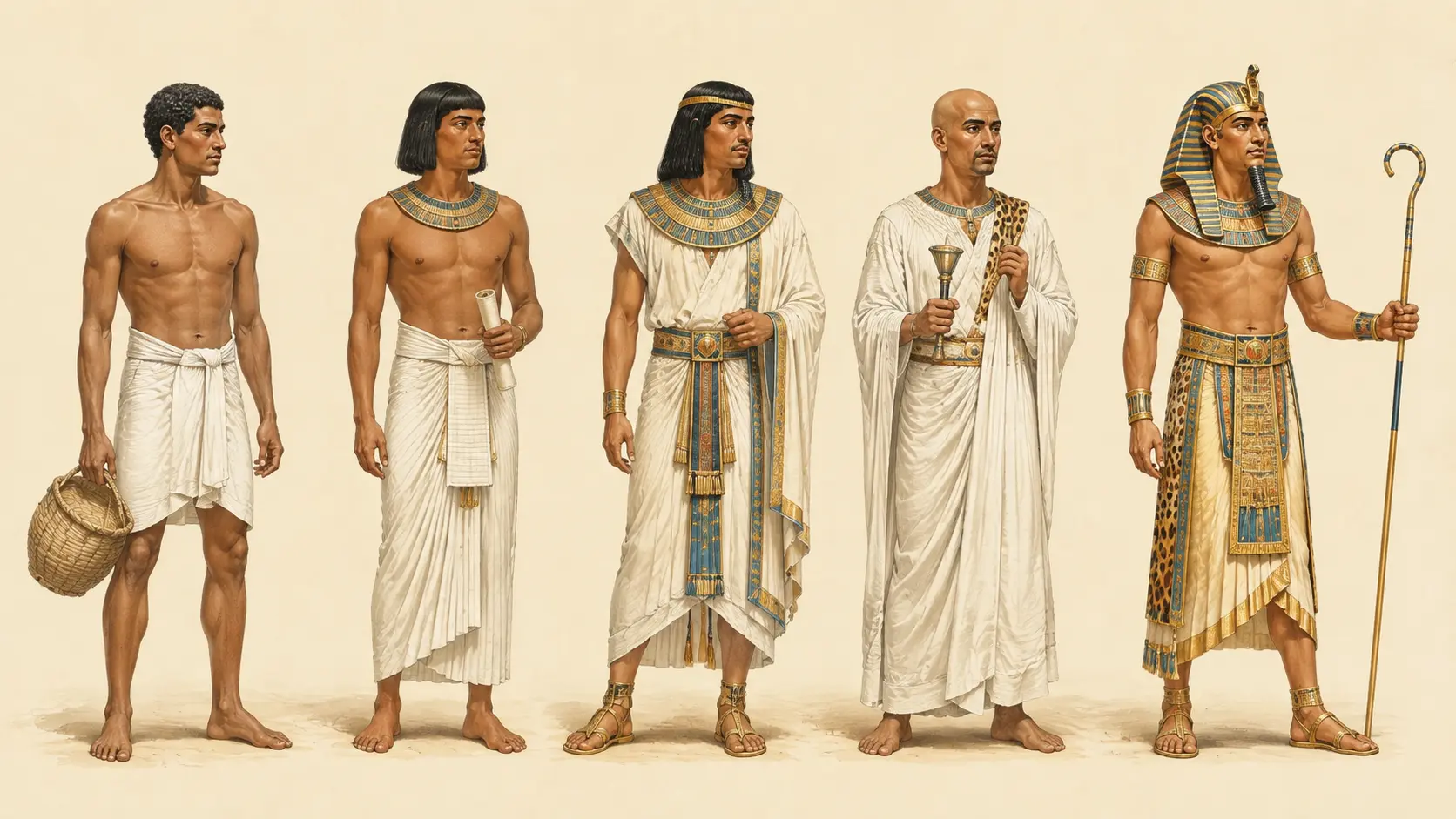
Egyptian menswear remained recognizable for thousands of years because the designs suited everyday life and the environment.
- Shendyt or schenti: A wrapped linen kilt secured around the waist, commonly worn by men across different social groups.
- Loincloths: Simple garments worn by workers such as farmers and builders who needed freedom of movement.
- Fine pleated linen: Wealthy officials and royalty wore higher-quality linen with detailed pleating.
- Priest clothing: Priests commonly wore white linen garments associated with ritual practices.
- Royal clothing: Pharaohs added ceremonial pieces such as the nemes headdress and a plaited false beard to represent authority and kingship.
The quality of linen, pleating, and decorative elements often reflected a person’s position in Egyptian society.
Women’s Clothing
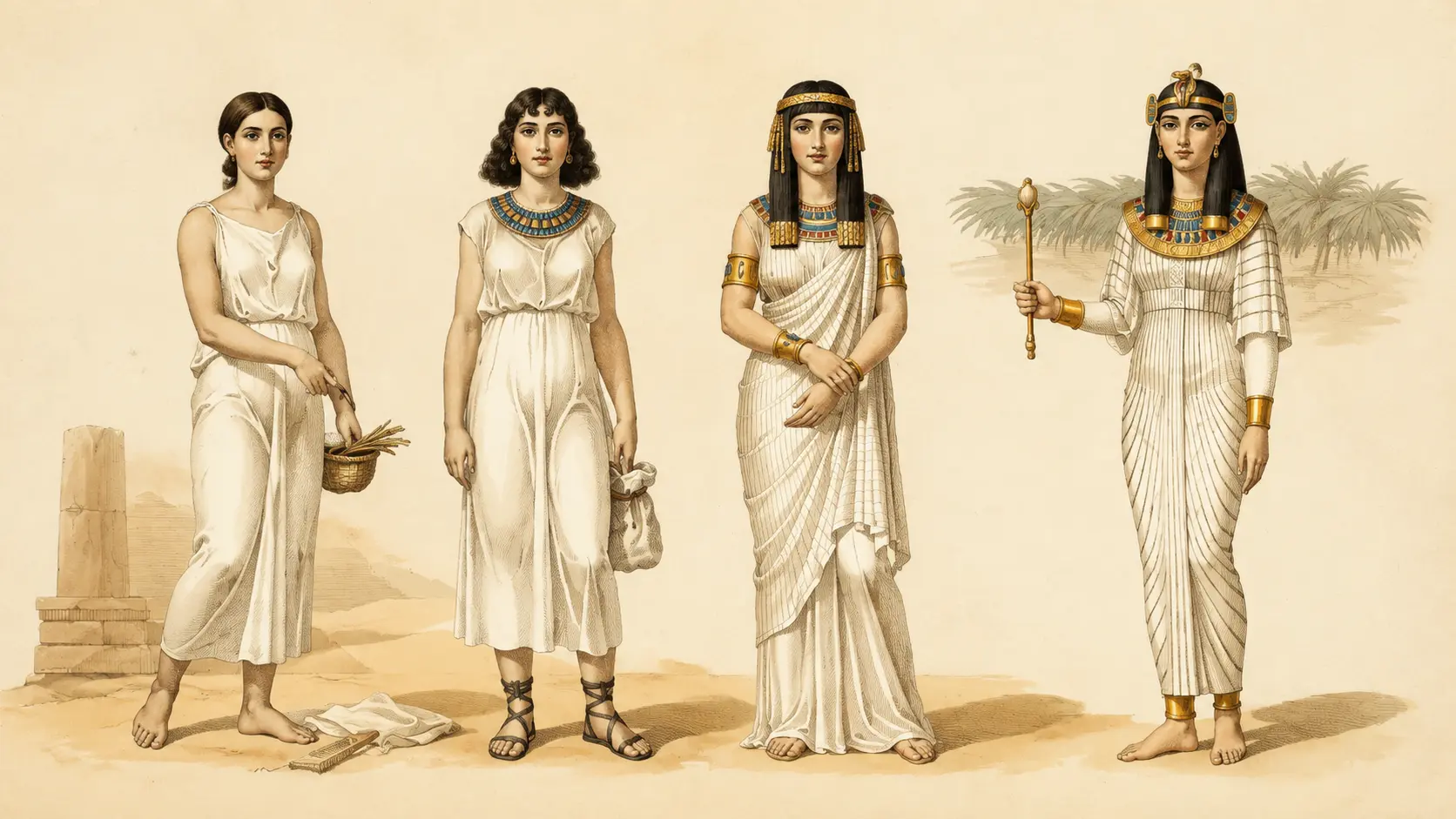
Women used many of the same linen materials as men but created more structured and decorative styles through different garment arrangements.
- Everyday dress: Women commonly wore ankle-length linen sheath dresses known as a kalasiris. Wealthier women could wear finer fabrics, pleats, jewelry, and additional decorative details.
- Royal and ceremonial dress: Elite women wore layered linen garments, elaborate collars, wigs, and cosmetics. Female rulers such as Hatshepsut sometimes adopted royal symbols linked with kingship, including the ceremonial false beard and kilt otherwise reserved for pharaohs, to express political authority.
From linen dresses in Egypt to carefully arranged draped garments in Greece, ancient fashion showed how simple fabrics could create distinct cultural identities.
The Greek approach to clothing shifted focus to folds, pins, and layers, shaping the styles worn by both men and women.
Ancient Greek Clothing for Men and Women
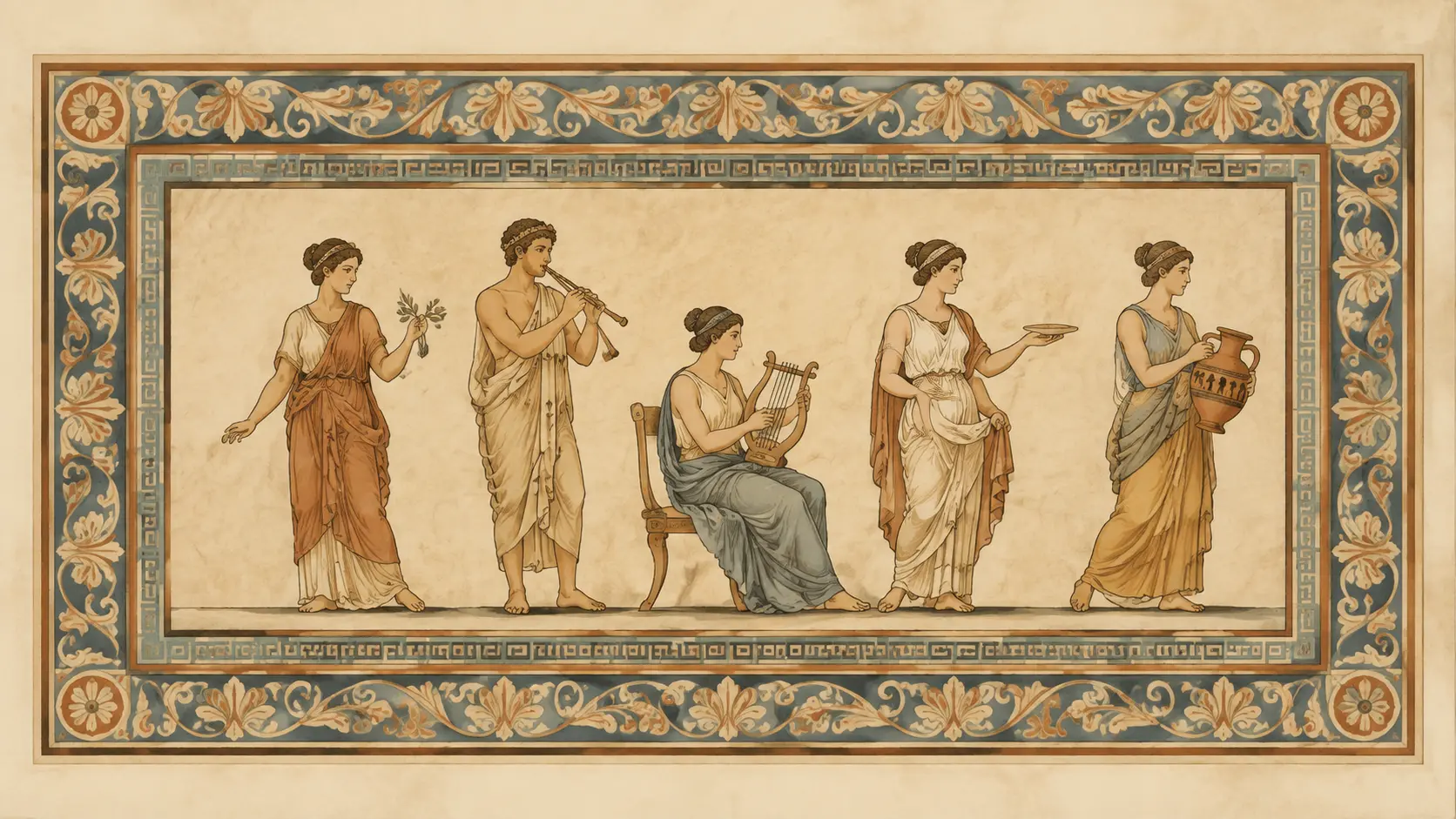
Ancient Greek clothing relied on simple rectangular fabrics that could be transformed through folding, pinning, and belting. Men and women often wore similar garment types, but the fabric weight, length, and styling created different looks for daily life, work, and formal occasions.
Professor Mireille Lee of Vanderbilt University, author of “Body, Dress, and Identity in Ancient Greece,” argues that Greek dress worked as a visual language, communicating gender, status, and identity rather than simply covering the body
| Garment | Worn By | Fabric | Features and Uses |
|---|---|---|---|
| Chiton | Men and Women | Wool or linen | Draped around the body and fastened at the shoulders, this tunic was adjusted with a belt for different fits. Men often wore shorter versions, while women preferred longer styles. |
| Exomis | Men | Wool or linen | Designed for movement, this one-shoulder tunic left one arm free and was commonly worn by workers, athletes, and soldiers during physical activities. |
| Himation | Men and Women | Wool or linen | Used as an outer layer, this large wrap provided warmth and added a formal touch for travel, public appearances, and special occasions. |
| Chlamys | Men | Wool | Recognized by its shorter length and single-shoulder fastening, this cloak was popular among young men, riders, travelers, and military figures. |
| Peplos | Women | Wool | Formed from a large piece of fabric folded and pinned at the shoulders, this garment created a structured silhouette and was often styled with belts or decorative accessories. |
| Epiblema | Women | Lightweight fabric | Worn as an additional layer over the main dress, this shawl-like covering offered extra warmth, modesty, and a decorative element to women’s outfits. |
| Strophion | Women | Wool or linen band | Wrapped around the chest beneath outer garments, this supportive band helped shape clothing and provided comfort under the peplos or |
The same pieces of fabric could create different silhouettes depending on how they were arranged. Belts, pins, folds, and layering allowed ancient Greeks to adapt their clothing for comfort, movement, and social occasions.
According to the Greek historian Herodotus (c. 484 to 425 BCE), Athenian women once wore only the peplos until a deadly incident involving the pins that fastened it led the city to adopt the lighter, pinless chiton instead. Modern historians treat this as legend rather than settled fact, but it shows how closely the Greeks linked clothing to gender and civic identity.
Ancient Roman Clothing
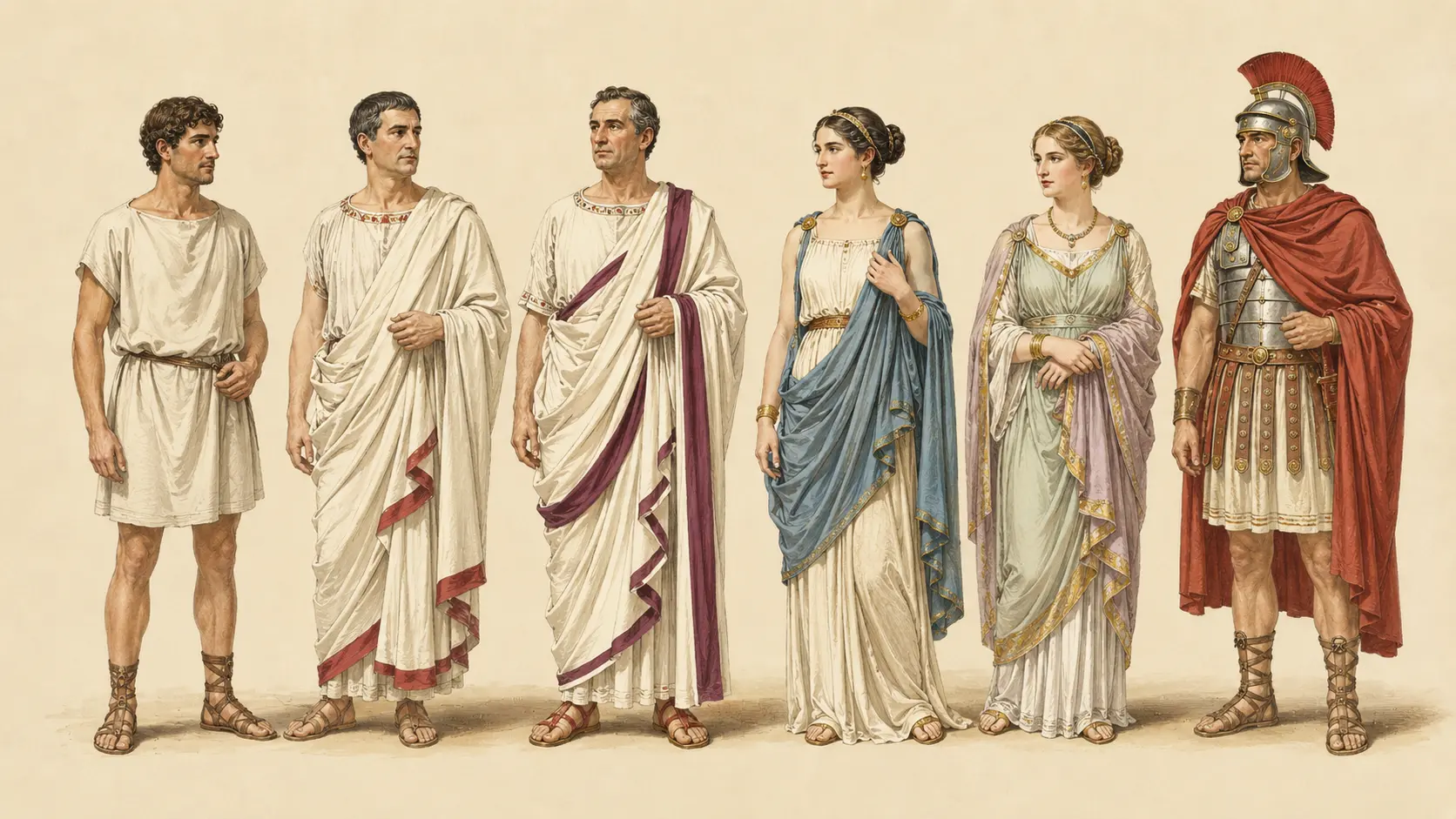
Roman clothing grew out of Greek and Etruscan dress but developed its own strict rules about who could wear what. Wool was the everyday fabric for most Romans, with linen used for lighter garments and silk reserved for the wealthy once it began arriving from China.
The tunic was the basic garment for both men and women: knee-length and short-sleeved for men, longer and often sleeved for women.
Over this, adult male citizens could wear the toga, a large semicircular piece of wool draped around the body, while married citizen women wore the stola, a long, simple gown, sometimes topped with a rectangular shawl called the palla.
Color signaled rank with real precision in Rome. The Toga Praetexta, with its purple border, marked magistrates and freeborn youths.
The plain white Toga Candida was worn by men seeking public office, and the dark Toga Pulla was reserved for mourning.
Citizens who lost their standing in Roman society could also lose the right to wear the toga or stola, which made clothing a visible marker of legal and social status, not just personal taste.
Ancient Mesopotamian Clothing
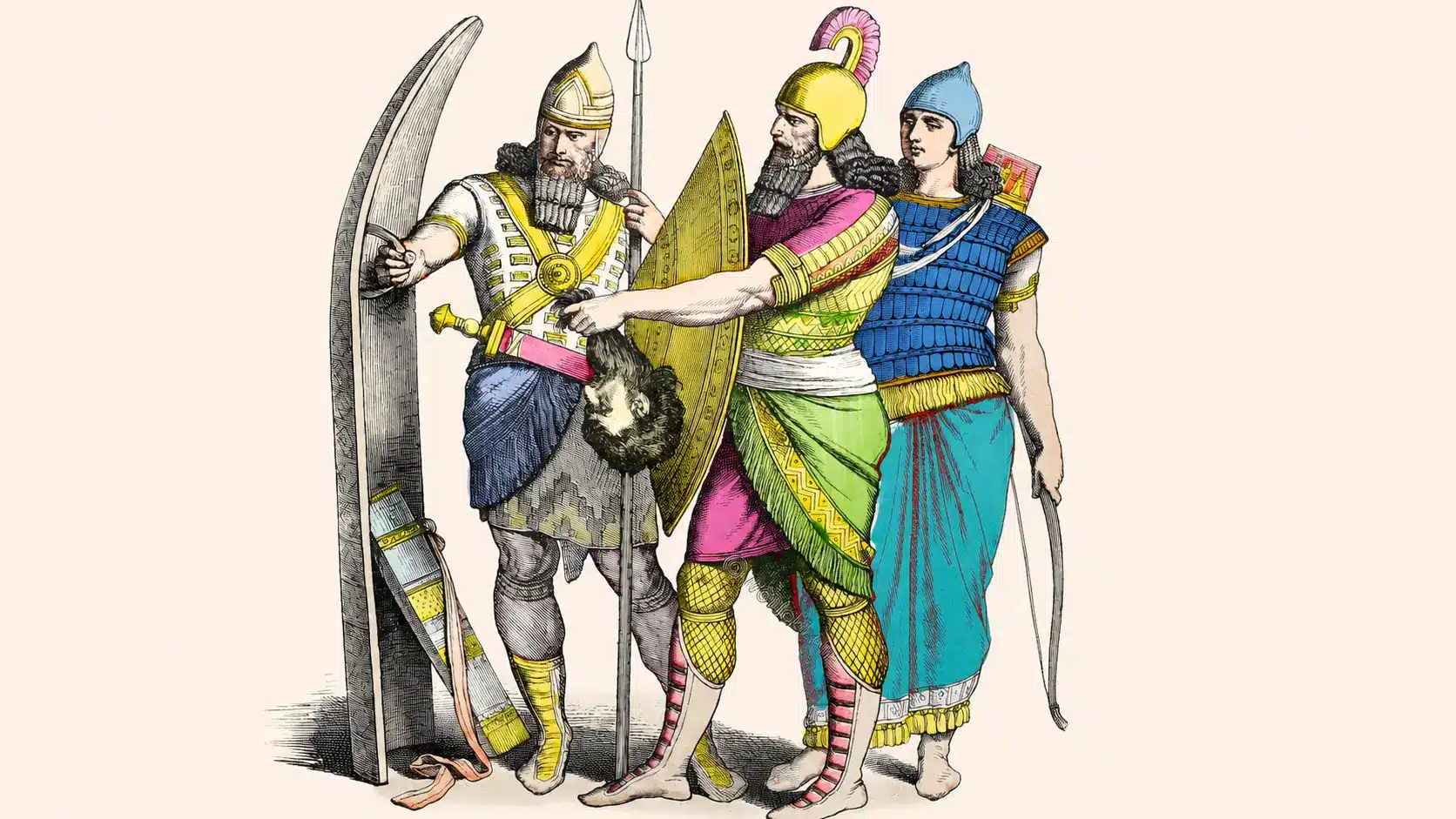
Mesopotamian dress, from the early Sumerians through the Babylonians and Assyrians, was built almost entirely around wool, with linen playing a smaller supporting role.
The earliest known Sumerian garment was the kaunakes, a wraparound skirt or shawl originally made from sheepskin with the fleece left on, later recreated in woven wool with tufts sewn or looped in to imitate the same texture.
Both men and women wore versions of the kaunakes, with length signaling status: short for servants and soldiers, long for royalty and religious figures.
By the Babylonian and Assyrian periods, fringed and tasseled tunics paired with layered shawls had largely replaced the kaunakes, especially for men.
Higher-status men and kings wore cloaks dyed in costly red, blue, or purple, and Assyrian dress in particular grew more ornate over time, with elaborate embroidery and decoration setting elite clothing apart from everyday wear.
Ancient Chinese and Indian Clothing
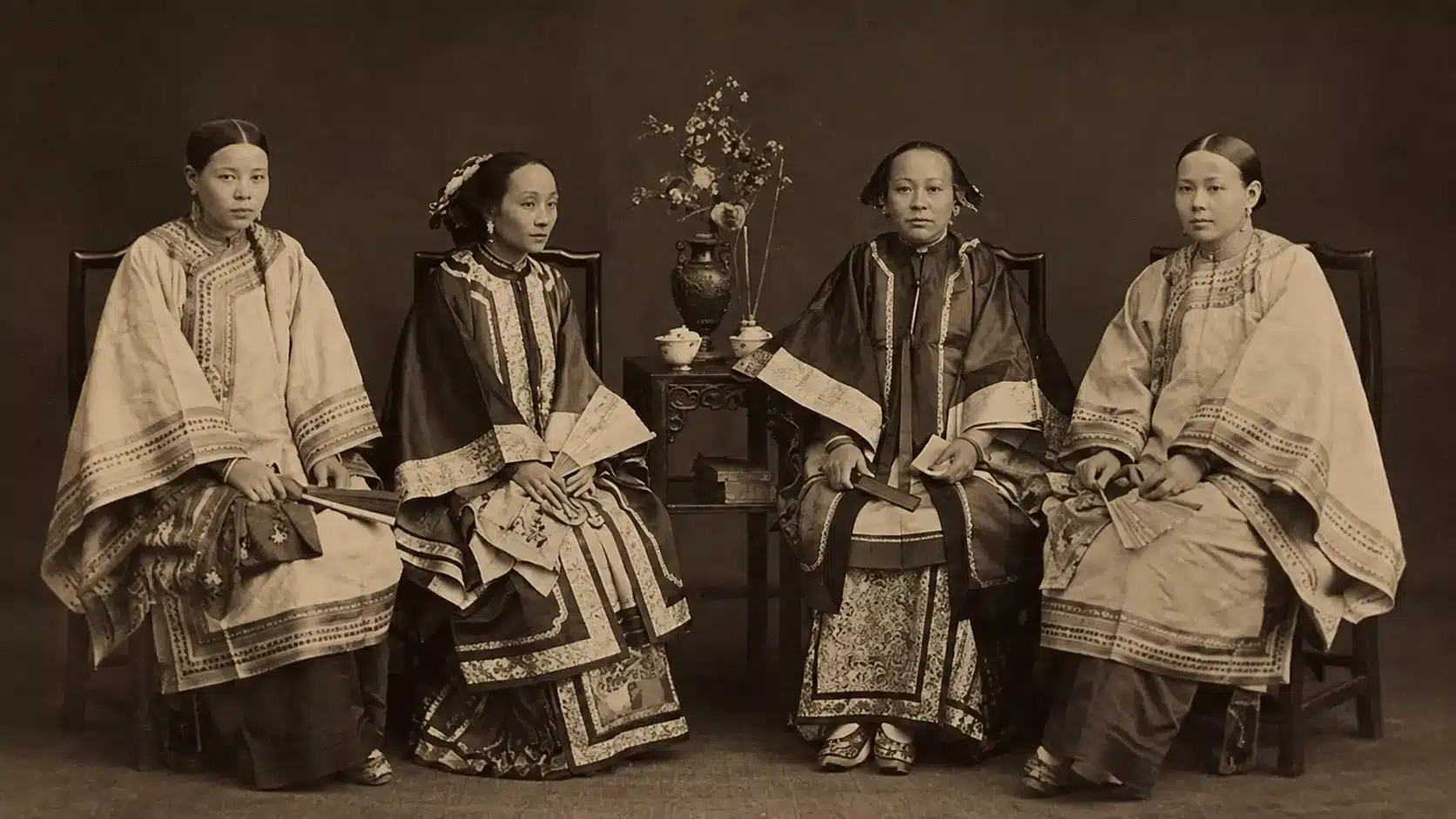
Ancient China and ancient India took almost opposite approaches to constructing clothing, and comparing the two says a lot about how differently two major civilizations solved the same basic problem.
In China, the hanfu tradition dates back to the Shang Dynasty, roughly 1600 to 1000 BCE. Hanfu garments crossed over at the collar and were fastened with a sash rather than buttons.
Silk, woven from the cocoons of silkworms, was reserved largely for the upper class, while hemp clothed most of the population until cotton became more widely available. Color carried strict rules of its own: yellow, for example, was reserved for the emperor.
In India, clothing traced back to the Indus Valley Civilization, with cotton cultivated in the region as early as 2500 BCE.
Rather than cutting and sewing fabric into fitted shapes, ancient Indian dress relied on unstitched, draped cloth.
Jewelry, Wigs, and Footwear in Egypt and Greece
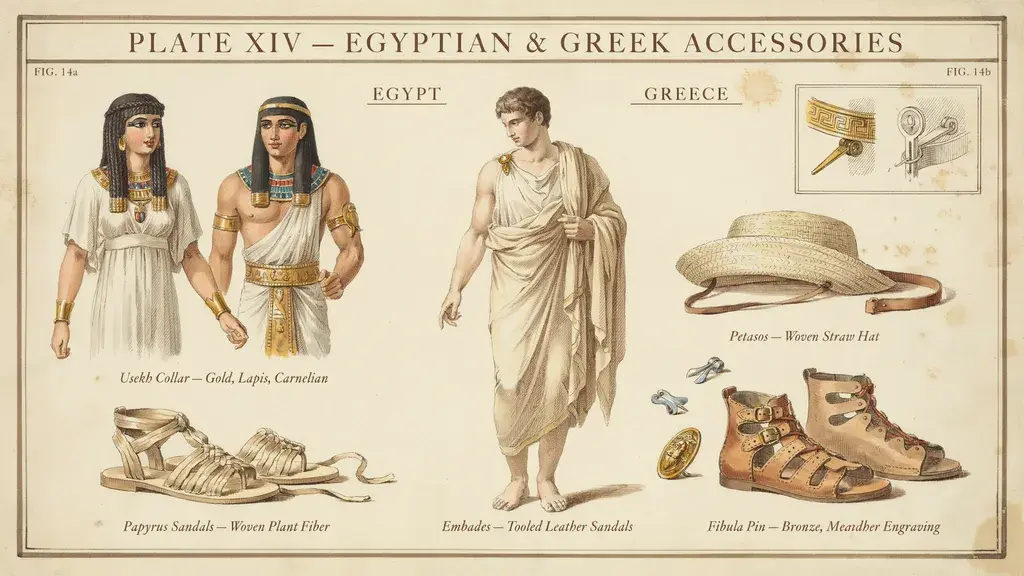
Accessories played an important role in ancient outfits, adding personal style while also reflecting wealth, identity, and social position. From decorative jewelry to practical footwear, these details completed the overall appearance of both Egyptian and Greek clothing.
Jewelry: Broad collars, bracelets, amulets, and pendants were commonly worn in Ancient Egypt. Wealthier Egyptians used gold and precious materials to display their social position.
Wigs: Both men and women wore wigs for appearance, sun protection, and social presentation.
Egyptian Footwear: Sandals made from materials such as papyrus, palm fibers, and other plant materials were used for daily activities.
Fibulae: In Ancient Greece, decorative pins secured garments at the shoulders while adding ornamentation to simple clothing styles.
Petasos: This broad-brimmed hat helped protect Greek travelers from the sun and was commonly used during outdoor activities.
Greek Footwear: Sandals, shoes, and boots were worn outdoors, while many Greeks preferred going barefoot inside their homes.
I always find it worth remembering that accessories like these weren’t just decoration. A wig, a pin, or a pair of sandals could tell you almost as much about a person’s rank as their clothing did.
These accessories added the finishing details to ancient outfits, showing that clothing was closely connected with identity, culture, and social position. Beyond materials and designs, colors and dyes also played an important role in expressing status.
Color, Dye, and Social Status in Ancient Clothing
Ancient clothing used color and dye as more than decorative elements. The shades, patterns, and materials chosen often reflected cultural preferences, available resources, and a person’s position in society.
- Greek Textiles: Ancient Greek garments were often colorful and included patterns, despite the common modern image of Greece being associated with plain white clothing.
- Egyptian Linen: Egyptian clothing was frequently kept close to the natural color of linen, although dyed textiles and decorative details were also used.
- Tyrian Purple: This rare purple dye became one of the most valuable colors in the Mediterranean because of its difficult production process.
Producing just one gram of dye required roughly 10,000 murex sea snails, and a Roman price edict issued by Emperor Diocletian in 301 CE set the cost of one pound of purple dye at 150,000 denarii, about three pounds of gold. - Status Through Color: Expensive dyes, detailed borders, and decorative elements were often linked with wealth, authority, and higher social standing.
Color choices in ancient clothing helped people communicate identity, occupation, and social position without words. These traditions show how fashion has long been connected to culture and status.
How Ancient Dyes Were Actually Made
Behind every colored garment was a labor-intensive production process tied directly to the materials on hand.
In Egypt, red came from boiling the root of the madder plant, blue from fermenting indigo or woad leaves until they oxidized into pigment, yellow from saffron crocus stigmas that had to be hand-picked from the flower, and reddish tones from dried, powdered henna leaves.
Mesopotamian dyers worked mostly with wool, using madder and pomegranate for reds. Greek dyers used the same crocus-based saffron for yellow and madder for red, alongside woad for blue.
How Ancient Clothing Still Shapes Fashion Today
Ancient clothing still influences modern fashion through flowing silhouettes, linen fabrics, pleating, and decorative accessories.
Greek-inspired dresses often echo garments like the chiton and himation, using soft drapes and layered designs. Egyptian influences can be seen in linen textures, gold accents, and structured collar details.
The appeal of ancient clothing remains strong because it combines comfort, function, and personal expression.
Spanish designer Mariano Fortuny built his celebrated 1907 Delphos gown directly on the lines of the Greek chiton worn by the bronze statue known as the Charioteer of Delphi, and the finely pleated silhouette he pioneered still influences eveningwear design today.
Whenever I look at a well-draped modern gown on a red carpet, I find it hard not to think back to a woman in ancient Athens pinning a plain rectangle of wool at her shoulders and calling it done. The techniques have barely changed, even if the fabric has.
Conclusion: What Ancient Clothing Still Tells Us
Ancient clothing shows how people used fabric, color, and design to adapt to their surroundings while expressing their beliefs and identity.
Egyptian linen garments reflected the needs of a warm climate, while Greek draped styles showed how simple materials could take meaningful form.
Looking at these historic garments reminds us that fashion has always been more than appearance.
From the Tarkhan Dress’s 5,000-year-old pleats to Fortuny’s twentieth-century Delphos gown, the choices ancient people made about fabric and form continue to shape what we wear today.
Frequently Asked Questions
What Clothes Did Ancient People Wear?
Ancient people wore linen, wool, leather, and plant-based garments shaped by climate, culture, and social position.
What are Ancient Clothes Called?
Ancient garments had names like chiton, peplos, shendyt, kalasiris, and himation, depending on the civilization.
What is the Oldest Clothing Ever Found in History?
The Tarkhan Dress from Egypt is the world’s oldest known woven garment, radiocarbon-dated to between 3482 and 3102 BCE, making it more than 5,000 years old.
What Did Ancient Royalty Wear?
Royal figures wore finer fabrics, decorative accessories, and ceremonial headwear, such as Egypt’s nemes headdress and ceremonial false beard, representing authority and status.
What is the Difference Between Egyptian and Greek Clothing?
Egyptian clothing used lightweight linen for desert heat, while Greek clothing featured draped wool or linen garments like chitons and peplos.