A bookshelf can be more than a place to store books.
With a little styling, it can become one of the nicest parts of a room.
Most bookshelf decor ideas use things you already have, like books, plants, picture frames, and a few objects you love.
This post shows easy ways to set those pieces up so your shelf looks neat instead of messy. You will also find a few quick formulas and tips for each room.
The Quick Formula for Decorating Bookshelves
Need your shelves to look pulled together right now? This is your shortcut. No endless rearranging, no design degree required, just a quick, one-glance formula that works every time.
- Empty and clean the shelves first. Start with a blank canvas.
- Divide into a simple grid. Mentally mark equal sections.
- Add anchors first. Place books, baskets, vases, or artwork.
- Balance height and visual weight. Distribute items evenly across shelves.
- Layer in smaller accessories. Tuck them next to books or art.
- Repeat a color or texture. Consistency pulls everything together.
- Leave breathing room and edit. Take a photo to check your balance.
This process removes the guesswork. You’re building systematically instead of hoping pieces “just work.”
Bookshelf Decor Ideas that Instantly Uplift Your Space
If your shelves feel more like storage than decor, these ideas will help. Pick a few that fit your space and mix them together.
1. Paint the Back Panel
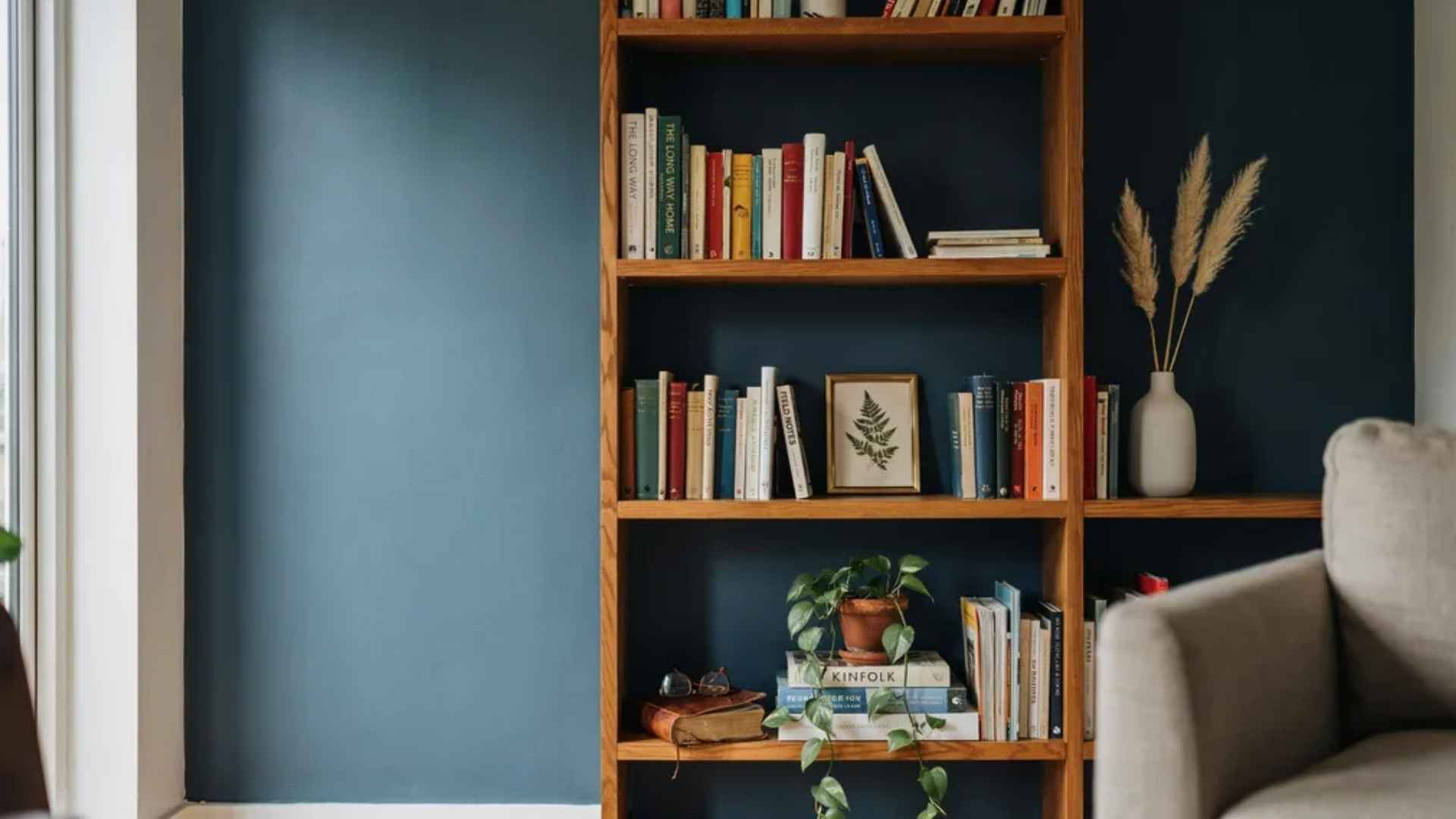
A coat of paint completely changes the feel of a bookshelf. Choose a deep navy, olive, or soft blush to create contrast against your books and decor.
Against a plain wall, this kind of shelf can blend into the background, but a painted panel gives it presence and makes every object in front of it pop. It is one of the highest-impact updates you can make without buying a single new piece.
Pro tip: Test paint on cardboard first, since shelf lighting shifts the shade a lot.
2. Go for a Color Gradient
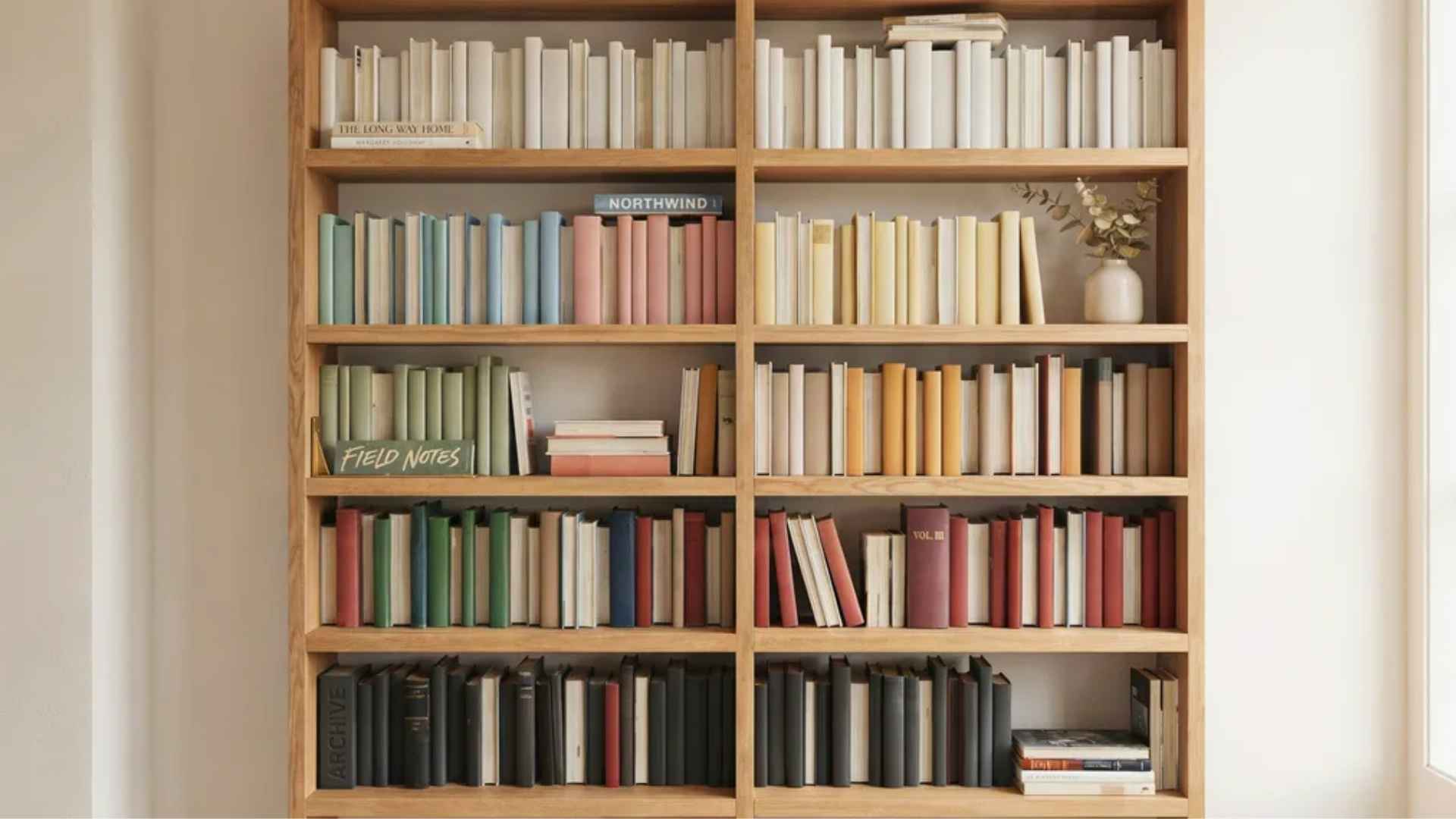
Arrange your books from light to dark for an ombre effect that reads as both tidy and artistic. Starting with white and cream spines, then moving through tans, greens, and blacks, gives your shelf a natural sense of order without any real sorting effort.
It works especially well on shelves with a large book collection, where a gradient does more visual work than any single decor piece could.
Pro tip: Flip a few odd-colored spines inward if they break the flow.
3. Mix Up Textures
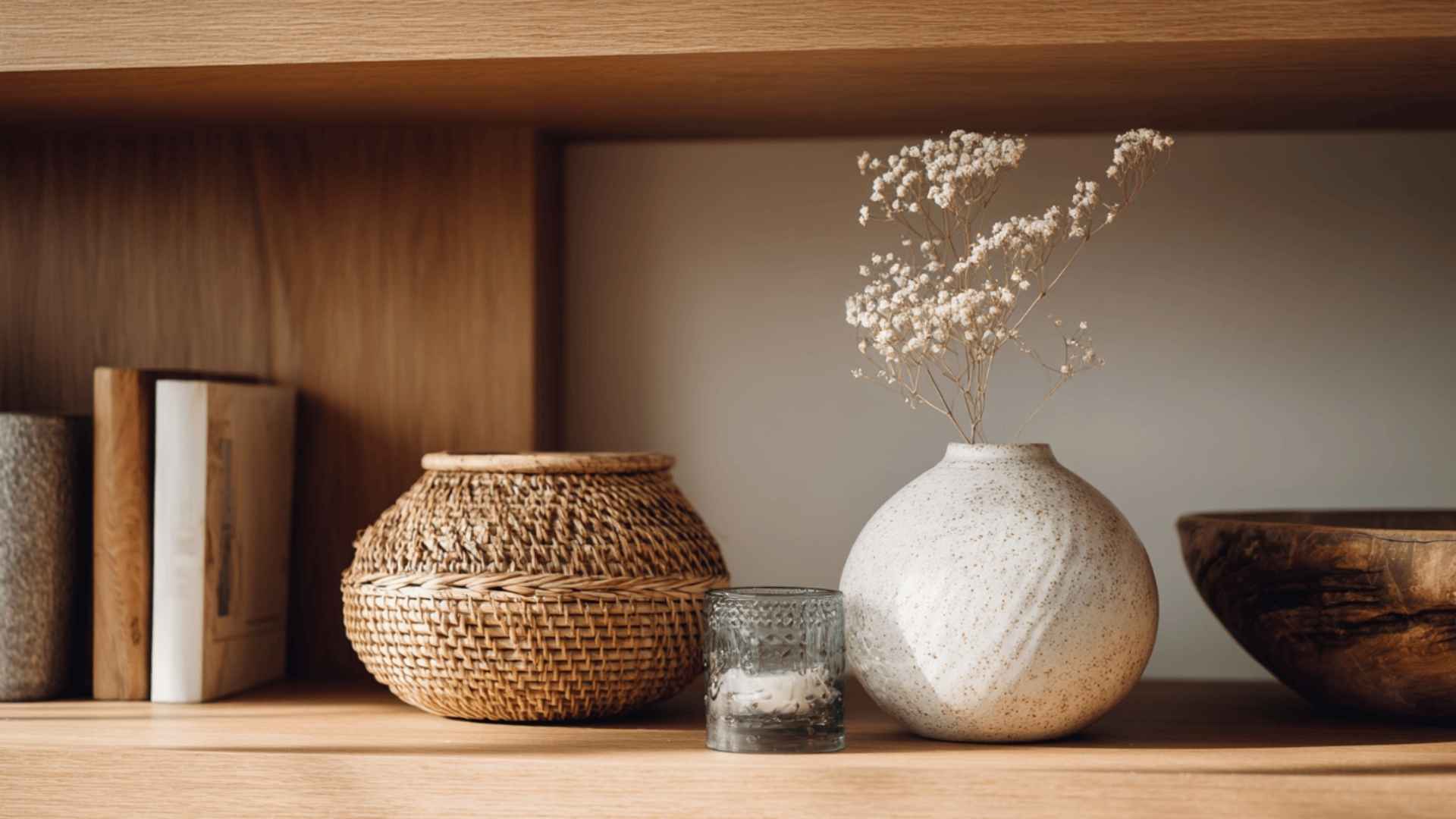
Texture is what keeps a bookshelf from feeling flat. Combine smooth ceramics with rough wood, or glass with woven baskets, so your eye has more to take in than rows of paper spines.
The contrast between materials adds warmth and depth, and it keeps a shelf full of books from looking one-note. Pull from what you already own before buying anything new, since most homes have more texture variety than they realize.
Pro tip: Pair one shiny object with one matte object per shelf.
4. Center an Art Moment
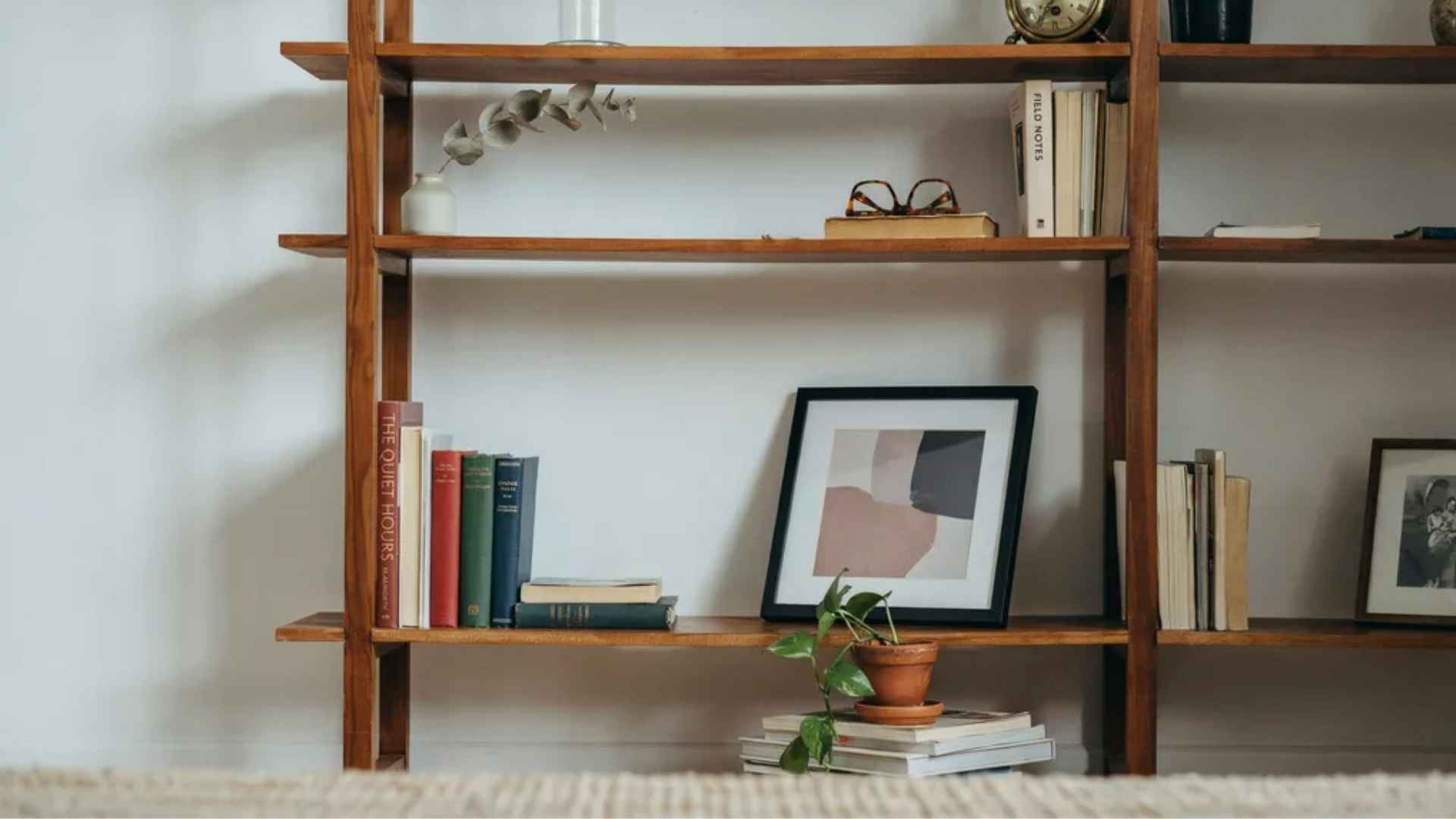
Pick one shelf and make it your focal point. Lean or hang a framed print, photo, or painting at eye level, then build the rest of your arrangement around it.
Everything else on that shelf, from books to small objects, should support the art rather than compete with it. This gives your whole unit a clear anchor point instead of leaving every shelf to fight for attention on its own.
Pro tip: Keep the art at eye level, not top shelf, for real impact.
5. Add a Book Nook

A tiny book nook adds charm in a way almost nothing else can. These small inserts, often built to look like miniature alleyways or shopfronts, slide between upright books and add a hidden detail people notice on a second look.
They work best tucked into a row of similarly sized books rather than sitting out in the open, where the surprise factor gets lost. It is a small piece with a lot of personality.
Pro tip: Save the nook for a shelf people browse slowly, not a quick-glance one.
6. Let Plants Trail Naturally
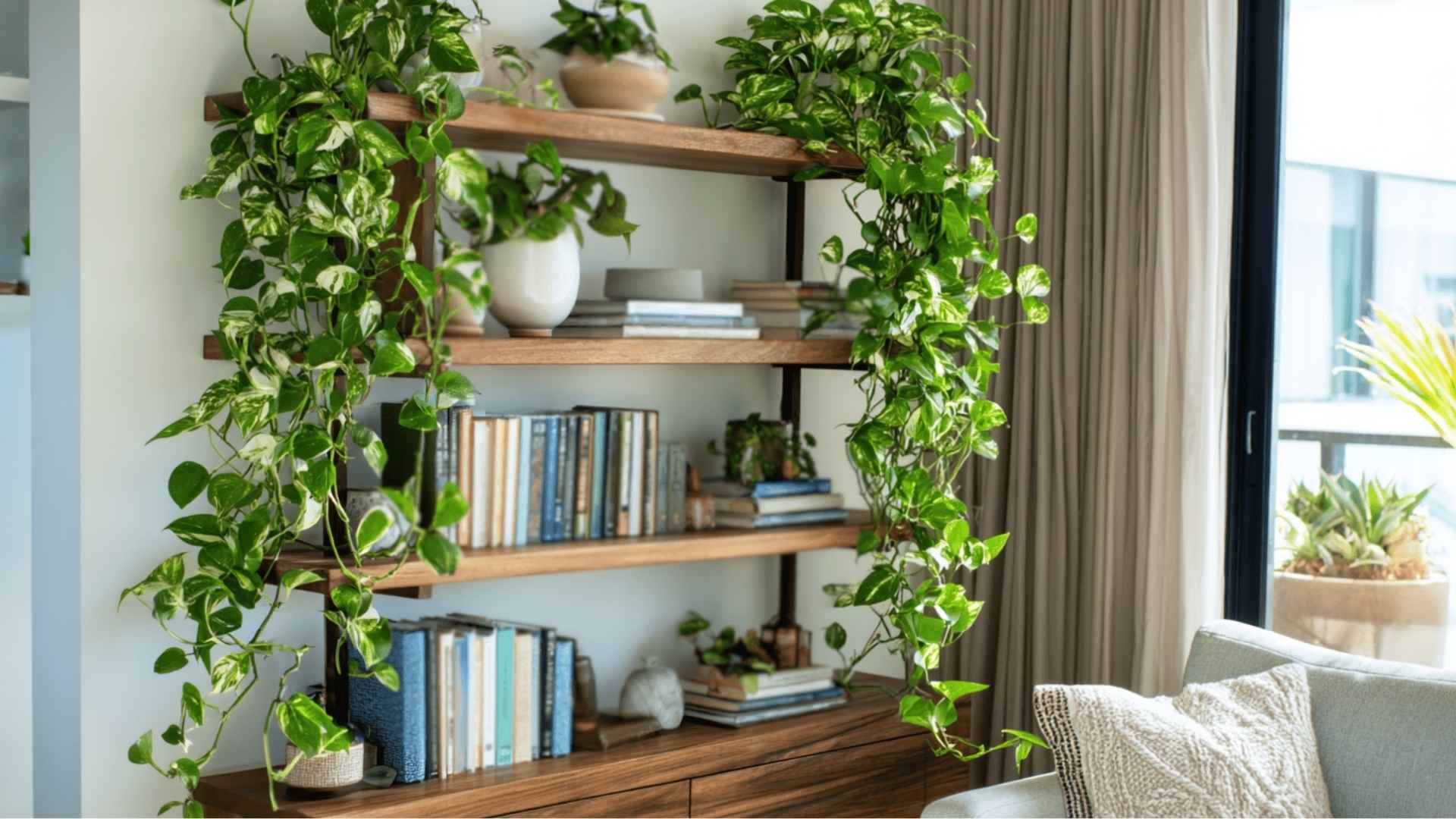
Add life and softness with greenery. Let a pothos or ivy trail down naturally over the edge of a shelf instead of forcing it into a pot with no room to grow.
The organic movement softens all the straight lines that books and frames create, and it brings a relaxed, lived-in feel to a display that might otherwise look too composed. A single trailing plant can do more than several small decor pieces combined.
Pro tip: Pick a low-light plant if the shelf sits away from windows.
7. Stack and Style
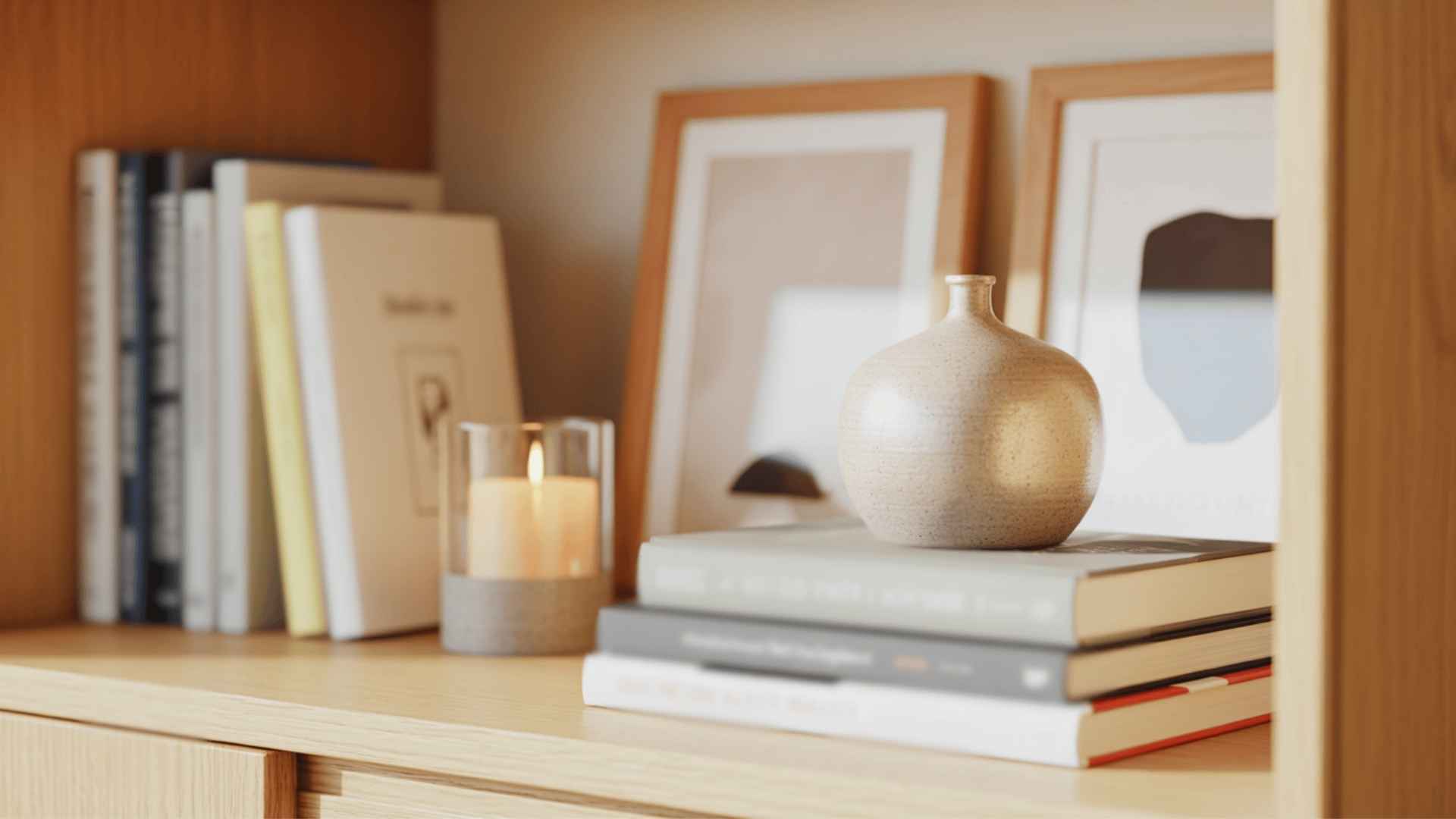
Stack a few books horizontally and top them with a candle, vase, or small sculpture. This adds height and variation without needing any extra furniture or shelving.
A stack works as a riser, lifting a smaller object so it doesn’t get lost next to taller items nearby. It is one of the fastest ways to add dimension to a shelf that currently looks flat and one-level.
Pro tip: Use three books, not two, for a sturdier and better-proportioned stack.
8. Use Baskets for Hidden Storage
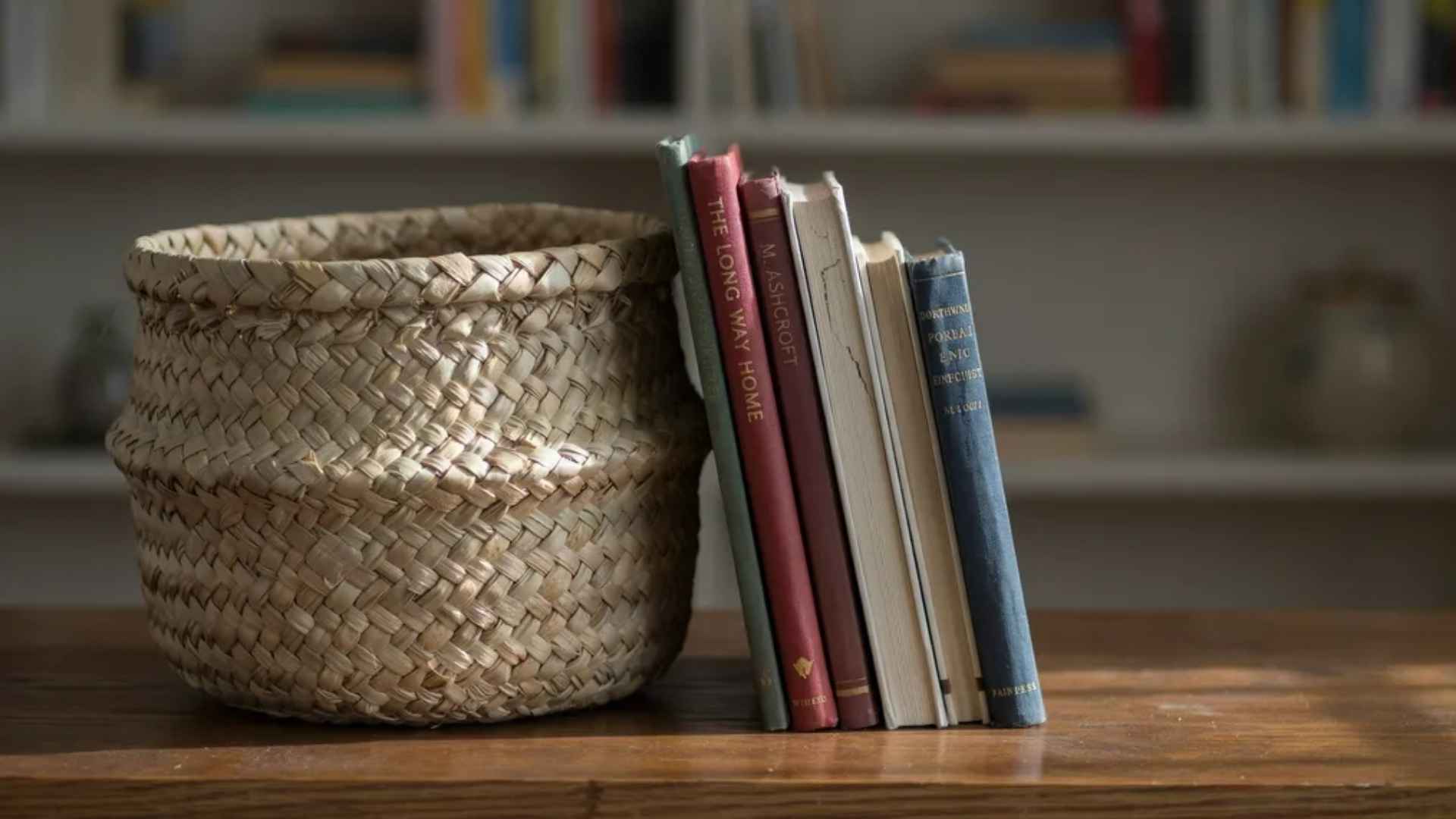
Tuck baskets onto your shelves to hide clutter without losing style. They add texture and structure while keeping loose items, like papers, chargers, or remote controls, out of sight.
A basket placed above eye level can hide storage entirely, while one at eye level works better with something decorative peeking out. Either way, it keeps a shelf functional without letting daily clutter take over the display.
Pro tip: Use see-through or open-weave baskets so they read as light, not bulky.
9. Lean Frames Casually
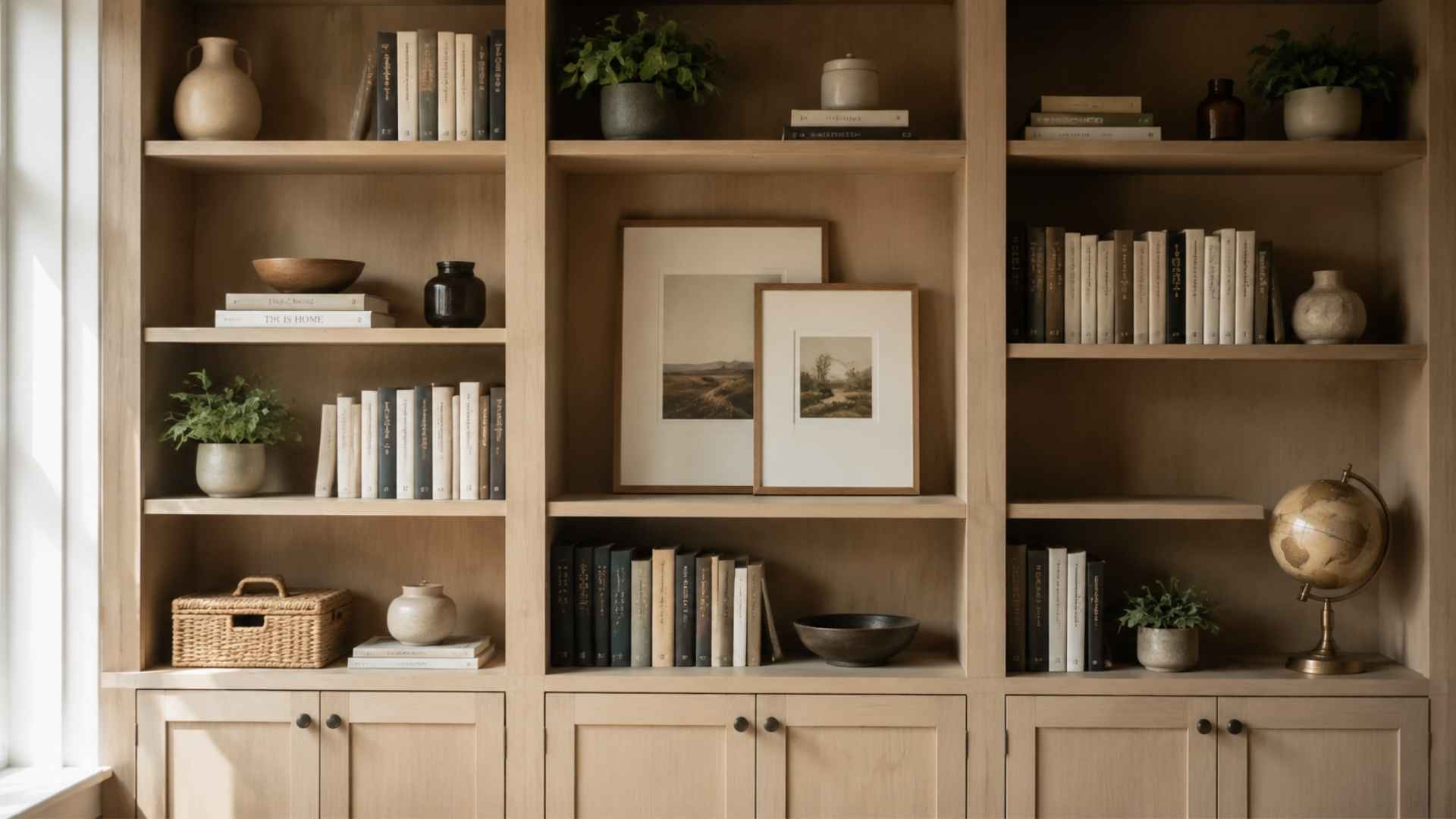
Leaning art and photos instead of hanging them creates a relaxed feel that suits most bookshelves better than a perfectly straight row.
Prop a few frames of different sizes against the back panel, slightly overlapping, so the arrangement looks gathered rather than lined up. This technique also makes it easy to swap photos in and out without new nail holes, which is useful if you rotate decor often.
Pro tip: Overlap two frames slightly for a collected, not staged, look.
10. Go Sculptural
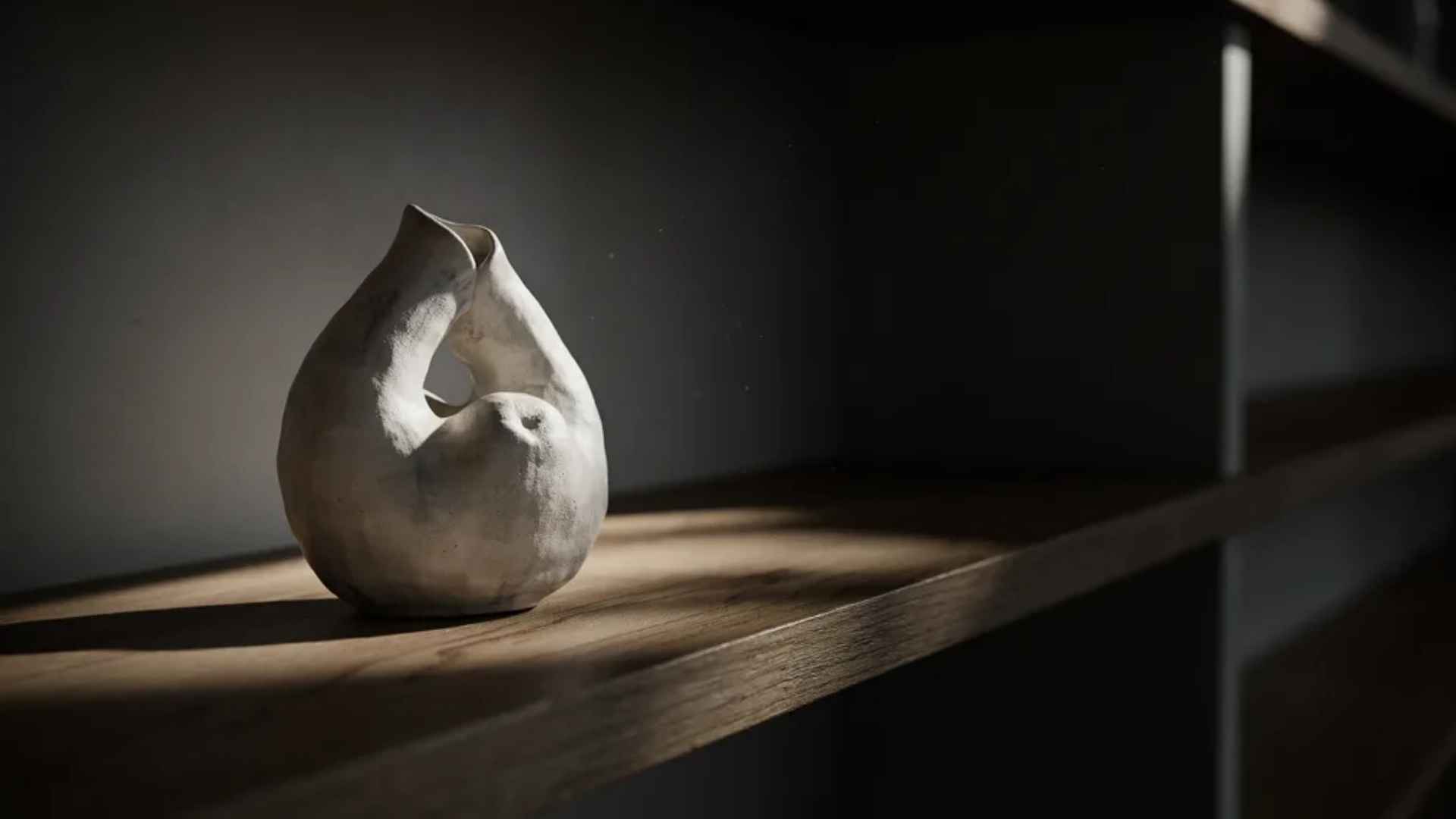
Add a statement object to anchor your shelf, whether that is a geometric vase, a ceramic figure, or an abstract sculpture. These pieces fill open space with visual interest in a way that books alone cannot, and they give a shelf a bolder, more designed look.
One well-chosen sculptural piece per section is usually enough. Adding more than one to the same shelf often competes for attention instead of adding to it.
Pro tip: Give the sculpture its own small patch of empty space around it.
11. Add Subtle Lighting
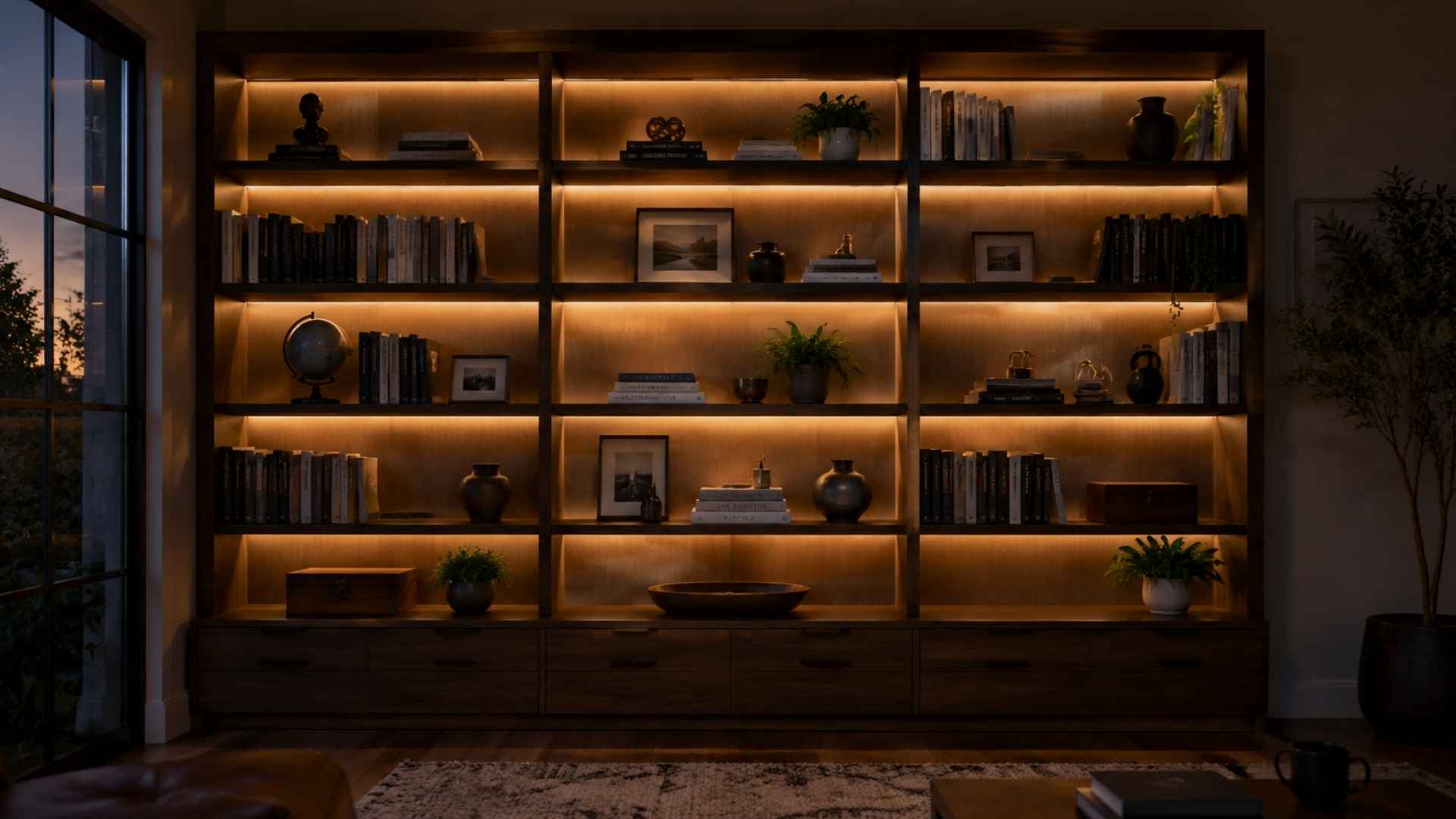
Lighting changes the mood of a shelf more than almost any object placed on it. A small lamp or a warm LED strip tucked along the underside of a shelf highlights favorite pieces and gives the whole unit a cozy glow after dark.
It also draws attention to sections that might otherwise get overlooked in a dim room, turning your bookshelf into a soft focal point rather than a shadowy corner.
Pro tip: Choose warm white bulbs, not cool white, for a homier glow.
12. Tell a Story With Themes
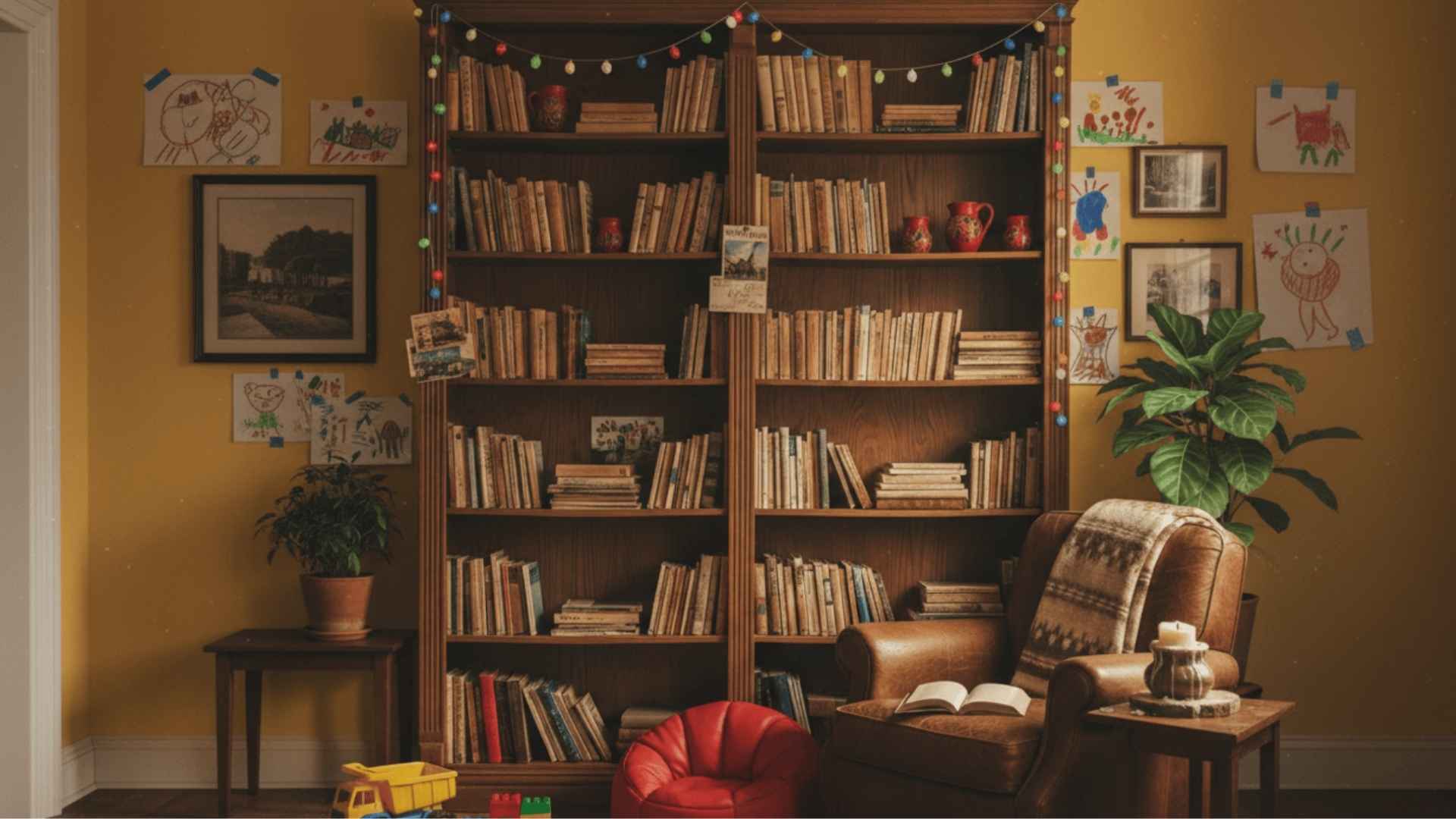
Give your shelves meaning by grouping items that share a story, whether that is travel mementos, art objects, or pieces passed down in your family.
A themed grouping makes a shelf feel personal rather than purchased, and it gives visitors something to ask about. This works especially well on a shelf that otherwise feels generic, since a clear theme gives every object on it a reason for being there.
Pro tip: Limit each theme group to four or five pieces max.
13. Rotate Seasonally
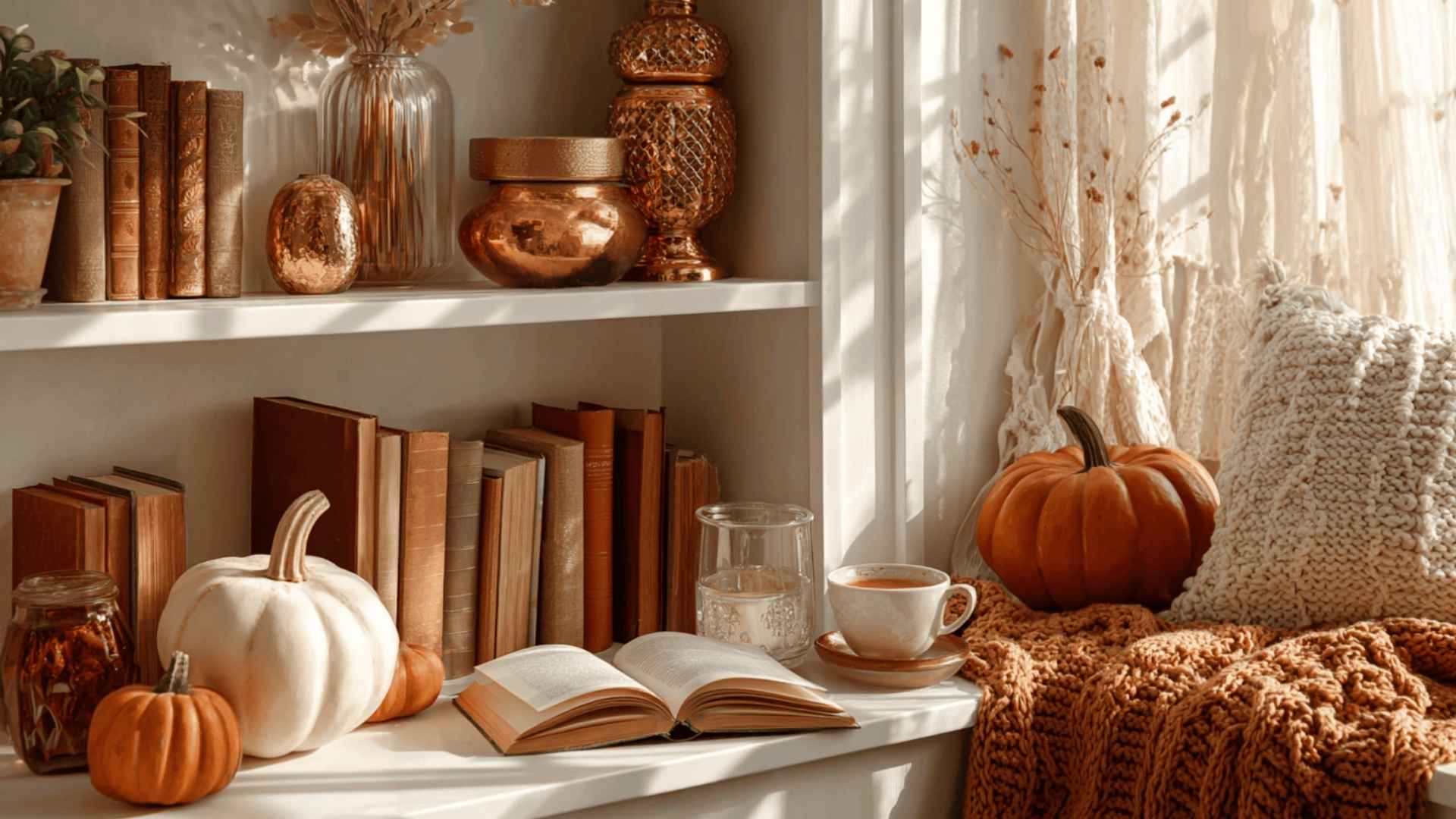
Change things up every few months to keep your shelves feeling fresh. Add earthy tones and a candle in the fall, then switch to bright ceramics and a small vase of stems in spring.
Seasonal rotation is an easy way to keep a display relevant without a full redesign, and it gives you a built-in reason to revisit and edit the shelf a few times a year instead of leaving it untouched.
Pro tip: Store off-season pieces in one labeled bin for easy swaps.
14. Curate a Mini Collection
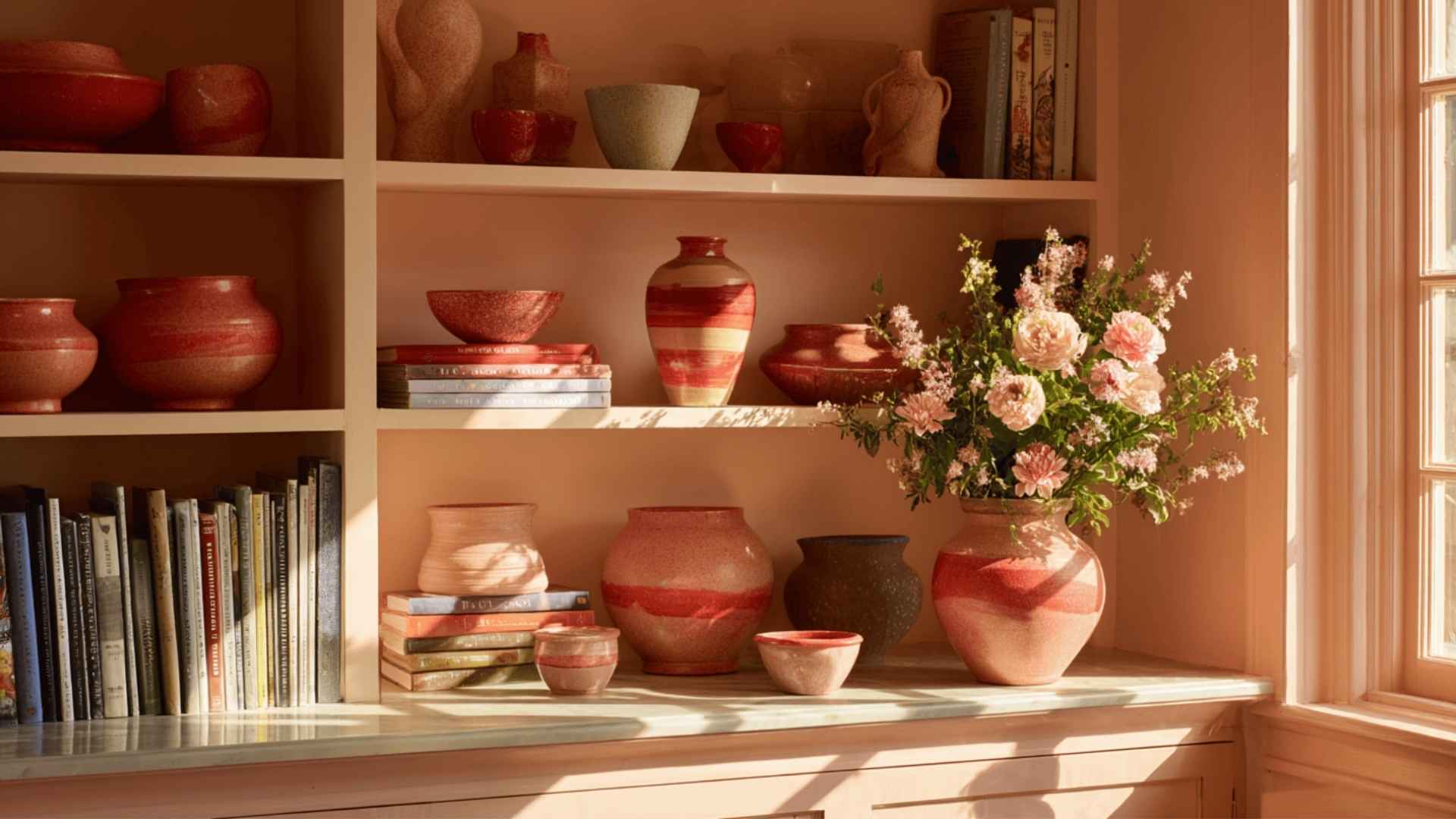
Group together a few similar items, like small pottery pieces, vintage cameras, or candles, so they read as a collection rather than scattered objects. Collections feel purposeful when they are displayed close together instead of spread across separate shelves.
This approach also shows off your interests in a natural way, since a grouped collection tells a clearer story than the same items placed randomly around the unit.
Pro tip: Keep the collection to one shelf so it reads as intentional.
15. Try All-White or All-Black
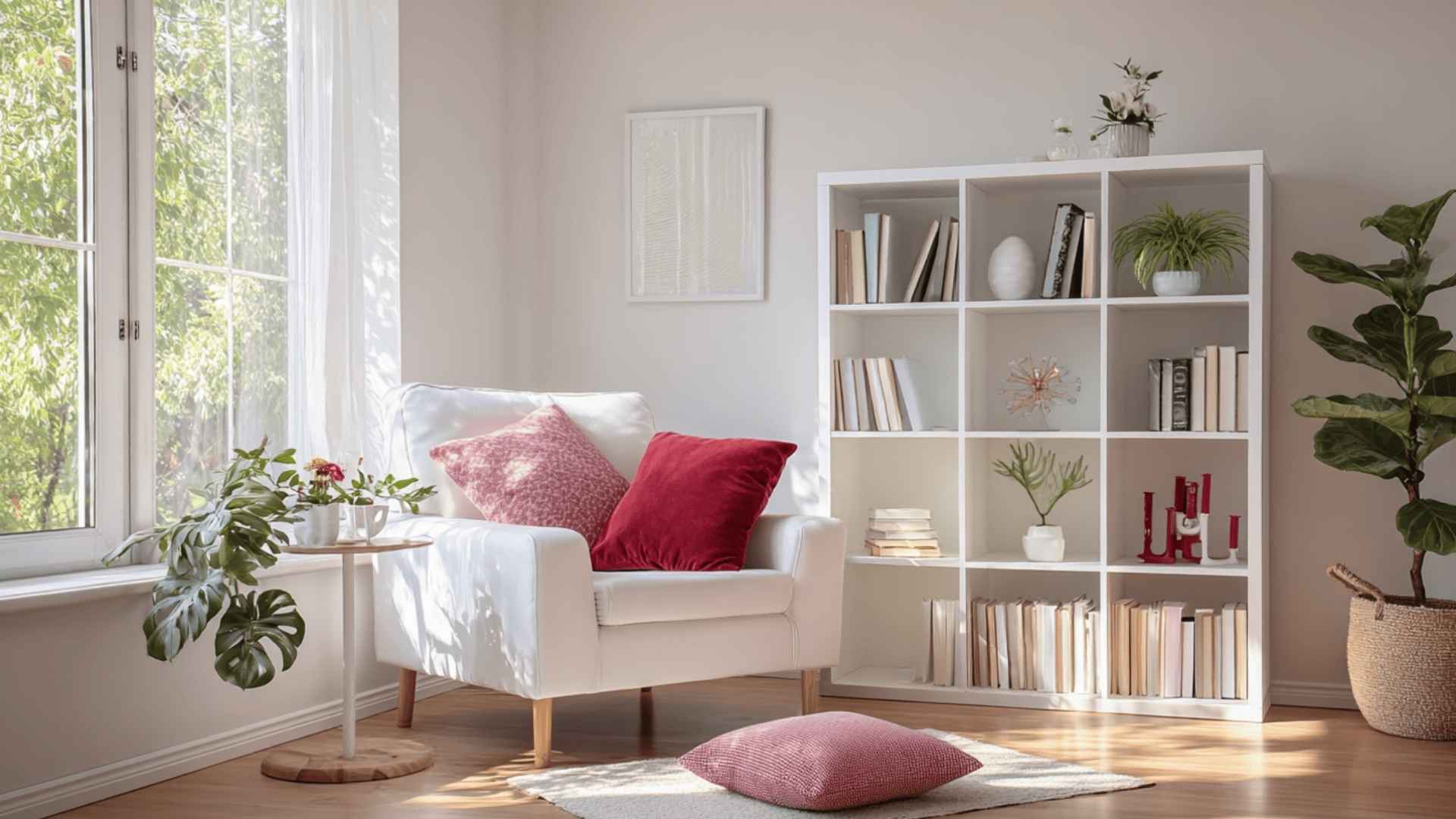
Go monochrome for a bigger visual impact. Styling everything in white keeps a shelf feeling light and polished, while an all-black palette adds more drama and contrast against a lighter wall.
A single unified color palette brings instant cohesion, even if the objects themselves are a mismatched mix of styles and origins. It is one of the simplest ways to make an eclectic collection look pulled together.
Pro tip: Add one neutral wood object so an all-white shelf does not feel cold.
16. Upgrade Your Bookends
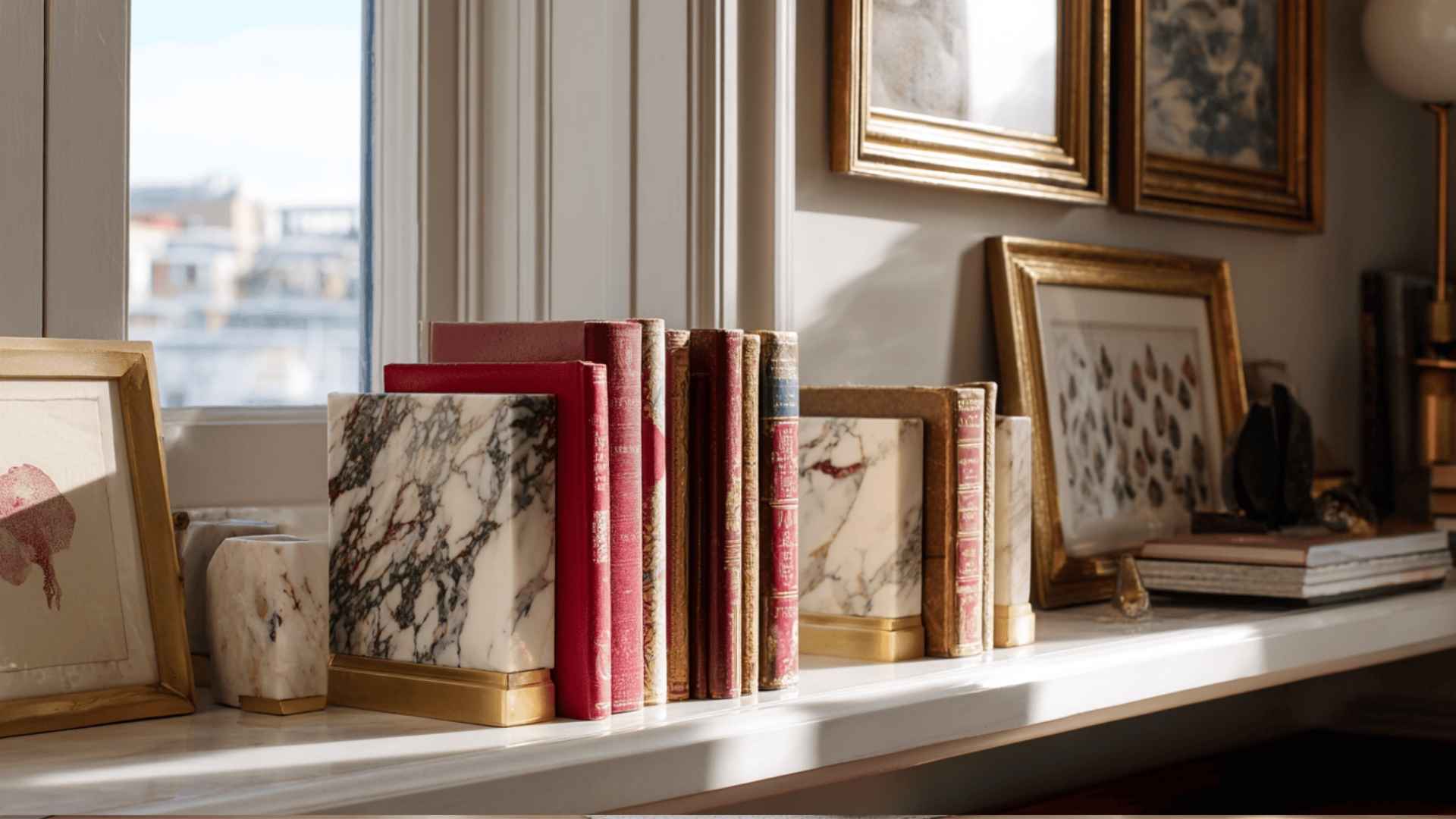
Swap plain bookends for ones in marble, brass, or a sculptural shape. They hold your books in place while doubling as decor, which is useful on shelves where books tend to lean or slide over time.
A good pair of bookends can also anchor a section visually, giving a row of books a clear start and finish instead of an open-ended row that trails off.
Pro tip: Match bookend material to one other metal already on the shelf.
17. Face Books Forward
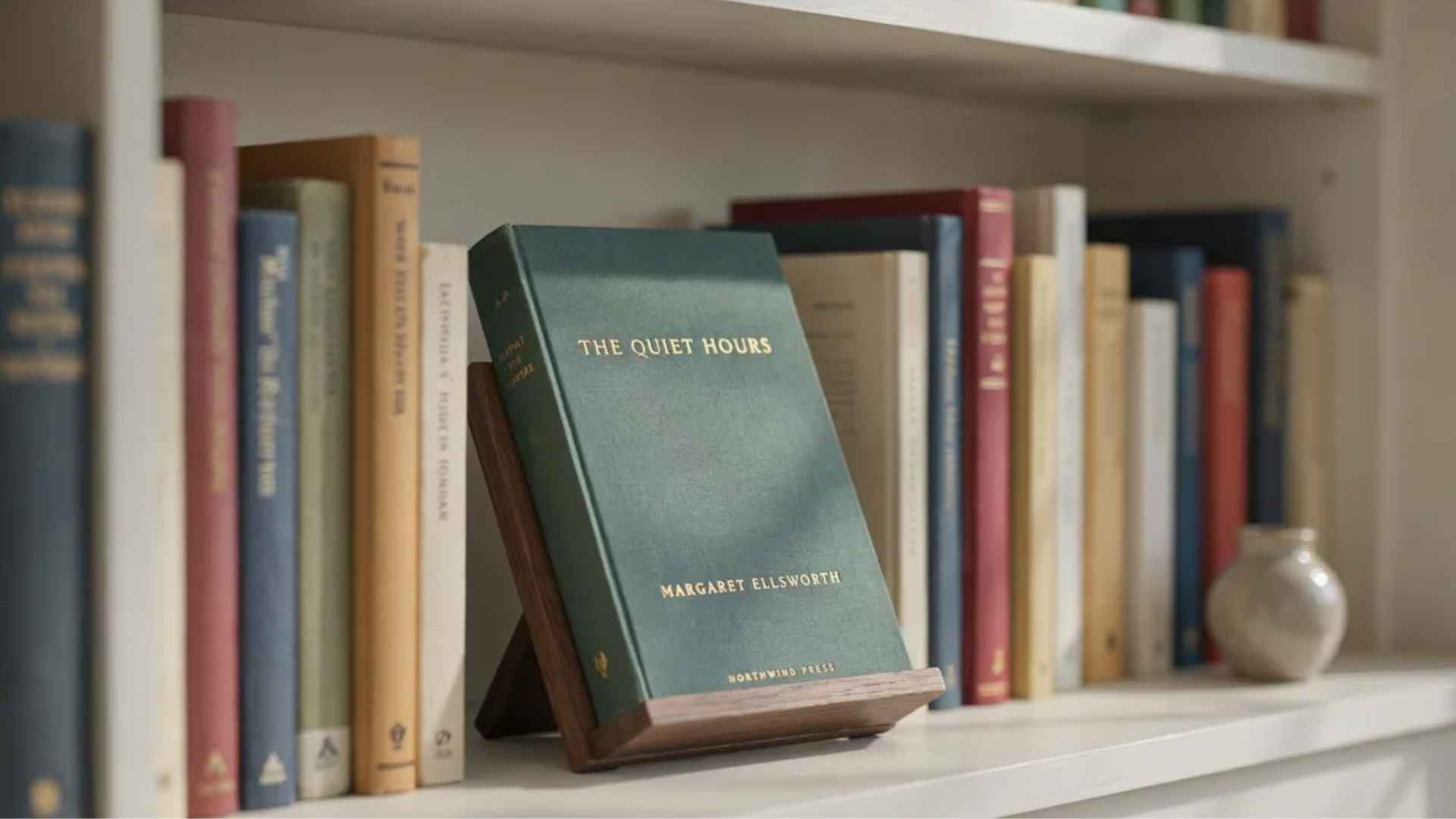
Turn your prettiest book covers outward to display them like art instead of hiding the spine. This trick highlights your favorite reads and adds a real hit of color and graphic interest to a shelf, especially with covers that have strong illustration or type design.
It works best used sparingly, with just one or two cover-forward books per shelf rather than turning the entire row around.
Pro tip: Prop the book on a small stand so the cover stays visible.
18. Group With Trays
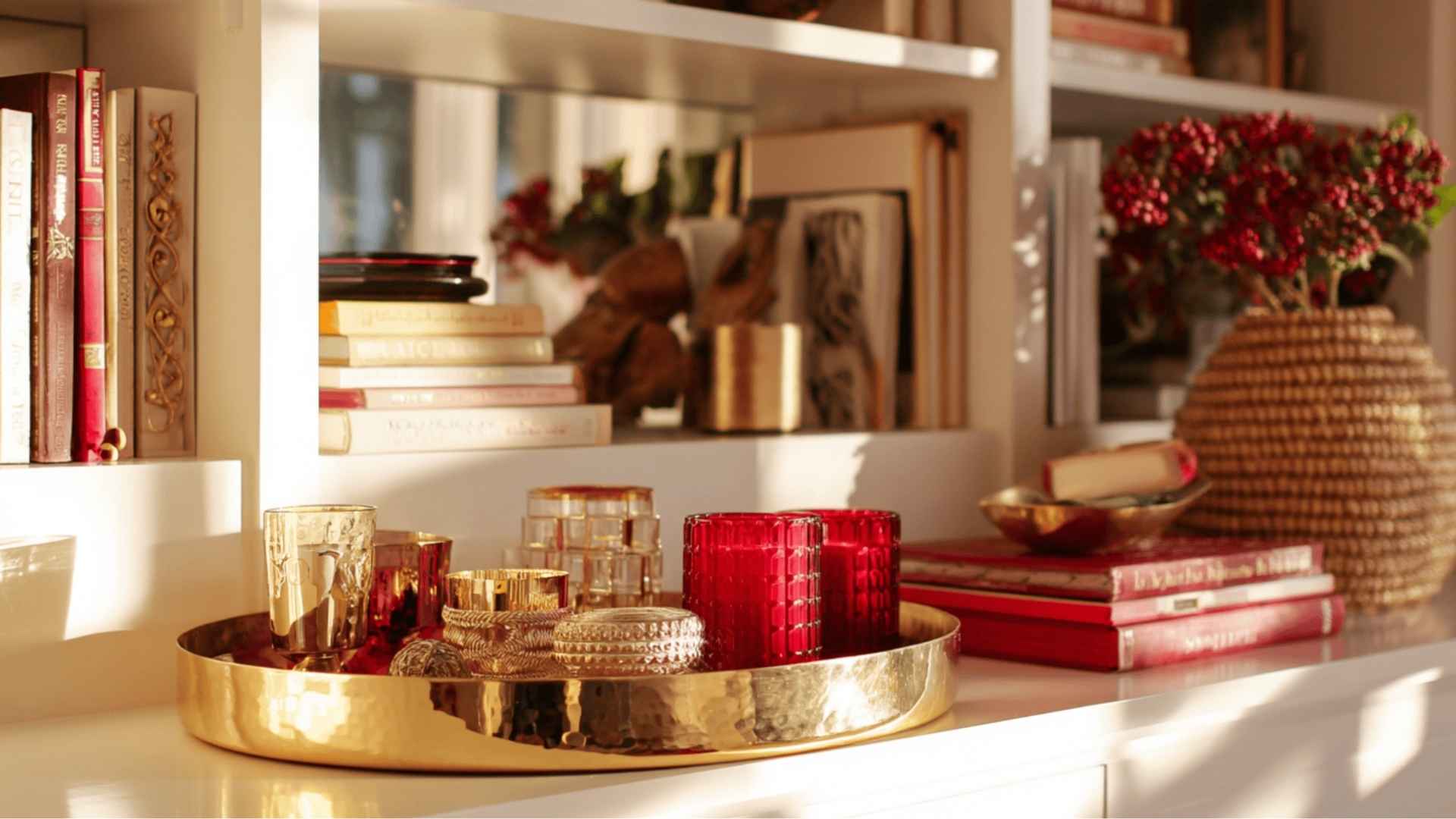
Gather smaller items onto a tray to create instant order. Trays keep candles, trinkets, or small decor grouped together instead of scattered loosely across the shelf, which makes even a busy mix of objects look deliberate.
This is especially useful for tiny pieces that would otherwise get lost or look like clutter on their own. A tray turns five small things into one clean, contained moment.
Pro tip: Choose a tray with a slight rim so nothing slides off easily.
19. Sprinkle in Metallic Accents
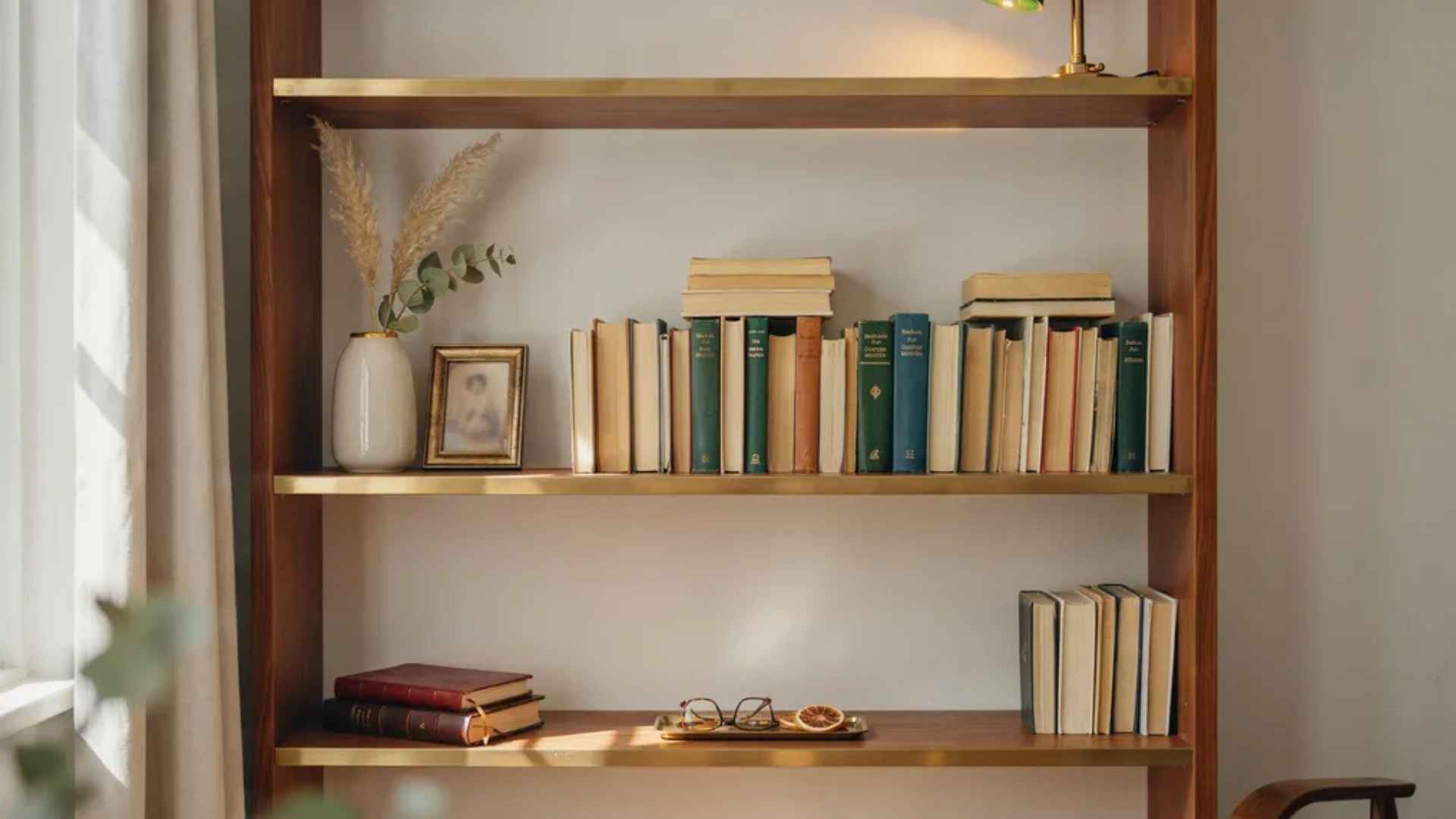
A touch of gold, brass, or copper adds warmth and a bit of shine to a shelf full of matte books and fabric-bound covers. Try a small metallic vase or a picture frame in the same finish for subtle contrast without overwhelming the display.
Metallics catch the light in a way that flat, painted objects do not, which gives even a simple arrangement a bit more polish.
Pro tip: Stick to one metal finish per shelf so accents feel intentional.
20. Layer Art Behind Books
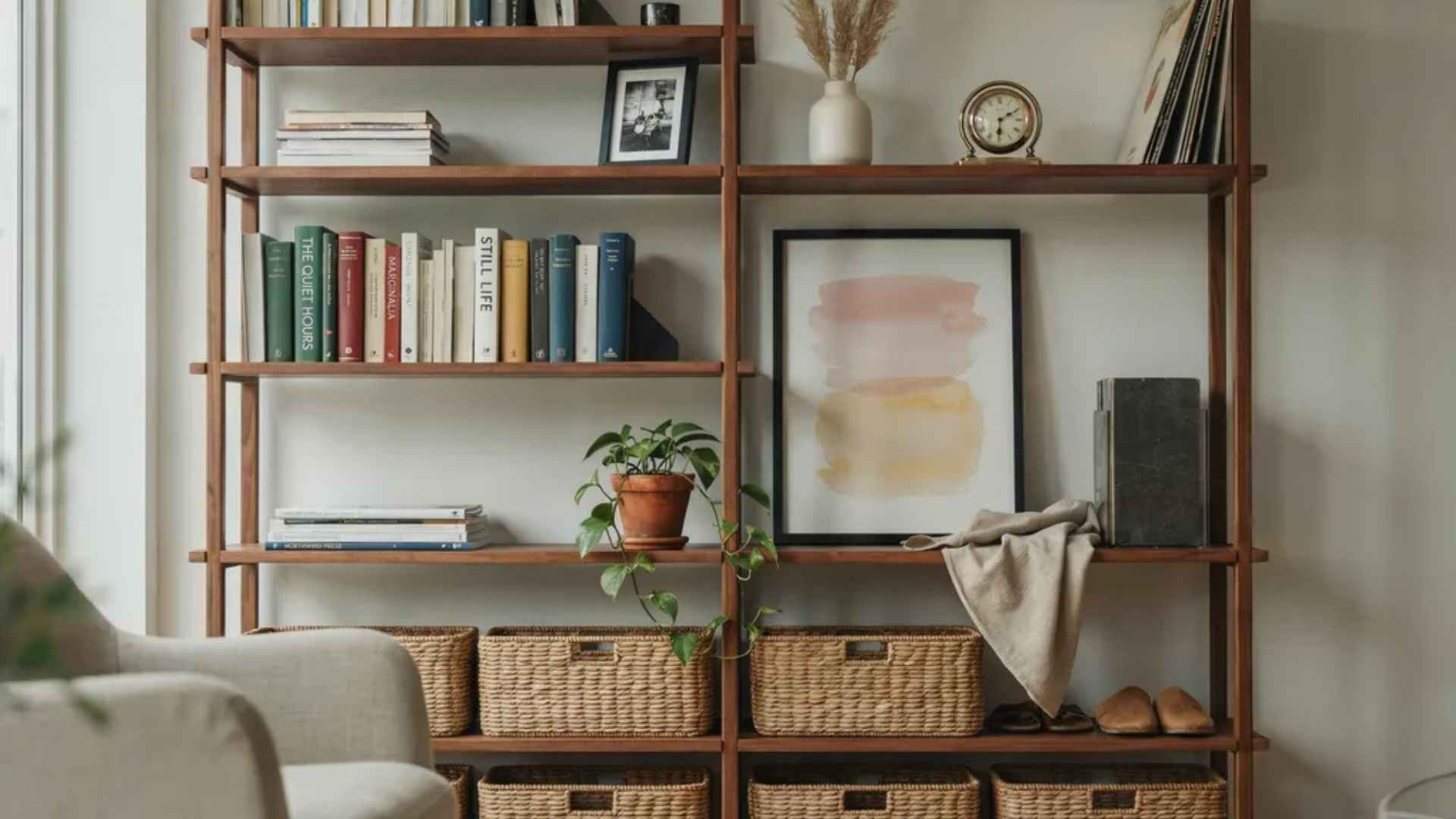
Place a framed print or photo behind a row of books to add depth instead of hanging it separately. This overlapping look makes a shelf feel more three-dimensional, since the art peeks out from behind the books rather than sitting flat against the back panel.
It is a small trick that designers use often, and it works especially well on shelves that feel too shallow or one-note otherwise.
Pro tip: Choose art slightly taller than the books in front of it.
21. Add a Mirror Moment
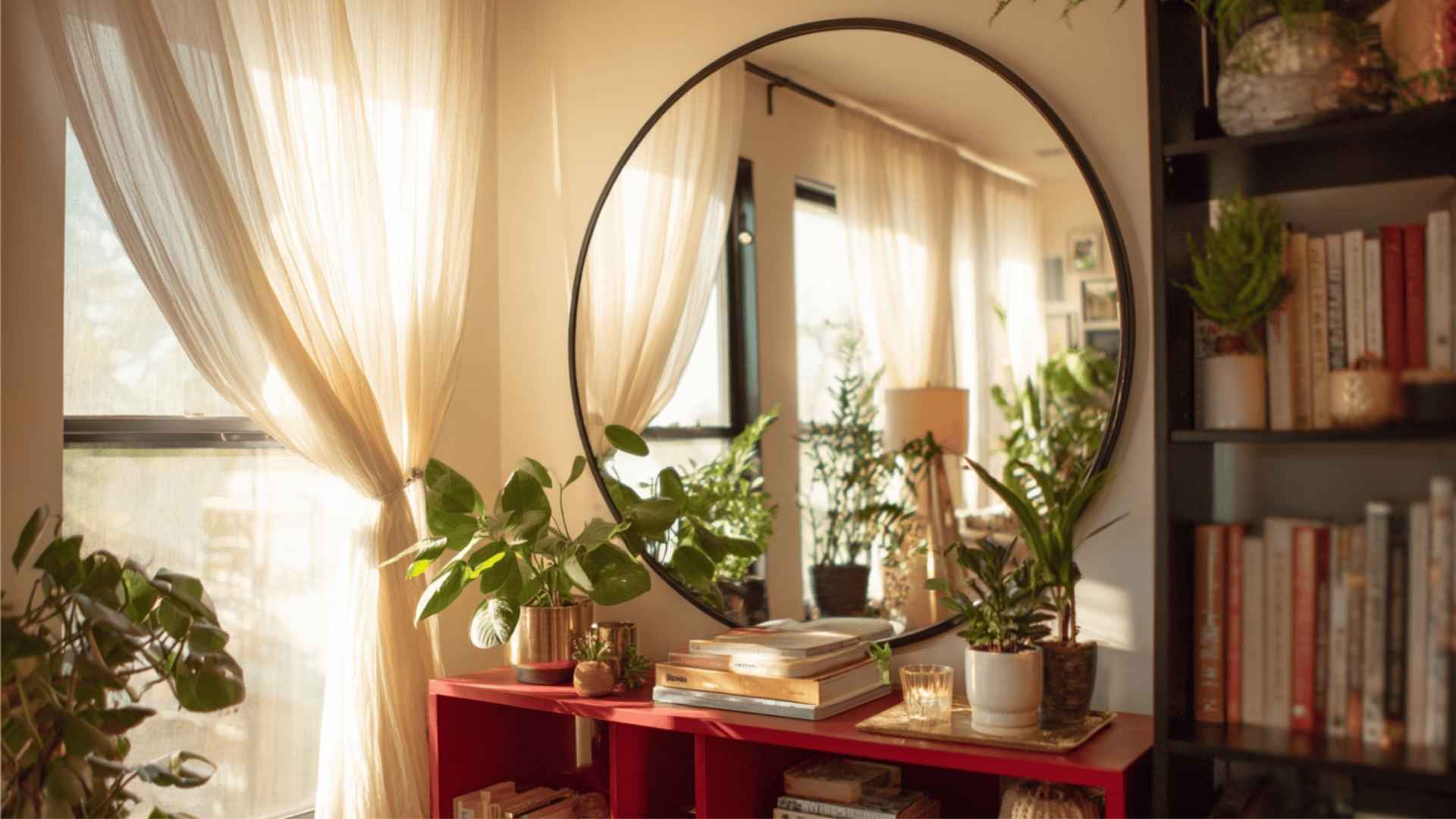
Mirrors reflect light and make a room feel larger, and a small one placed behind books or decor can brighten an entire shelf. It works well on a unit tucked into a darker corner, where natural light does not reach easily.
A mirror also adds a bit of sparkle without requiring a full redesign, and it pairs especially well with metallic accents already on the same shelf.
Pro tip: Angle the mirror slightly to catch window light, not a blank wall.
22. Play With Height
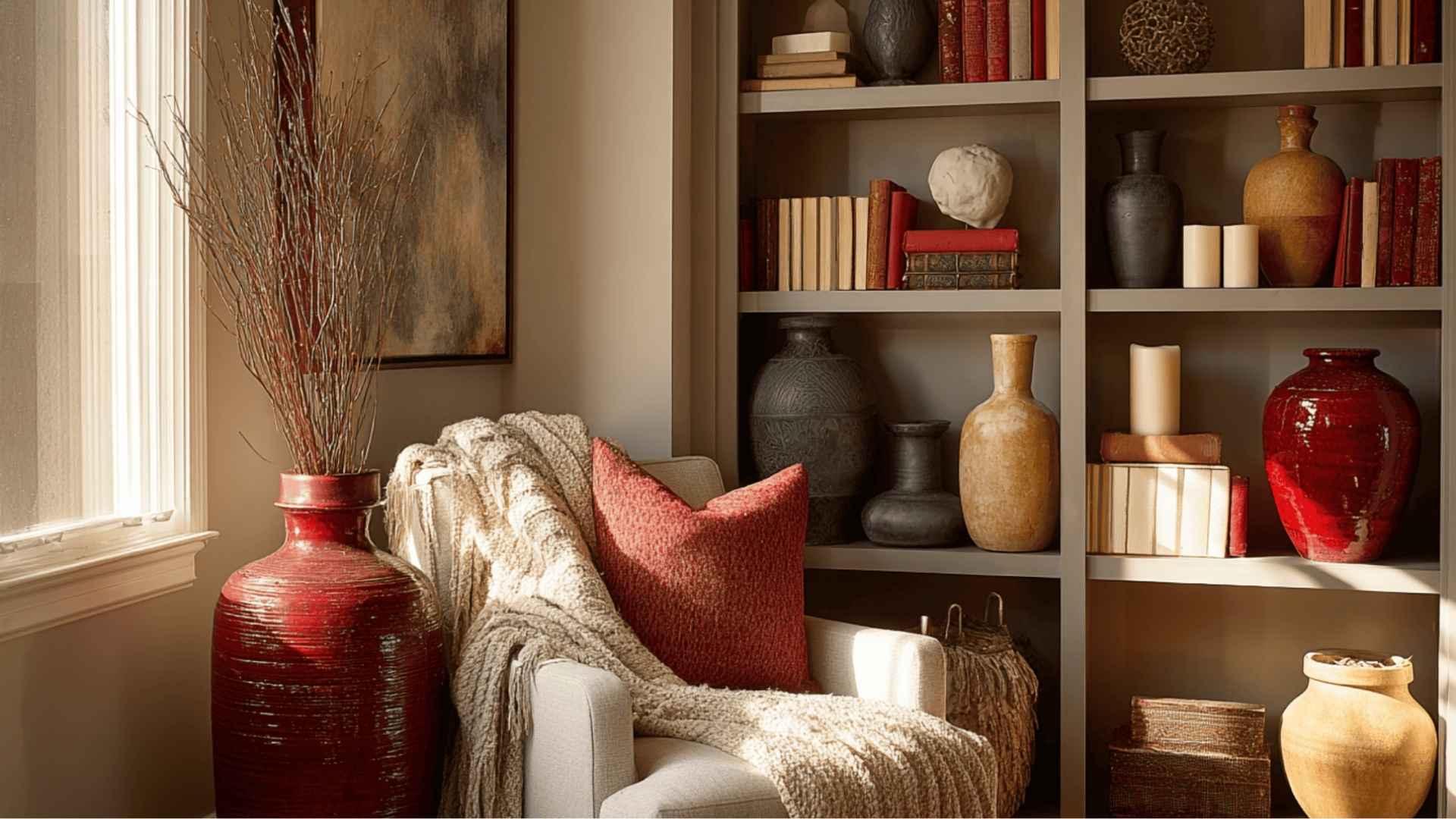
Vary object heights across a shelf for better flow. Combine tall vases, medium candles, and small accents so the eye moves naturally instead of stopping on one flat row of same-sized items.
This keeps a shelf feeling lively rather than stiff, and it is one of the fastest fixes for a display that currently looks too uniform or predictable from one end to the other. It’s also worth anchoring taller pieces to the wall if small children are nearby, since top-heavy shelving is one of the more overlooked hazards in a living room.
Pro tip: Use odd numbers of heights per shelf, not even pairs.
23. Include Personal Touches
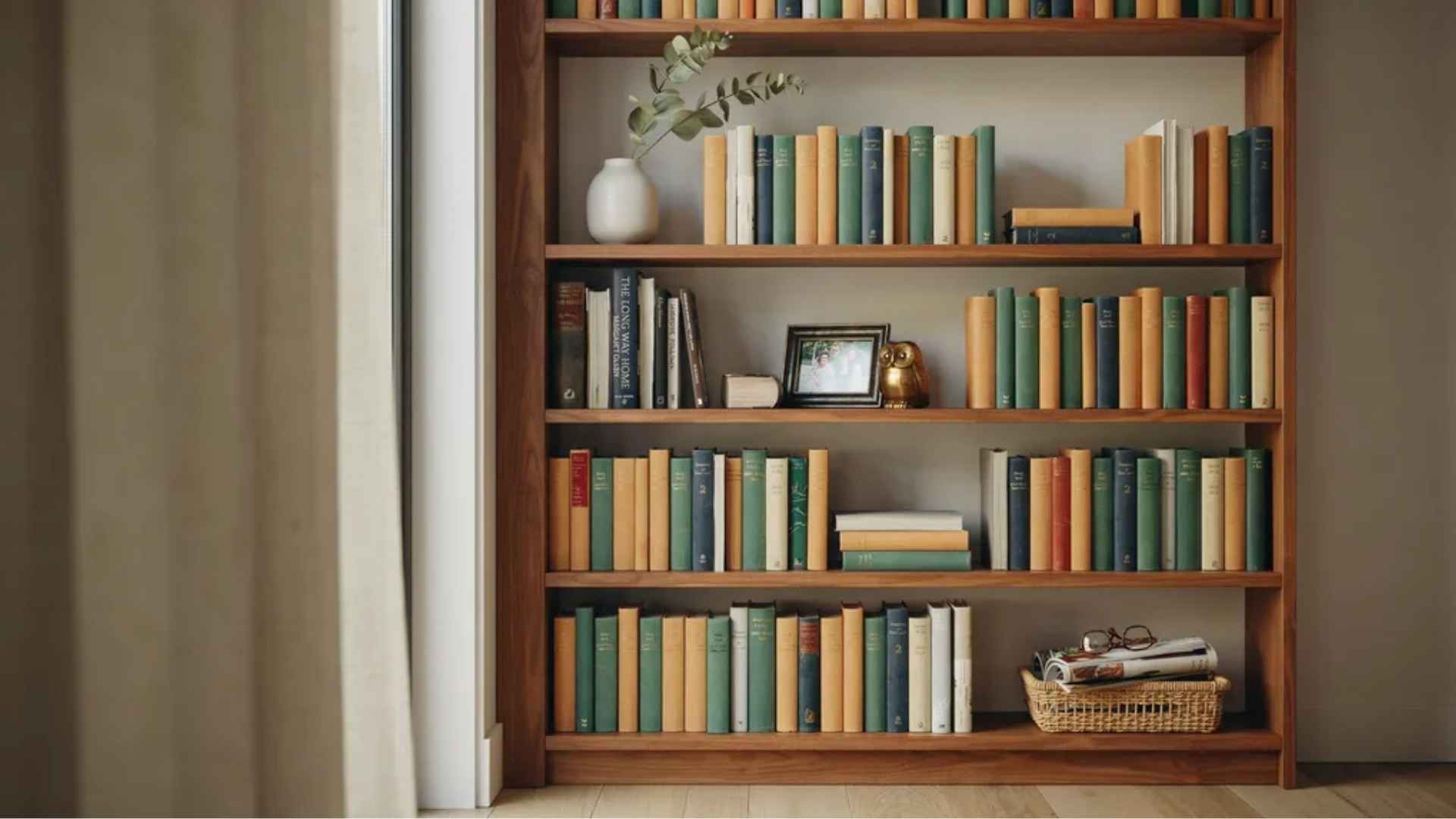
Style isn’t just about objects; it’s about you. Add framed photos, keepsakes, or travel finds that mean something rather than filling every shelf with store-bought decor alone.
These personal touches make a shelf feel warm and specific to your life instead of a generic showroom display. One or two meaningful pieces per unit is usually enough to give the whole arrangement real character.
Pro tip: Choose one meaningful object per shelf, not one per surface.
24. Create a Centerpiece
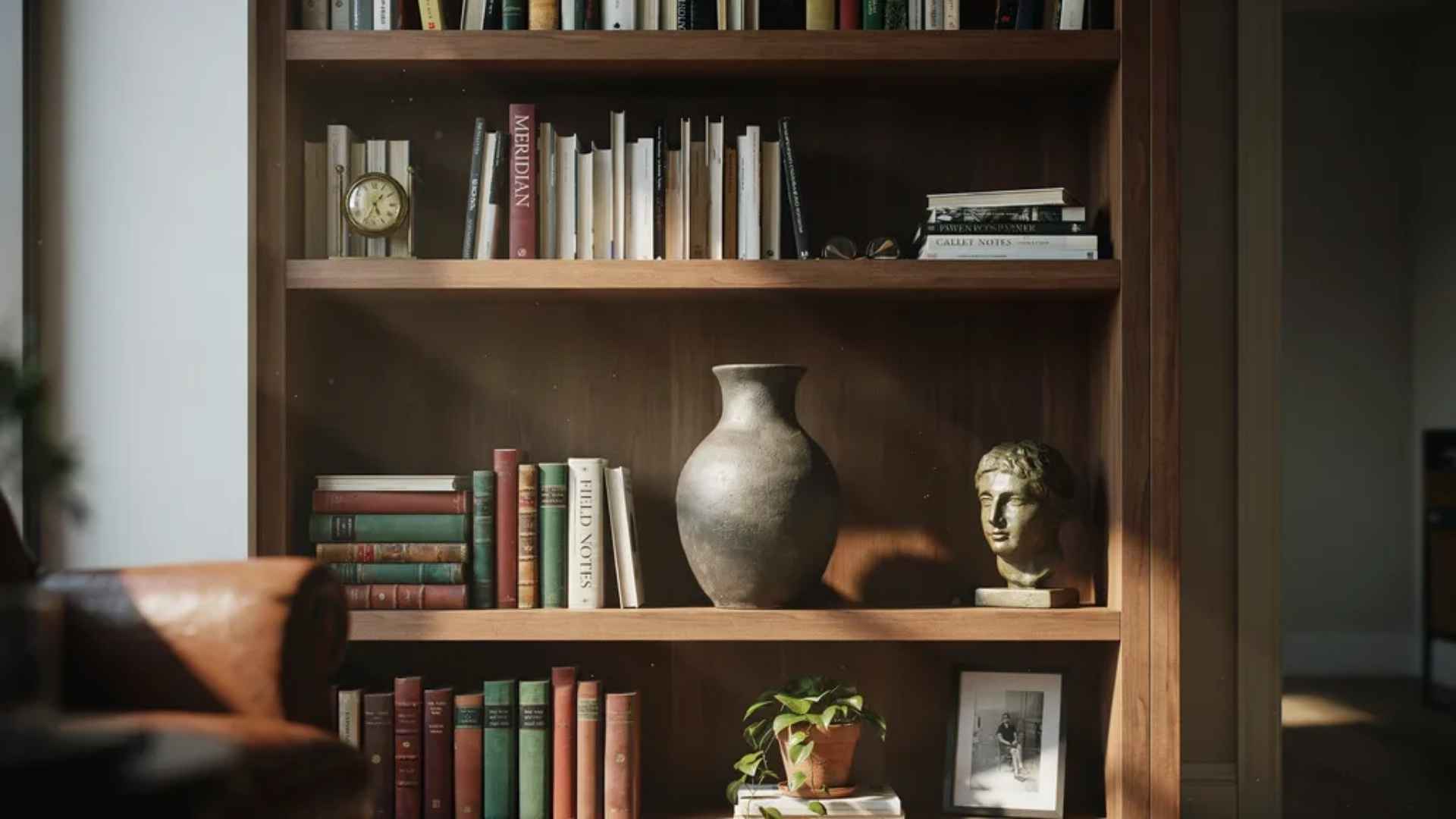
Choose one showstopper item to anchor your whole design, whether that is a large vase, a bold sculpture, or a piece of framed artwork.
This centerpiece should draw the eye first, with every other object on the shelf supporting it rather than competing with it. Building your styling around one strong focal point keeps the whole arrangement feeling grounded, even across multiple shelves.
Pro tip: Place the centerpiece at eye level, not on the top shelf.
25. Style by Color Blocks
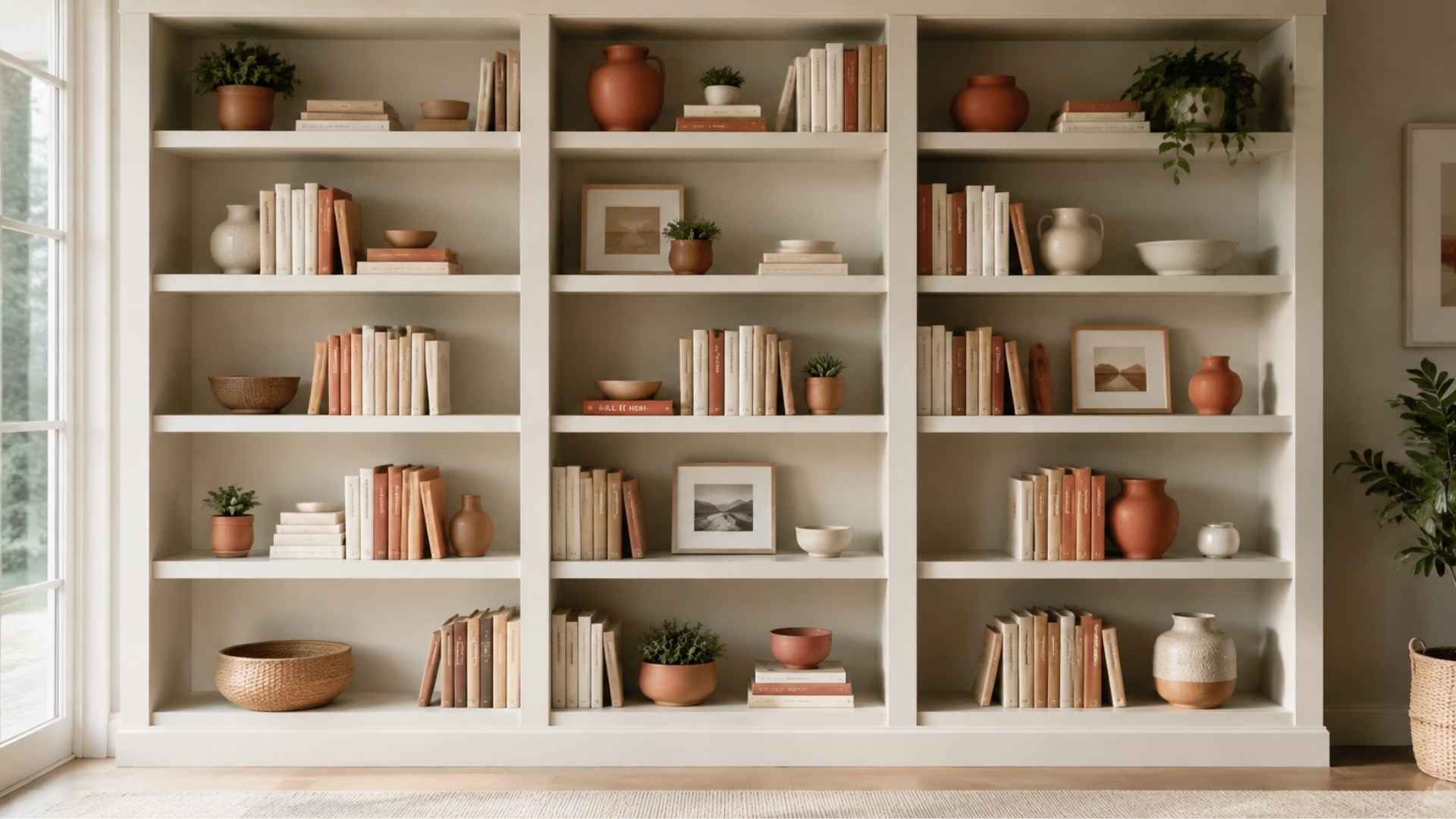
Group books and decor by color to create natural balance across a shelf. It keeps things looking tidy and cohesive, even when the objects themselves come from completely different sources.
This trick makes any mismatched collection feel purposeful, since a shared color palette does the visual organizing for you. It works especially well on shelves with a lot of everyday, non-matching items.
Pro tip: Pick two colors per shelf, not one for the whole unit.
26. Use Negative Space
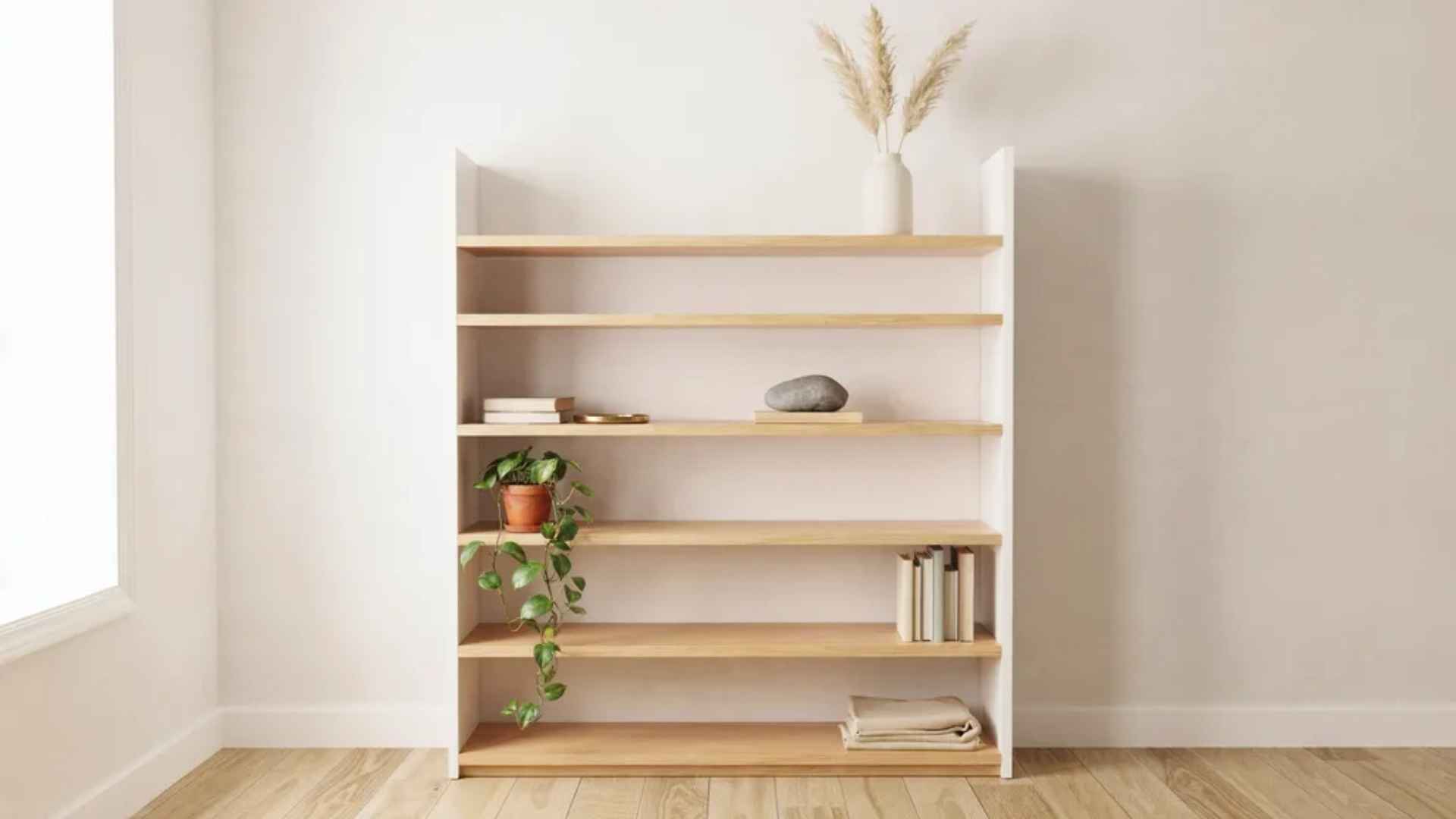
Don’t fill every inch of your shelf. Empty areas give your eyes a place to rest between objects, instead of forcing them to process a wall of clutter all at once.
Space creates balance and helps highlight the pieces you actually want people to notice. A shelf with some breathing room reads as more refined than one packed edge to edge, no matter how nice each item is.
Pro tip: Leave about a third of each shelf visibly open.
27. Mix Horizontal and Vertical
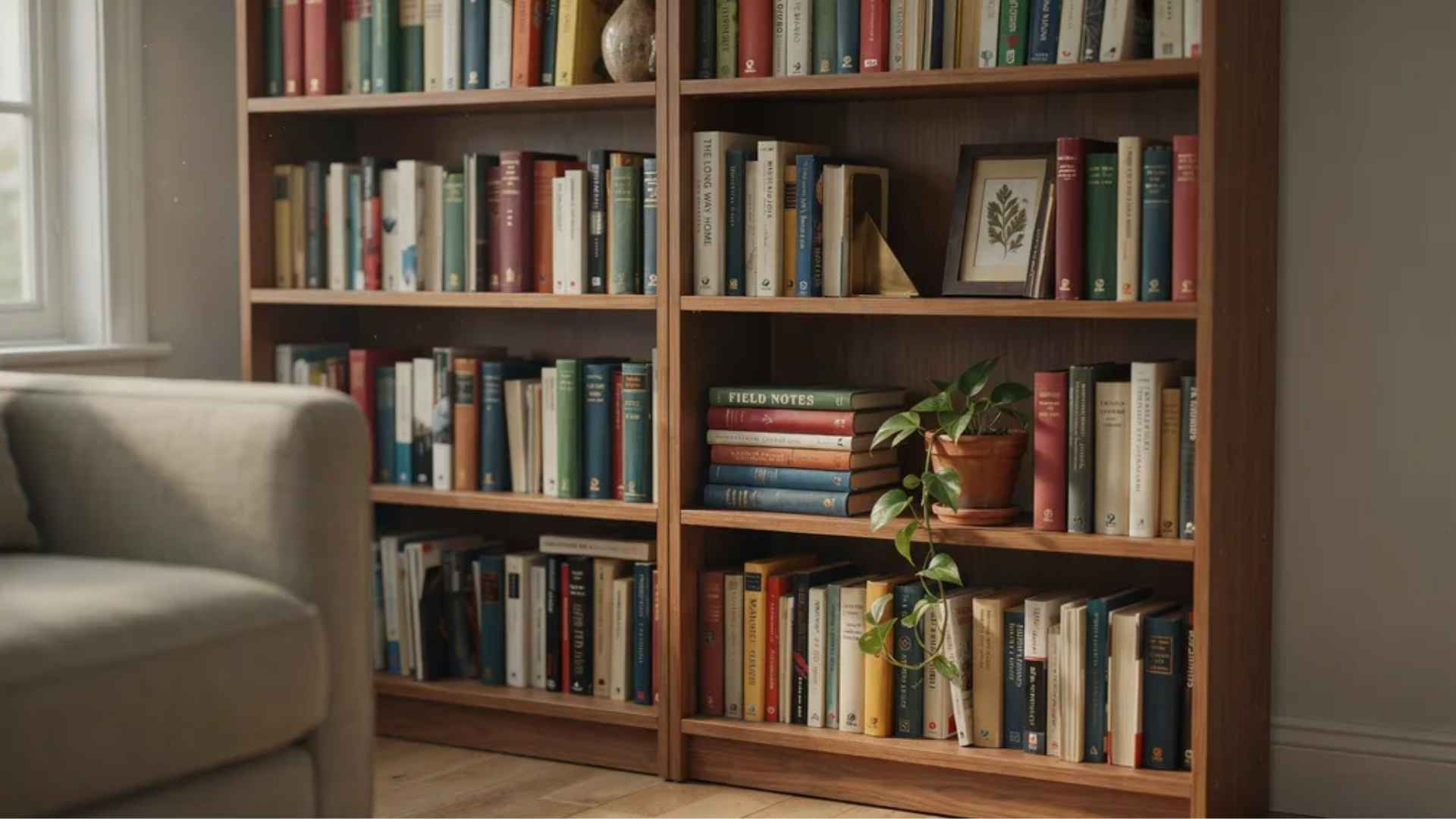
Combine upright books with a few stacked flat to add rhythm across the shelf. The mix of directions breaks up the monotony of a straight, uniform row and keeps the arrangement feeling lively rather than rigid.
This easy tweak works on almost any shelf, regardless of how many books you own, and it takes only a few minutes to rearrange once you know the pattern.
Pro tip: Stack no more than four books high to avoid tipping.
28. Add Scent With Candles
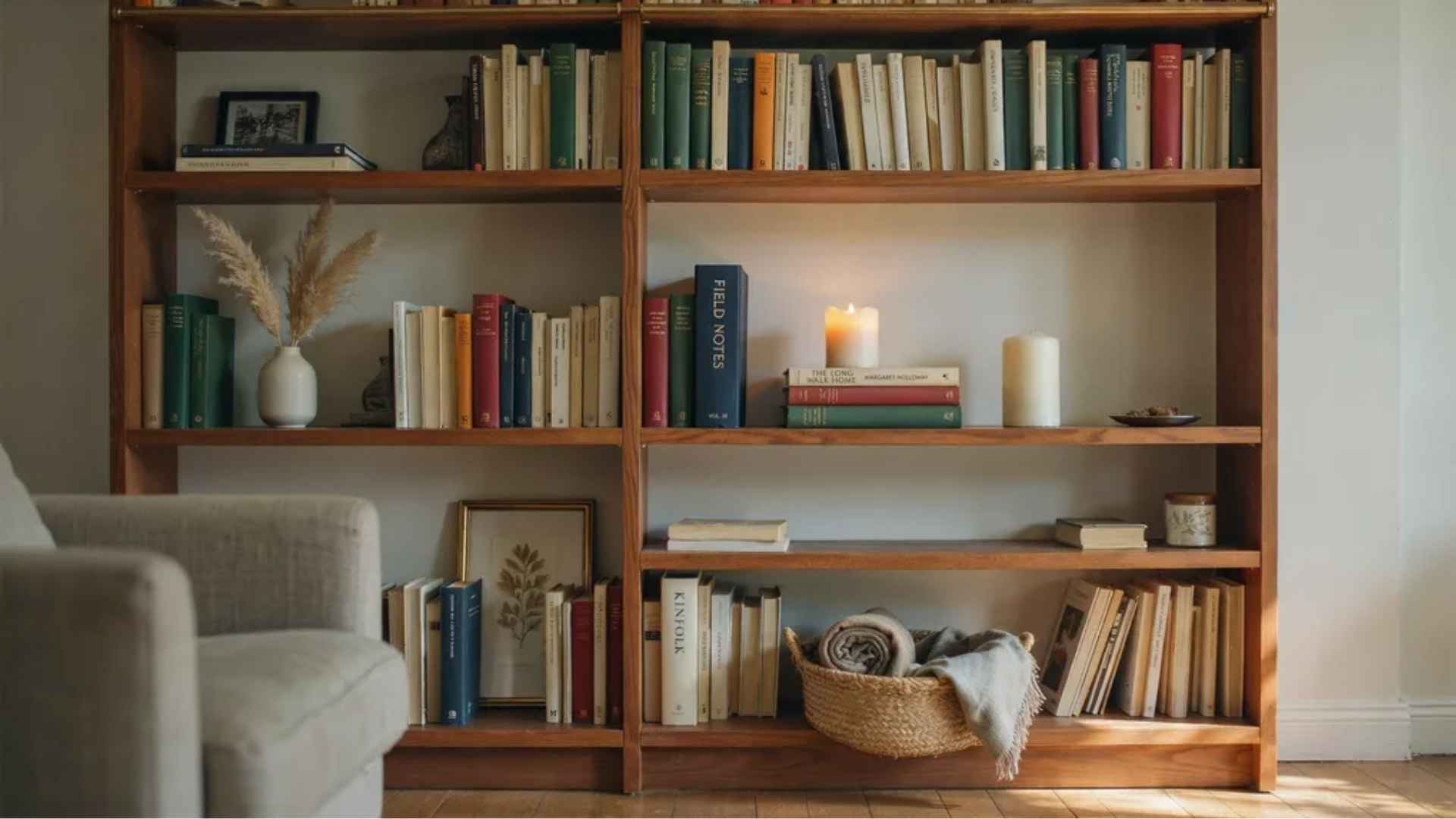
A well-chosen candle looks good and adds atmosphere at the same time. Add one to your shelf for warmth, whether it is sitting on its own or grouped on a small tray with other objects.
Candles also fill awkward gaps between taller pieces without adding visual clutter, and they give a shelf a lived-in, welcoming feel that purely decorative objects sometimes miss.
Pro tip: Choose an unscented candle if the shelf sits near food or books.
29. Try Unexpected Objects
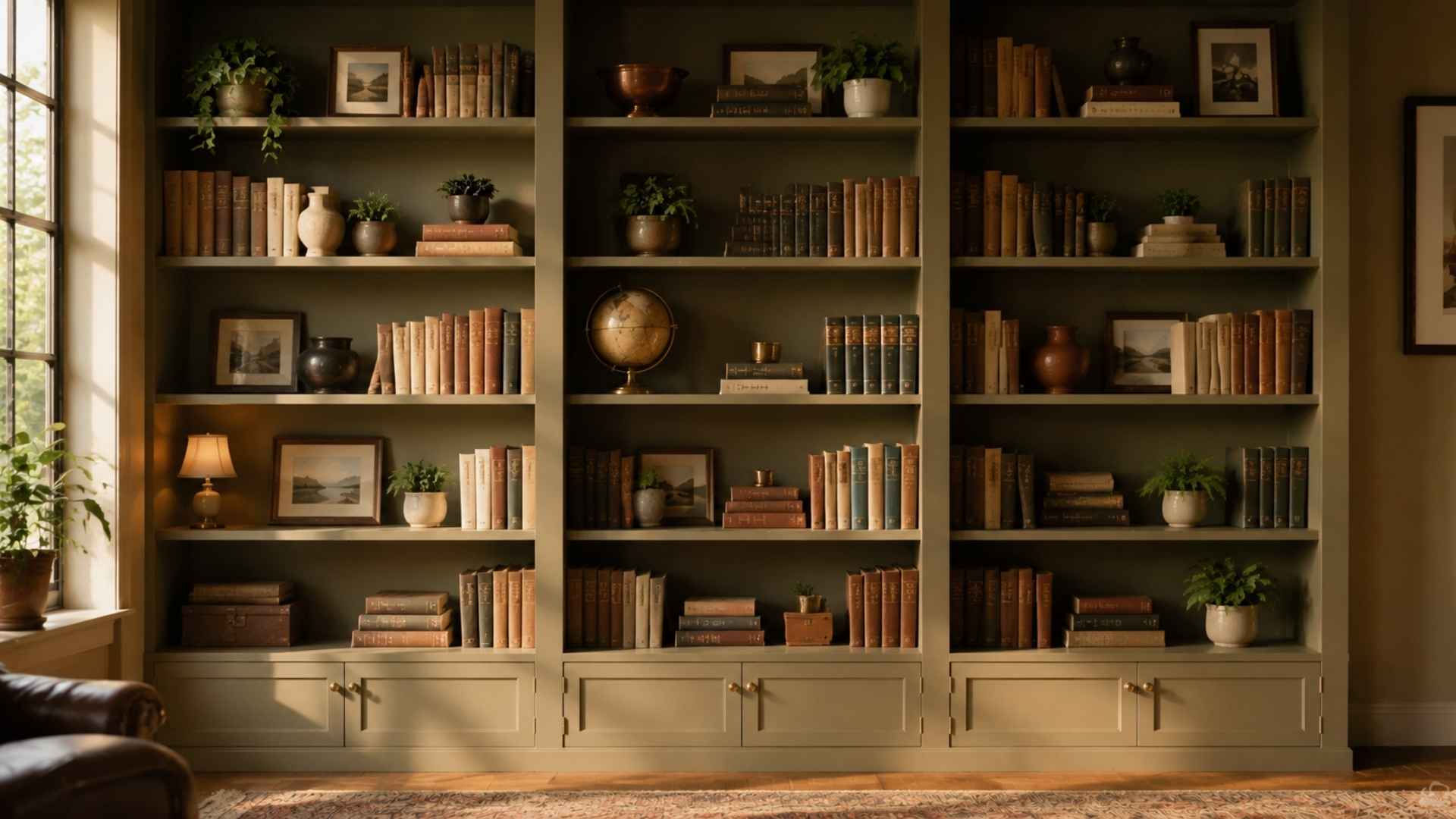
Add something a little unusual to catch attention, like an antique camera, a small sculpture, or a vintage globe. These unexpected touches make a shelf memorable and give it a bit of personality that standard decor pieces often lack.
One surprising object per unit is usually enough, since too many novelty items in one place can start to feel cluttered instead of charming.
Pro tip: Pick one conversation piece, not several, per shelf.
30. Use Coordinated Containers
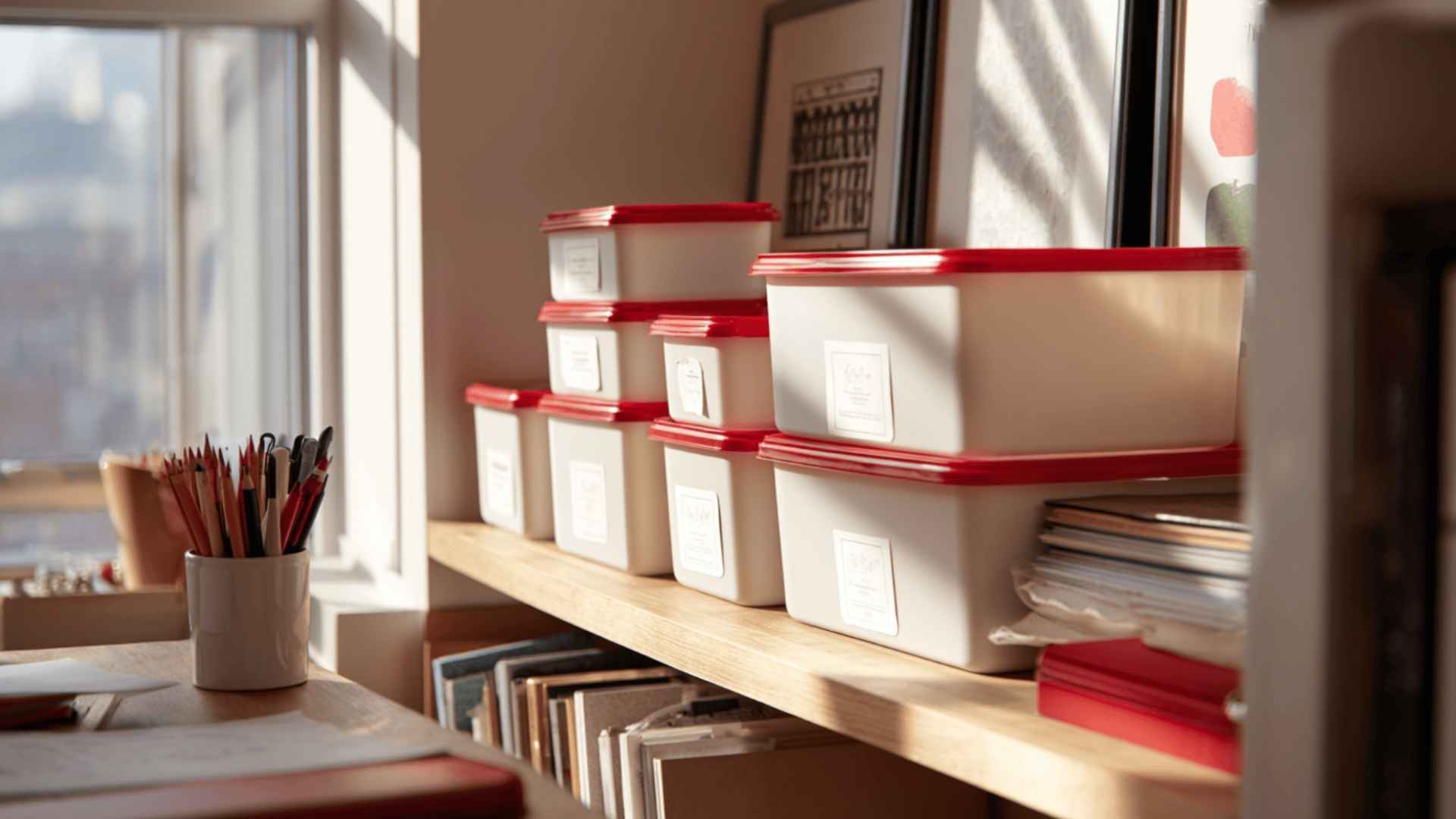
Store small items in matching boxes or jars to keep things organized and visually calm. Coordinated containers create structure and a sense of symmetry, even on a shelf packed with a lot of small, mismatched items.
This is especially useful on shelves that double as storage, since matching containers hide the clutter while still contributing to the overall look of the display.
Pro tip: Choose one material, like rattan or ceramic, across all containers.
31. Add a Woven Wall Hanging Behind One Shelf

A small woven wall hanging tucked behind one section of your shelf adds texture without taking up any shelf space itself.
It softens the hard edges of a bookshelf and gives one area a handmade, textured backdrop that books and ceramics alone cannot create. This works especially well on open shelving units, where the wall behind is just as visible as the shelf in front of it.
Pro tip: Keep the hanging smaller than the shelf width so it doesn’t overwhelm.
Styling Formulas That Always Work
If you want beautiful shelves without overthinking, these easy styling formulas are your shortcut. Each one works like a ready-made layout.
Just plug in what you have and watch your shelves look instantly balanced, layered, and designer-level in minutes. Formula 5 is the fastest fix when there’s ten minutes and zero patience for rearranging.
Formula 1: Tall + Mid + Small
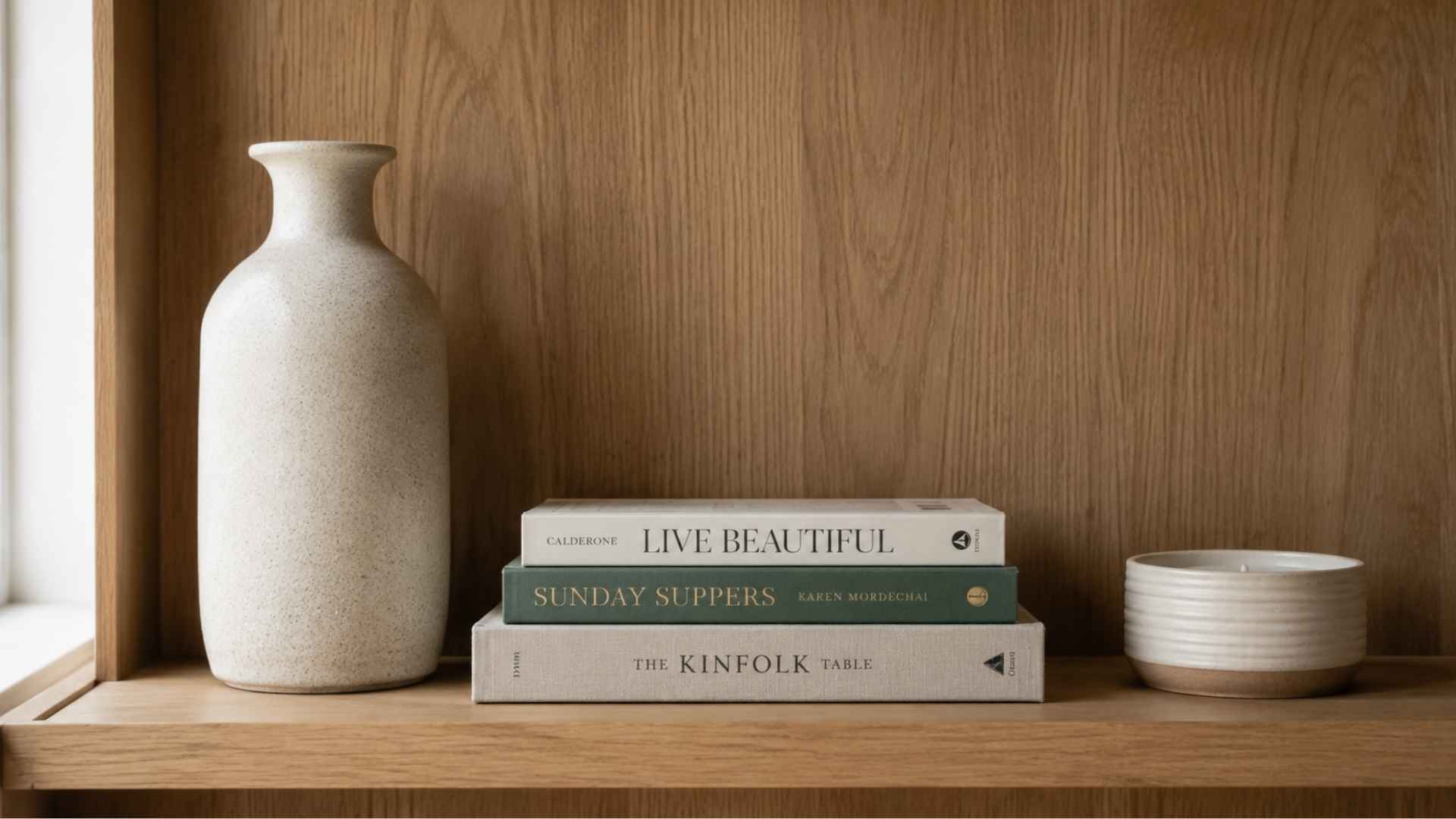
Combine three pieces of different heights to create flow. A tall vase, a mid-sized stack of books, and a small candle or bowl instantly balance each other.
The varied scale keeps your display dynamic and visually interesting without clutter.
Formula 2: Horizontal Stack + Vertical Row + Accent
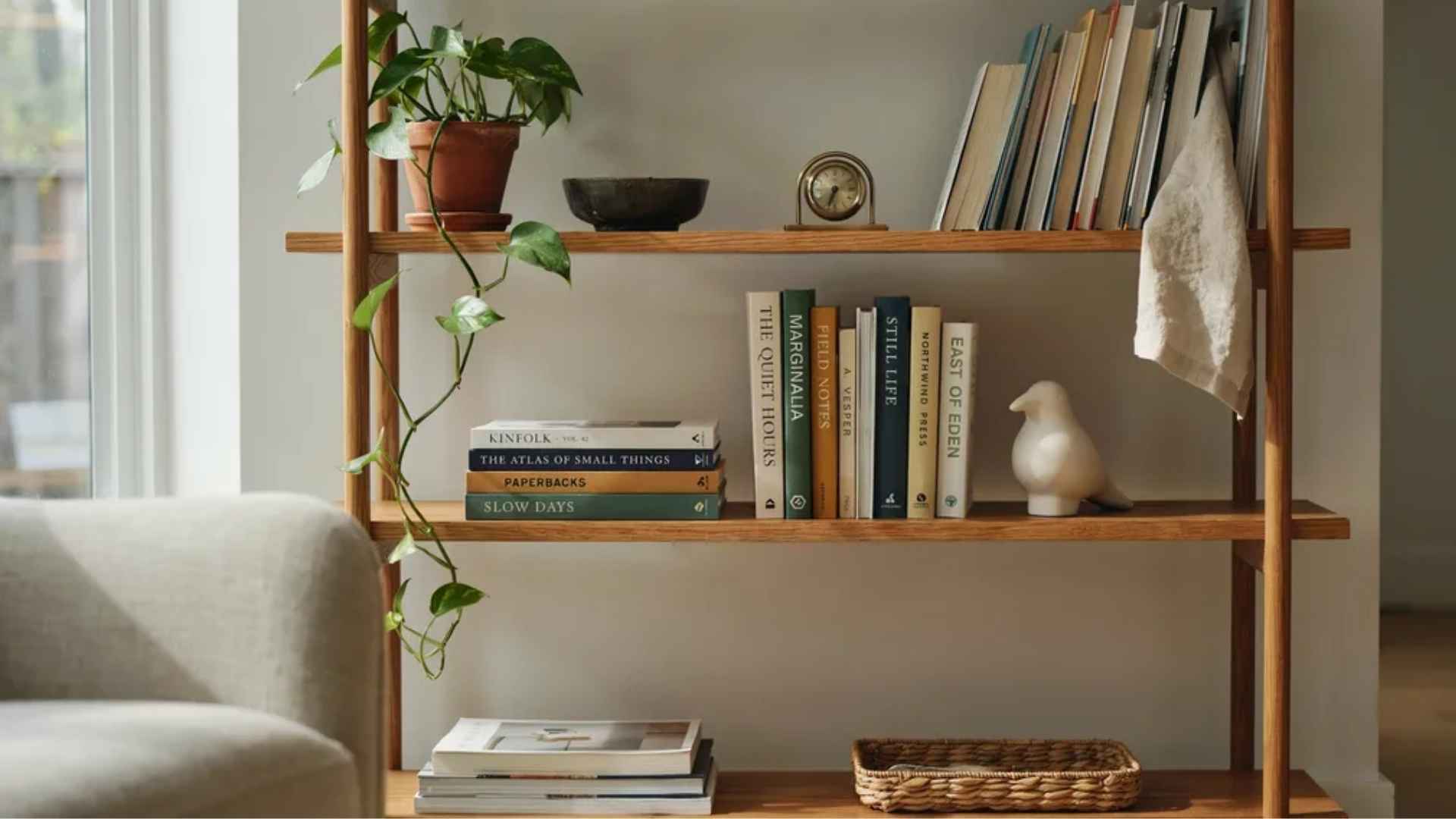
Place a few books flat, some standing upright, and add a finishing touch like a sculpture or plant.
The mix of directions adds movement and makes your arrangement feel layered and intentional, even if it took just a few minutes.
Formula 3: Mirror Layer + Books + Greenery
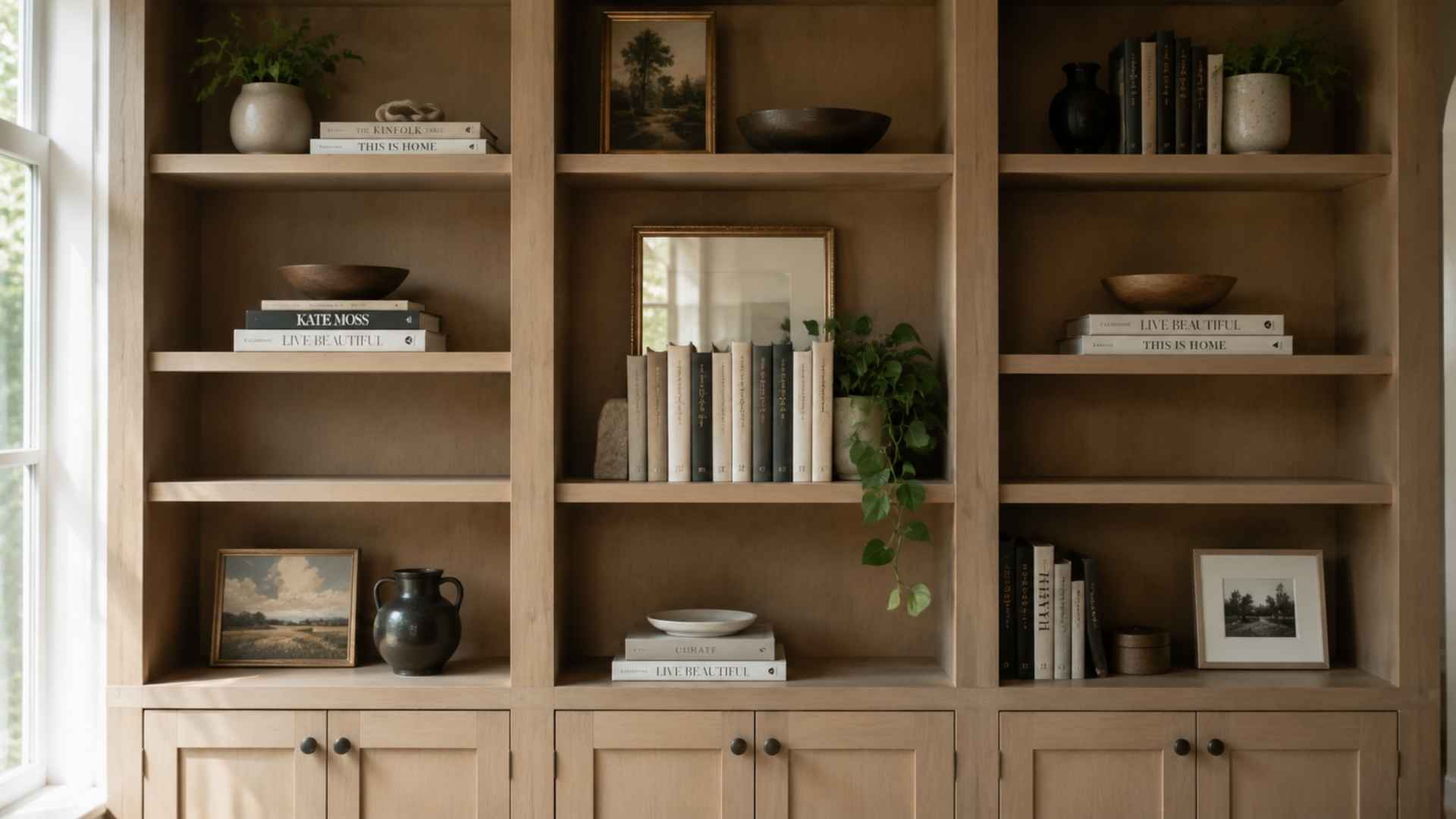
Lean a small mirror or framed art behind your books, then add a trailing plant beside them. The mirror adds light and depth, while the greenery softens edges.
It is simple but creates a rich, dimensional display that feels calm and inviting.
Formula 4: Symmetry With Variation
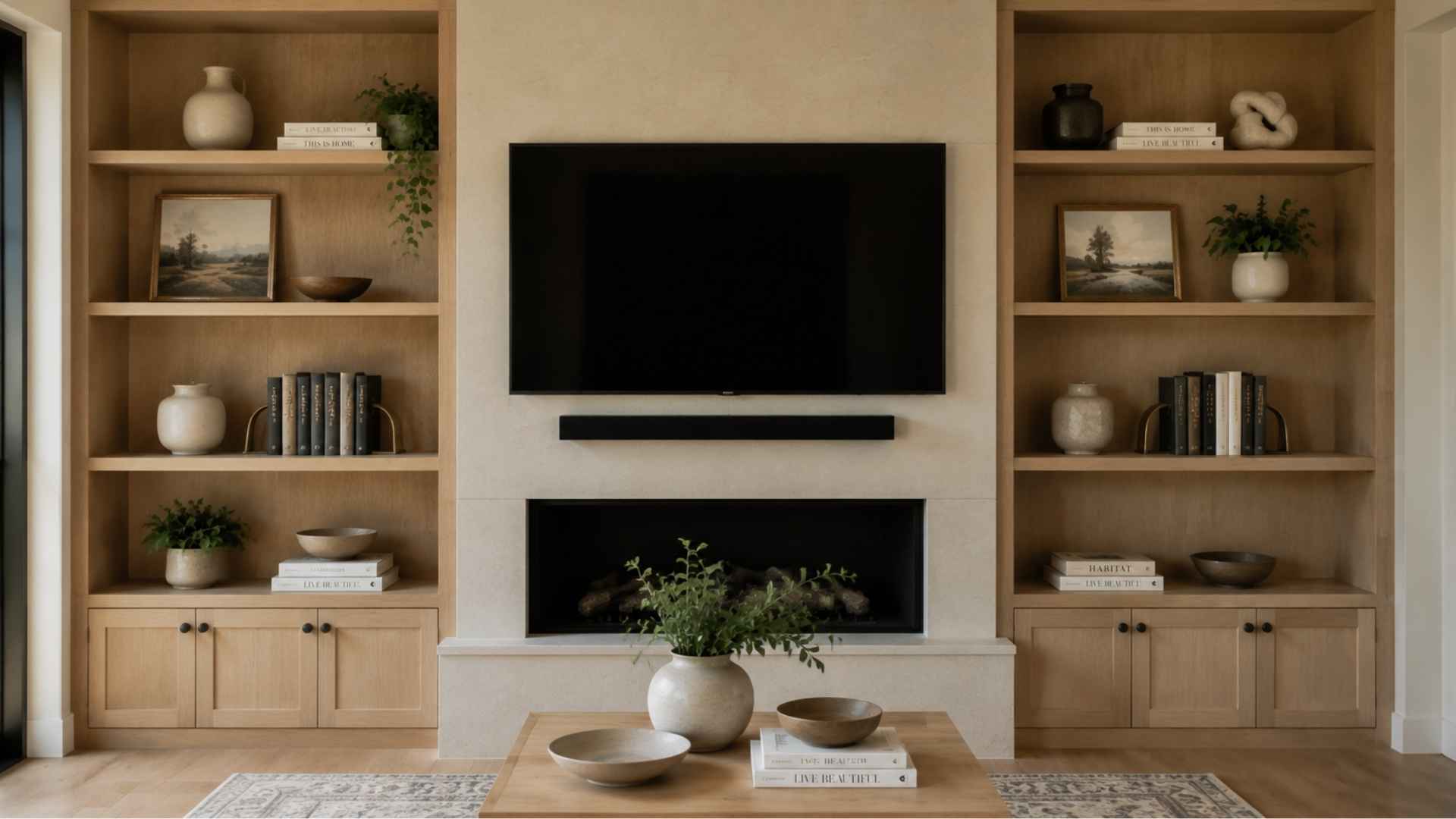
Balance both sides of your shelf without using identical objects. Try pairing a vase on one side with a sculpture or a stack of books of similar height on the other.
The arrangement feels even, yet still has that modern, lived-in energy.
Formula 5: Stack + Tray + Candle
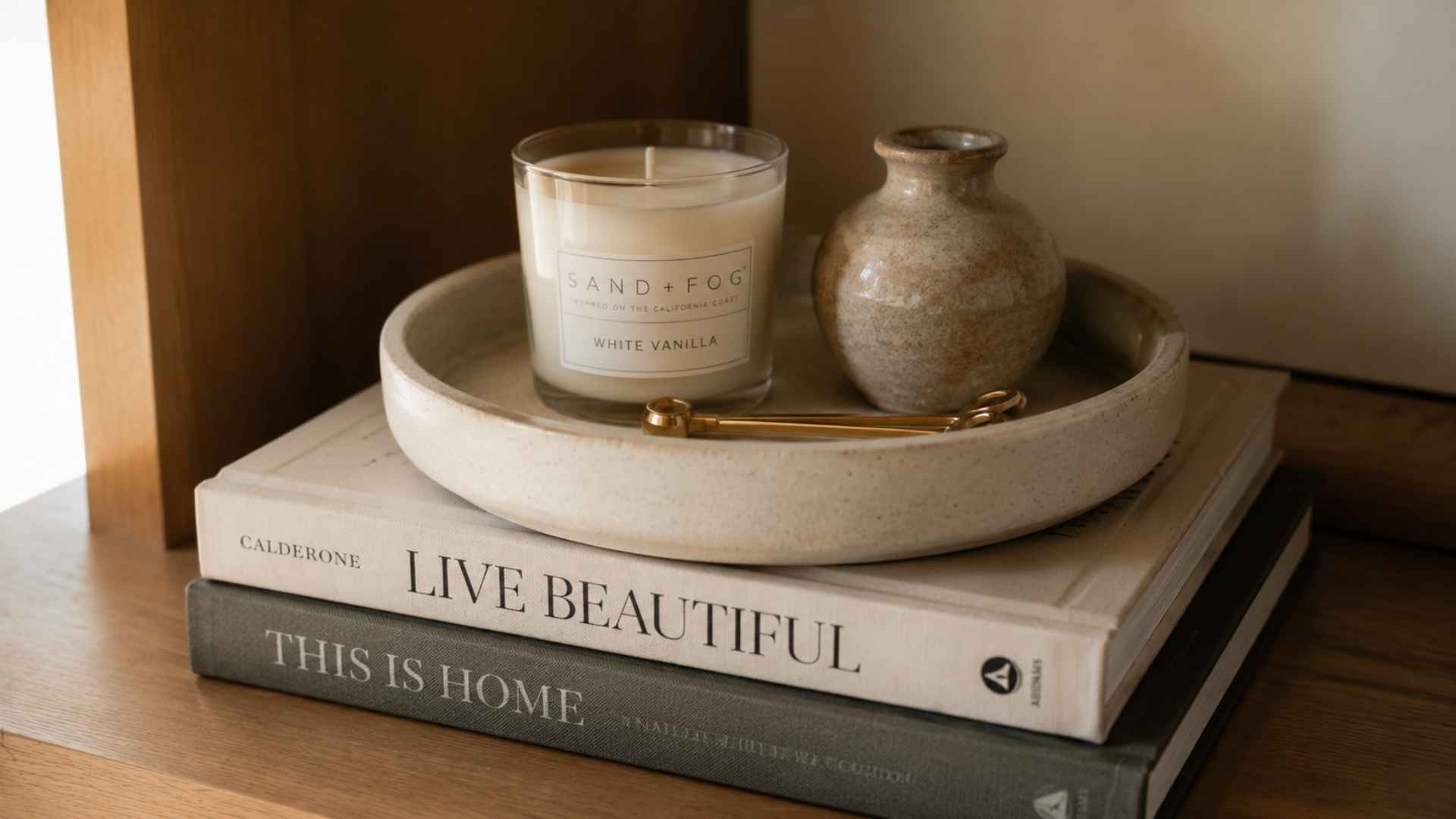
Stack two or three books, place a tray on top, and add a candle or small decor piece. It is an easy, layered look that adds structure and warmth.
This setup works anywhere, from living room shelves to bedside tables.
How Styling Changes From Room to Room
The same styling principles shift slightly depending on where the shelf actually lives. Here’s how to adjust your approach for each specific space in your home.
Floors and shelves work as a pair in that sense: the story your floors tell often sets the tone before a shelf ever gets a second look, so it helps to treat both as part of one connected design.
| Room | Styling Approach |
|---|---|
| Living Room | Treat it as a focal point. Use Formula 4 (Symmetry With Variation) around a TV or fireplace, and stack coffee table books low. |
| Home Office | Group reference books and binders together. Use baskets to hide cords and paperwork, and save sculptural pieces for eye level. |
| Bedroom | Keep it calmer with soft textures, a trailing plant, and one or two personal photos. Try Formula 5 (Stack + Tray + Candle) on built-ins. |
| Open Kitchen Shelving | Keep everyday cookbooks within arm’s reach. Save the top shelf for decor that doesn’t need daily handling. |
No two rooms call for the exact same shelf. Match the styling to how the space actually gets used, and the whole display will feel far more natural.
Where Most Bookshelves Go Wrong
Even the best ideas fall flat when a few habits sneak in. These mistakes quietly undo good styling, though each one is simple to fix once you notice it.
- Treating books as filler instead of the foundation. Books should anchor the shelf and set its rhythm, not simply fill in gaps left behind by decor pieces.
- Skipping the “empty first” step. Rearranging around existing clutter rarely creates real change. Clearing the shelf first lets you actually redesign it instead of just shuffling pieces.
- Filling every inch. A shelf packed edge to edge reads as cluttered, no matter how nice each individual piece is.
- Ignoring proportion. Oversized objects crowd a small shelf, while tiny ones get lost on a large one, throwing off the whole arrangement.
- Keeping things you don’t actually like. If an item doesn’t earn its spot through color, texture, or meaning, it simply doesn’t belong on the shelf.
Small fixes matter more than any single decor piece. Notice which habit shows up on your own shelf, correct it, and let the rest of your styling fall naturally into place
Final Thoughts
A bookshelf doesn’t need a full redesign to feel special. A little editing, a few anchors, and some breathing room can turn a cluttered stack of books into a display you actually enjoy looking at every day.
I’ve rearranged my own shelves more times than I’d like to admit, and the formulas above are the ones that stuck because they work without overthinking every placement.
Start small. Pick one shelf, empty it, and try just two or three ideas from this list. Notice what changes.
Which of these bookshelf decor ideas are you trying first? Drop a comment below, or bookmark this page so you can come back to it the next time your shelves need a refresh.
Frequently Asked Questions
What Should I Put on A Bookshelf Besides Books?
Vases, framed art, baskets, plants, candles, and personal keepsakes all work well. Mix a few categories rather than relying on just one type of object.
How Do You Keep a Bookshelf from Looking Cluttered?
Leave visible negative space on every shelf, group items instead of scattering them, and remove anything that doesn’t add color, texture, or meaning.
Should You Organize Books by Color?
Color grouping can look striking, especially for a gradient or monochrome effect, but it works best mixed with a few shelves organized by category or height instead of the whole unit.
How Much Empty Space Should a Bookshelf Have?
Aim for roughly a third of each shelf left open. It gives the eye somewhere to rest and keeps styled objects from competing with each other.