You book a facial expecting cleaner, brighter, more comfortable skin. Then the treatment menu gives you two options: a standard facial and a custom facial.
They can sound like two names for the same thing, and in some clinics, the difference may be small. Both can include cleansing, exfoliation, hydration, masks, serums, and other skincare steps. The real difference is usually how much the treatment changes based on what your skin needs that day.
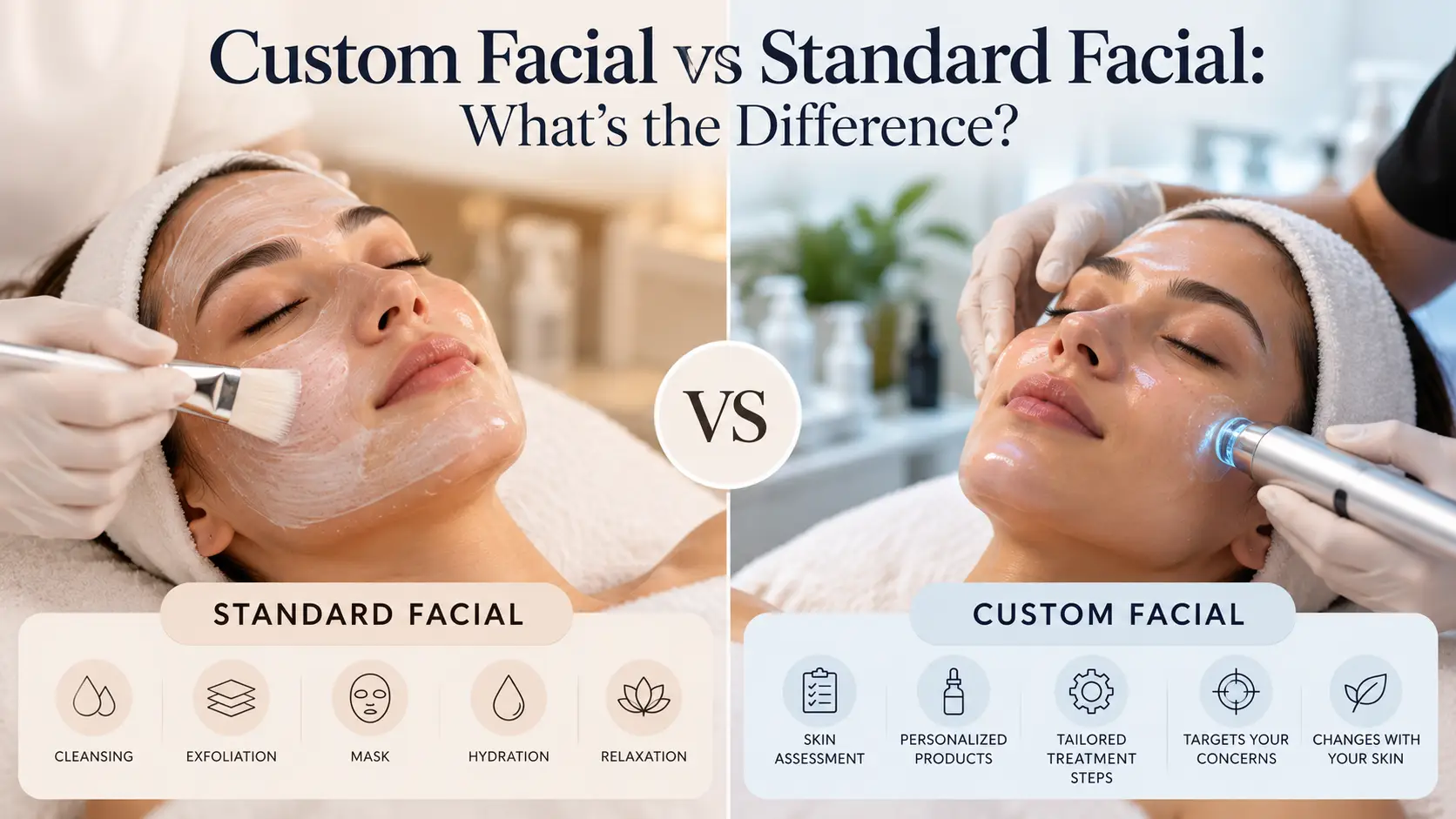
A standard facial generally follows a more consistent treatment sequence. A custom facial starts with your skin, current concerns, and goals, then adjusts the products or treatment steps around them.
That difference matters if your skin is dry one month, congested the next, or simply does not fit neatly into a pre-set facial menu.
What Is a Standard Facial?
There is no single universal formula that every spa must follow when it uses the term “standard facial.” Treatment menus and protocols vary between providers.
Still, a typical facial usually follows a familiar sequence.
A standard facial treatment may include cleansing, exfoliation, a mask, moisturizer, light facial massage, and skincare recommendations. Depending on the provider and your skin, steam, extractions, or serums may also be included.
The main idea is consistency.
The clinic has a treatment protocol, and most clients receiving that facial go through roughly the same core steps. Products may still be selected for skin type, but the overall structure tends to stay fairly predictable.
For someone who wants regular cleansing, hydration, exfoliation, and relaxation without addressing a specific concern, that can be perfectly reasonable.
What Makes a Custom Facial Different?
A custom facial is less about choosing a facial name and more about building the session around the person receiving it.
Instead of assuming every appointment should follow exactly the same path, the provider can adjust the products, exfoliation method, hydration level, masks, or other parts of the treatment after looking at your skin and discussing what you want to address.
For example, someone dealing with dryness may need a different treatment approach from someone concerned about congestion or uneven-looking tone.
That is how custom facials are approached at The Derm Project in Missouri City. Treatments are personalized around skin type, current concerns, and skincare goals rather than treating every face with the same preset routine. The clinic’s facial treatments can include cleansing, exfoliation, hydration, and targeted products selected around individual needs.
So, “custom” does not necessarily mean a completely different facial every time. It means there is more room to adapt the treatment instead of forcing the skin into a fixed protocol.
Custom Facial vs Standard Facial at a Glance
|
Standard Facial |
Custom Facial |
|
|
Starting point |
Pre-designed facial protocol |
Current skin assessment and goals |
|
Treatment sequence |
Usually fairly consistent |
Can change based on skin needs |
|
Products |
Selected from the facial’s standard range |
Chosen around specific concerns |
|
Exfoliation |
Often predetermined |
May be adjusted for skin tolerance |
|
Mask or serum |
Often part of the preset treatment |
Selected around the skin that day |
|
Best suited for |
General skincare maintenance and relaxation |
People wanting a more individualized session |
|
Repeat appointments |
Similar experience each visit |
Treatment may change as the skin changes |
Neither format is automatically better.
The better option depends on why you are booking the appointment.
Why Skin Assessment Matters More Than the Name of the Facial
Skin changes.
Weather, travel, hormones, skincare products, sun exposure, irritation, and recent treatments can all affect how your face looks and feels.
That means the facial that felt great three months ago may not be the ideal approach today.
Imagine someone who normally has combination skin but arrives with dryness and sensitivity after starting a new product. Automatically giving them the strongest exfoliation simply because it is part of the standard facial may not make sense.
A custom approach gives the provider room to modify the appointment.
The opposite is also true. Someone who routinely tolerates a certain facial well and has no new concerns may not need a long list of add-ons simply because customization is available.
Personalization should have a reason behind it.
Does a Custom Facial Mean More Aggressive Treatment?
No.
“Custom” should not be confused with “stronger.”
Sometimes personalization means doing less.
Sensitive or irritated skin may call for gentler cleansing, less exfoliation, fewer active ingredients, and more focus on hydration and barrier comfort.
This becomes particularly important when redness is involved. Redness and acne-like bumps are not always ordinary breakouts. Rosacea, for example, can resemble acne and can be aggravated by irritating products or aggressive skin treatments. The American Academy of Dermatology’s guidance on acne and rosacea notes that the two can look similar even though their management differs.
For rosacea-prone skin specifically, gentle care matters. Rubbing, scrubbing, and some exfoliating ingredients can worsen irritation, which is one reason a provider needs to consider how the skin is behaving rather than applying the same protocol automatically.
What Can Be Customized During a Facial?
Customization can happen at several points without turning the appointment into a complicated treatment plan.
Depending on the clinic and the person’s skin, adjustments might involve:
- the type or amount of exfoliation;
- whether extractions are appropriate;
- the level of hydration;
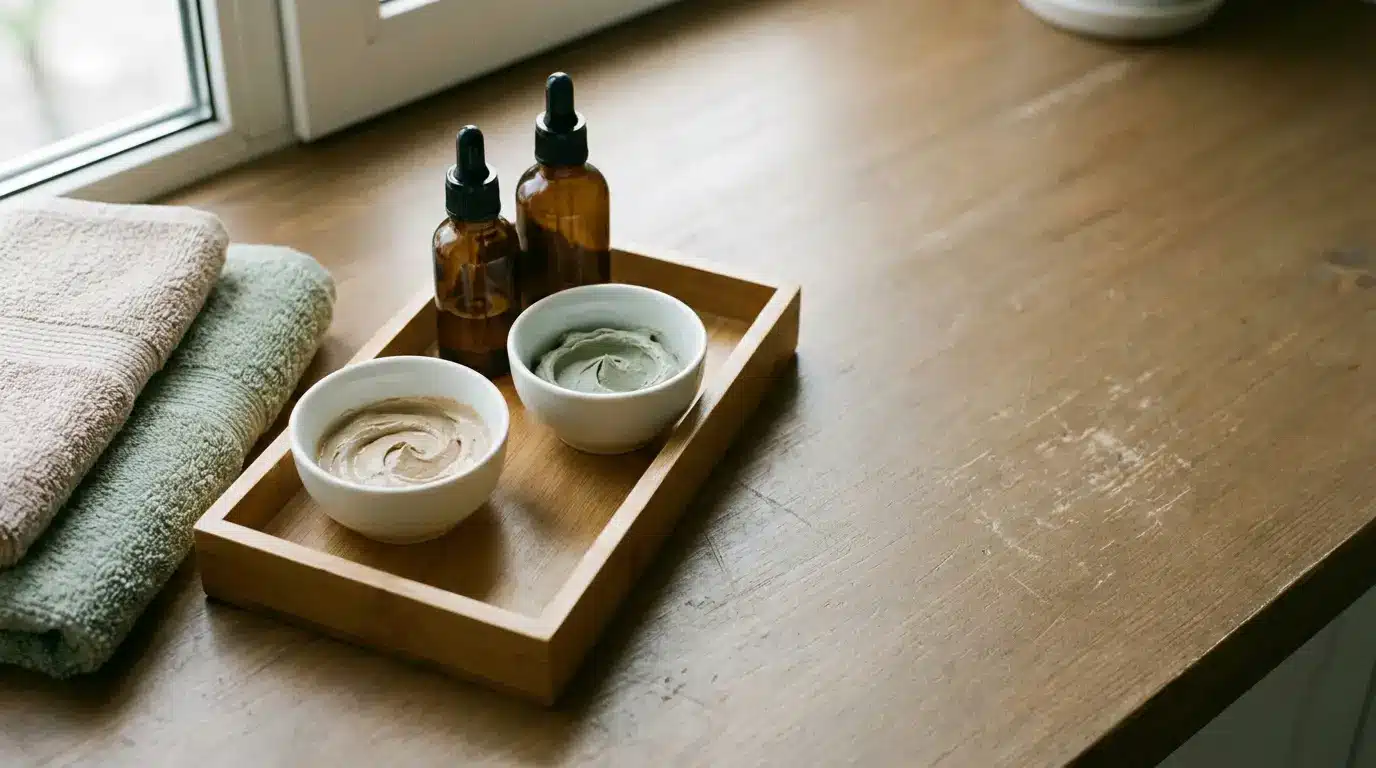
- masks chosen for dryness, congestion, or other concerns;
- serums used during the treatment;
- whether dermaplaning or another compatible add-on makes sense;
- recommendations for home skincare after the appointment.
A good custom facial should not feel like someone is adding treatments simply to make the appointment more expensive.
Every adjustment should make sense for the skin being treated.
What About Dermaplaning, HydraFacial and Other Add-Ons?
This is where facial menus can become confusing.
Dermaplaning, device-based facials, LED sessions, peels, and other treatments are not automatically part of every standard or custom facial.
They may be separate services or optional additions.
Dermaplaning, for example, is a form of superficial exfoliation that removes the upper layer of dead skin cells along with fine facial hair. It can be offered alongside certain facial treatments, but it should not be assumed to be necessary for everyone.
The Derm Project’s current service menu illustrates this distinction well. Its facial offerings include options such as the Luxe Signature Facial, Trio Facial, Mini Duo Facial, Epicutis Facial, and separate enhancements including dermaplaning and LED sessions.
That is another reason to ask what is actually included rather than choosing purely by the word “custom.”
Which Facial Is Better for Acne-Prone Skin?
It depends on what is causing the breakouts and how active they are.
A facial may help with surface cleansing, oil, hydration, or some types of congestion, but it should not be presented as a replacement for medical acne treatment.
Deep, painful, persistent, or scarring acne may need evaluation and treatment beyond what a routine facial can provide.
A customized appointment can still be useful because the provider can avoid products or steps that do not suit acne-prone skin and focus on appropriate skincare support.
The key is knowing where an aesthetic facial ends and medical treatment begins.
What About Dry, Dull or Uneven-Looking Skin?
These concerns are often where customization feels most intuitive.
Dry skin may benefit from less aggressive exfoliation and more hydration. Someone dealing with dullness may be able to tolerate a different exfoliation approach. A client concerned about uneven-looking tone may need products selected differently from someone mainly concerned about dehydration.
But a facial cannot correct every cause of pigmentation, redness, texture change, or aging.
At a clinic that also provides medical aesthetic treatments, the consultation can help determine whether a facial makes sense on its own or whether another option better matches the concern.
The Derm Project follows that broader personalized-treatment model, offering facials alongside services such as chemical peels, microneedling, laser treatments, and medical-grade skincare at its Missouri City location.
Standard Doesn’t Mean Generic, and Custom Doesn’t Mean Better
The terminology can make this comparison sound more dramatic than it really is.
A well-performed standard facial can still involve thoughtful product selection and professional skin assessment.
Likewise, putting the word “custom” in a service name does not automatically make the treatment more appropriate.
What matters is what happens during the appointment.
Does the provider ask about your current routine? Do they look at how your skin is behaving? Are they willing to modify something if your skin looks irritated? Can they explain why they are recommending a particular product or step?
Those questions tell you more than the facial’s name.
How to Choose Between the Two
A standard facial may make sense if you already know your skin tolerates the treatment well, your goal is straightforward maintenance, and you like knowing what the appointment will include.
A custom facial may be more useful when you have several concerns, your skin changes frequently, you are unsure what it needs, or you want the treatment adjusted rather than selected from a fixed menu.
For people around Missouri City, Sienna, Sugar Land, Stafford, Pearland, and the Houston area, location is only one part of choosing a provider. The more useful question is whether the person treating your skin can explain why they are recommending each step.
The Difference Comes Down to Flexibility
Standard and custom facials share many of the same building blocks.
Both can involve cleansing, exfoliation, hydration, masks, serums, and professional skincare guidance.
The difference is mainly in how those pieces are selected.
A standard facial begins with an established treatment format. A custom facial begins with the condition of your skin and adjusts the session from there.
If your skincare needs are straightforward, either approach may work well. If your skin changes, reacts easily, or you have a specific concern you want to discuss, having more flexibility can make the appointment more relevant to you.