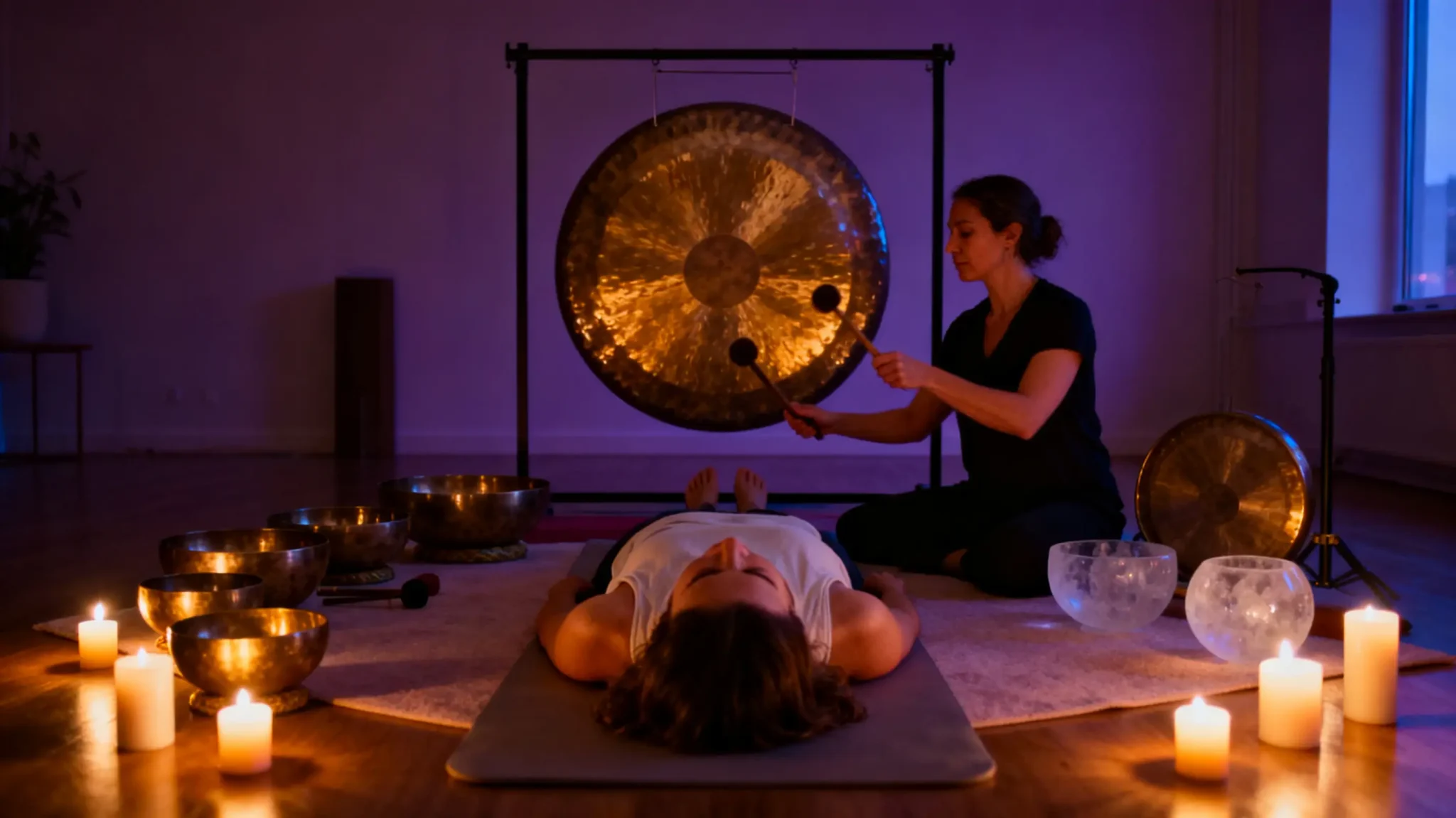
Picture lying on a mat in a dim room while a low hum spreads across the floor and up into your chest. Nobody asks you to empty your mind or hold a pose. You just listen. That’s a sound bath, and it has gone from niche wellness ritual to something your local studio, your meditation app, and even your smartwatch now offer.
What Is a Sound Bath?
A sound bath is a guided meditation where a facilitator plays resonant instruments while you lie still and let the sound wash over you. The usual cast includes Tibetan and crystal singing bowls, gongs, chimes, and tuning forks. There’s no melody to follow and no rhythm to keep. The point is to let layered tones settle your attention until your mind quiets on its own.
The instruments aren’t random. Singing bowls and gongs come from centuries-old traditions across Asia, and they produce long, overlapping tones that are easy to sink into. Silent meditation asks you to concentrate, and a sound bath instead hands your brain one gentle thing to track. And if you can’t stop sounds and thoughts in your head even for a moment, which traditional meditation demands, that’s a perfect practice for you.
How It Works
Steady, low tones coax your body out of fight-or-flight and into what physiologists call the parasympathetic state, the “rest and digest” mode. Your heart rate slows, your breathing deepens, and your blood pressure tends to drop.
Researchers have measured real changes. A 2017 study in the Journal of Evidence-Based Integrative Medicine, led by UC San Diego’s Tamara Goldsby, had 62 people lie through a singing-bowl session. Afterward, they reported significantly less tension, anger, fatigue, and depression. Smaller studies have also linked sessions to lower cortisol, the main stress hormone, and to improved heart rate variability, a marker of how well your body bounces back from stress.
There may be a brainwave story too. Some research suggests sustained tones help shift the brain from busy beta activity toward the slower alpha and theta states tied to deep relaxation. The science here is still young, and most studies are small, so it’s fair to call the evidence promising rather than settled. As a low-risk way to unwind, though, sound baths have a strong case and a few good effects.
Better Sleep
Stress and sleep are tangled together, and cortisol is the knot. When you’re wound up, cortisol stays high at night when it should be falling, which makes it harder to drift off and stay asleep. By calming the nervous system and easing cortisol back down, a sound bath helps reset that cycle. Plenty of people report falling asleep faster and sleeping more deeply afterward, and the deep tones of gongs and bowls seem to encourage exactly the brain states linked to restorative sleep.
The Skin Connection
Here is not an obvious part, but your skin may also improve. Chronically high cortisol breaks down collagen and elastin, the proteins that keep skin firm, and it cranks up oil production, which clogs pores and feeds breakouts. It also weakens the skin’s protective barrier and aggravates eczema, rosacea, and psoriasis.
Poor sleep compounds the damage. Night is when skin does most of its repair work, and poor sleepers had skin-aging scores twice as high as good sleepers, plus slower recovery after sun exposure.
So the chain is simple: a sound bath lowers stress and improves sleep, and those two upstream wins give your skin a better chance to repair itself. No gong will replace sunscreen or a decent moisturizer, but calmer nerves and deeper sleep are real friends to your complexion.
Where to Find One
In-person sessions happen at yoga studios, wellness centers, and meditation spaces, usually in groups on the floor with blankets and bolsters. If you’d rather stay home, virtual options have multiplied since 2020. Meditation apps, livestreamed classes, and a deep bench of free recordings on YouTube and streaming services let you try the practice for nothing.
You don’t need a studio. A single decent singing bowl runs roughly $20 to $50 and is plenty to start. A set of tuning forks is another cheap option, and even a guided recording through good headphones does the job.
Keep it simple. Dim the lights, silence your phone, and lie down somewhere comfortable. Play your bowl slowly, or press play on a recording, and let the sound carry your attention for ten to twenty minutes. Do this in the hour before bed instead of scrolling or playing Tether casino to unwind, and you stack two benefits at once: you shed the tension of the day, and you set your body up for the sleep your mind and your skin have been missing.