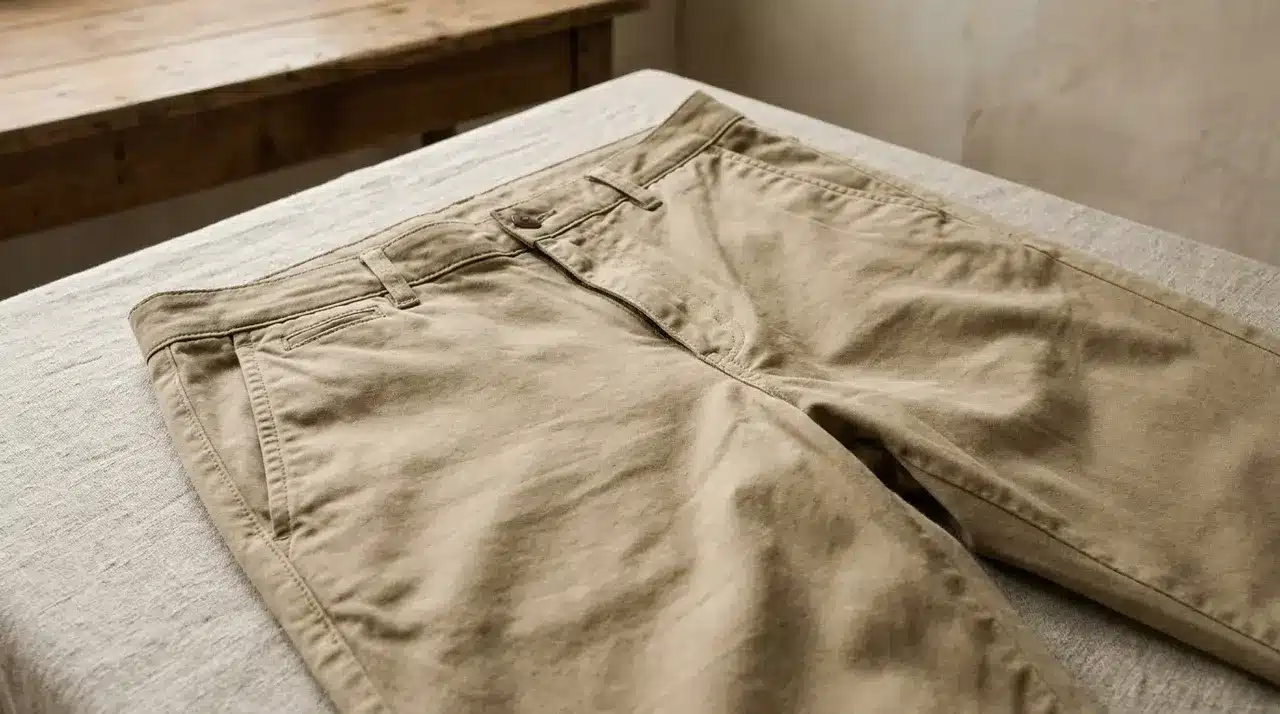
I didn’t own a single pair of chinos until my late twenties. Now they outnumber every other pair of pants in my closet by a wide margin.
“Chino” gets tossed around in menswear and womenswear alike, yet most people couldn’t answer the real question: what are chino pants? Is it the fabric, the cut, or just a fancier word for khakis?
I spent years guessing on fitting room floors before I actually learned the difference between chinos, khakis, and dress slacks, and I still remember how much easier shopping got once I did.
What are Chinos?
Let’s start with the basics, because “chino” is technically a fabric name before it’s a pants name.
Chinos are pants made from cotton twill fabric, cut with a flat front (no pleats), slim seams, and a fixed waistband. They started as military trousers and grew into one of the most useful items in modern wardrobes.
In short: chino pants are lightweight cotton twill trousers with a flat front, slim seams, and a fixed waistband, sitting in formality right between jeans and dress pants.
That definition covers the essentials, but the details are what separate a genuine pair of chinos from something that just looks similar on a rack.
The fabric is smooth and mid-weight. The leg opening sits cleaner than a dress pant. There’s usually no pleating at the waist, which gives chinos that laid-back, put-together look.
I think of them as the pants that split the difference between jeans and slacks, casual enough for a Saturday, sharp enough for a Monday. If you’re still figuring out where chinos fit among other everyday pant styles, it helps to see the full lineup side by side.
Once you know what makes a chino a chino, the fabric behind it is worth a closer look.
A Quick History of Chinos
Chinos have a surprisingly military backstory, and it explains a lot about why the fabric looks and behaves the way it does today.
- The era: Traces back to the Spanish-American War of the late 1890s
- The need: U.S. troops stationed in the Philippines and Cuba needed lightweight cotton trousers suited to a tropical climate, not the heavier wool uniforms issued back home
- The name: “Chino” is widely believed to come from the Spanish word for “Chinese,” a nod to the cotton twill often sourced from China at the time, though the exact origin is debated among historians
- The proof: The Smithsonian’s National Museum of American History holds a khaki cotton jacket and hat worn in Cuba by Colonel Leonard Wood during the Spanish-American War, part of its broader collection documenting the era’s khaki uniforms
- The crossover: Soldiers brought the pants home after the war, and civilians picked up on how comfortable and durable they were
From battlefield gear to wardrobe staple, chinos picked up some defining traits along the way, and those are worth breaking down next.
Sources:
- National Archives, “ Researching Service in the U.S. Army During the Philippine Insurrection”
- Smithsonian National Museum of American History, uniform artifact worn in Cuba
What is Chino Fabric Made Of?
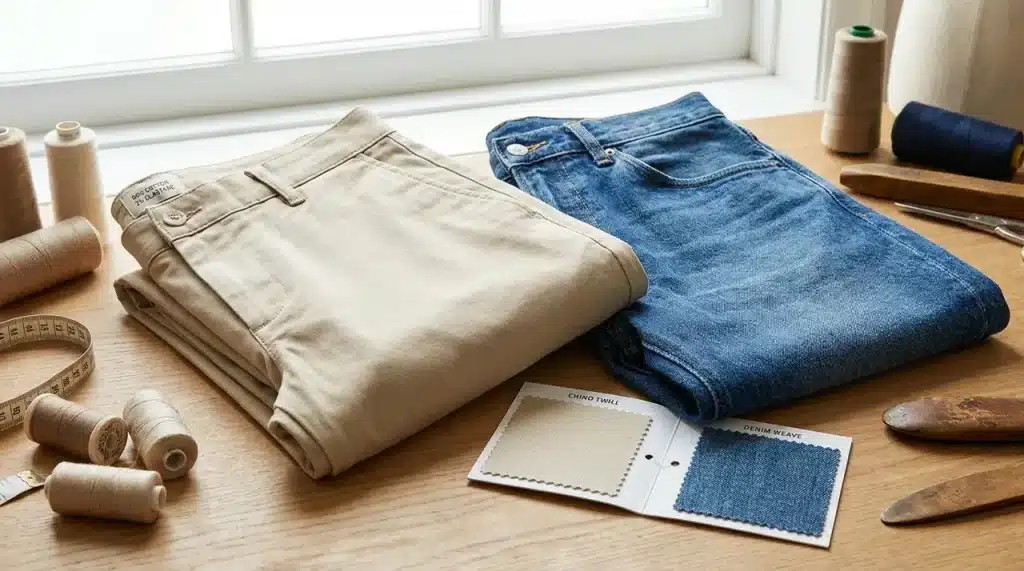
The fabric is really where the chino story begins, and it’s the reason these pants feel so different from jeans or dress pants the moment you put them on.
| Attribute | Chino Fabric | Denim |
|---|---|---|
| Weave | Twill | Twill (heavier) |
| Weight | Light to mid | Heavy |
| Common Blends | Cotton, cotton-poly, cotton-elastane | Cotton, cotton-elastane |
| Feel | Smooth, breathable | Rigid, textured |
| Best For | Warm weather, office, travel | Rugged everyday wear |
Chino fabric started out as pure cotton, but most pairs I buy now include a small percentage of elastane or spandex for stretch, which makes them far more comfortable for sitting through a long workday.
Most modern chinos land somewhere around 7 to 9 ounce cotton twill blended with 2 to 3 percent elastane, a combination that gives you stretch without losing the crisp, structured look.
The tighter twill weave is also what gives chinos that smooth, almost matte finish instead of the visible diagonal ribbing you see on denim. That lighter weight is exactly why chinos breathe so well in humid or warm climates, something I noticed the first summer I swapped my jeans out for a pair.
That cotton-elastane split on the tag isn’t a guess either; federal labeling rules from the Federal Trade Commission (FTC) require it to be accurate.
That breathable, durable weave is also exactly why chinos need a slightly different laundry routine than your jeans.
How Often Should You Wash Chinos?
Overwashing is the fastest way to wear out a good pair of chinos, so here’s the rule of thumb I actually follow.
For light, occasional wear, I wait until 4 to 5 wears before washing. That lines up with what Howie, Volcom’s global denim and pants designer, recommends: washing chinos every 4 to 5 wears, adjusted to personal preference. For daily or active wear, I tighten that to about once a week.
Visible stains or odor are the only exception. Those get washed right away, no waiting it out.
My Chino Wash-Day Checklist:
☐ Turn pants inside out before washing
☐ Use cold water to protect the dye
☐ Wash similar colors together, never light with dark
☐ Skip the dryer’s high heat setting
☐ Hang or lay flat to dry instead of tumbling
Underwashing keeps chinos in better shape longer. Every trip through the washer and dryer works the fibers a little harder, fades the color a shade more, and loosens the fit you spent months breaking in. I hold off until there’s an actual reason to wash, and my chinos have held their shape and color far longer for it.
Every pair of chinos comes with a care label because federal rules from the FTC require it, not just a manufacturer’s suggestion.
Taking care of the fabric is one thing, but chinos also come in more style variations than most people realize.
Different Chino Styles and Fits
Not all chinos are cut the same, and picking the right fit changes how the whole pair wears, sits, and photographs.
By Fit
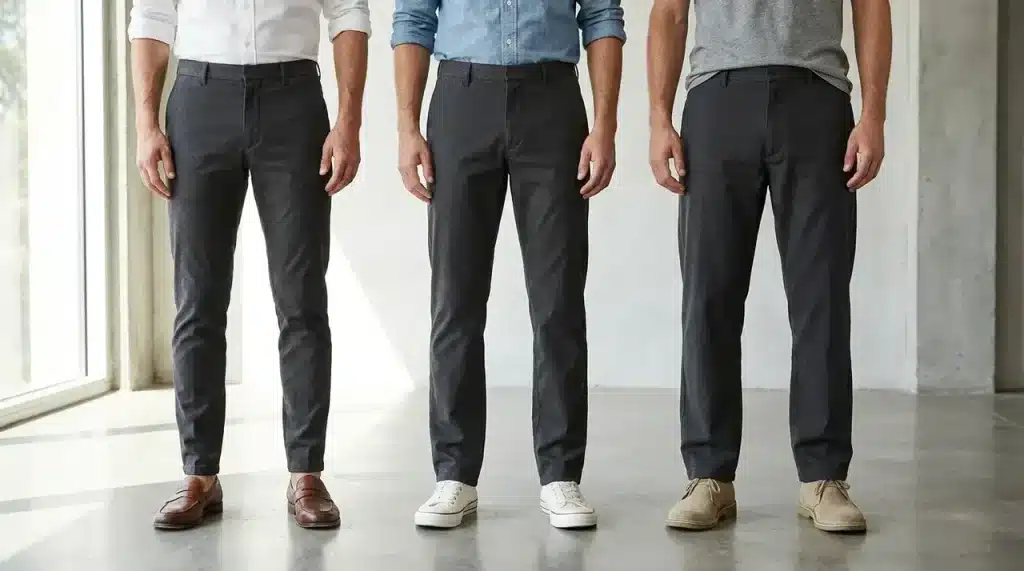
Fit is the first thing to nail down since it decides how the pants sit at the waist and thigh.
- Slim or modern fit: tapered and close to the leg, the most tailored option
- Regular fit: straighter with more room through the thigh, a safe everyday choice
- Relaxed or loose fit: the roomiest cut, straight leg from thigh to ankle
By Leg Shape
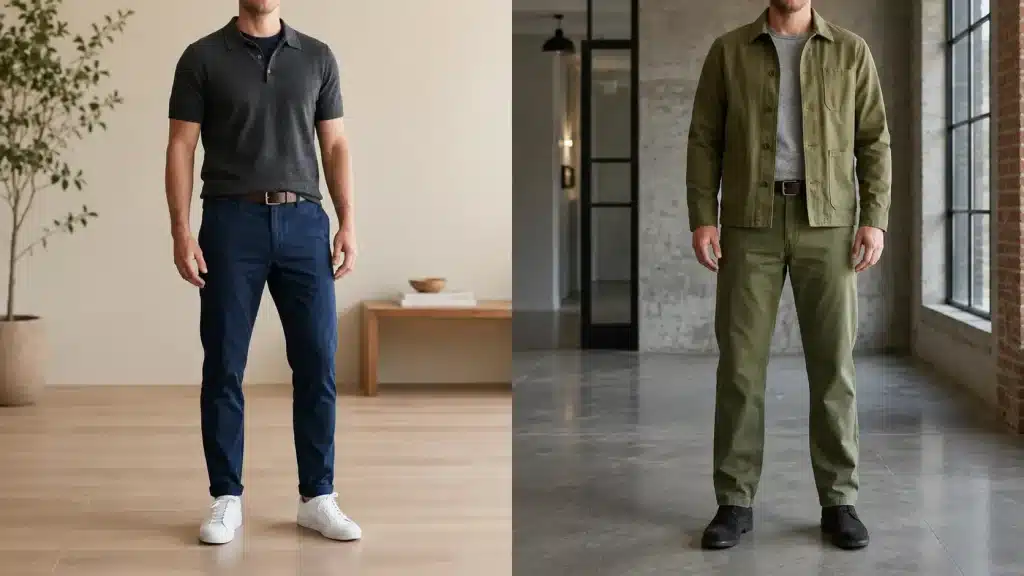
Beyond overall fit, the leg shape below the knee changes the silhouette just as much.
- Tapered leg: wider at the thigh, narrower at the ankle, for a more sculpted look
- Straight leg: consistent width from top to bottom, for a looser, retro feel
Chino Shorts
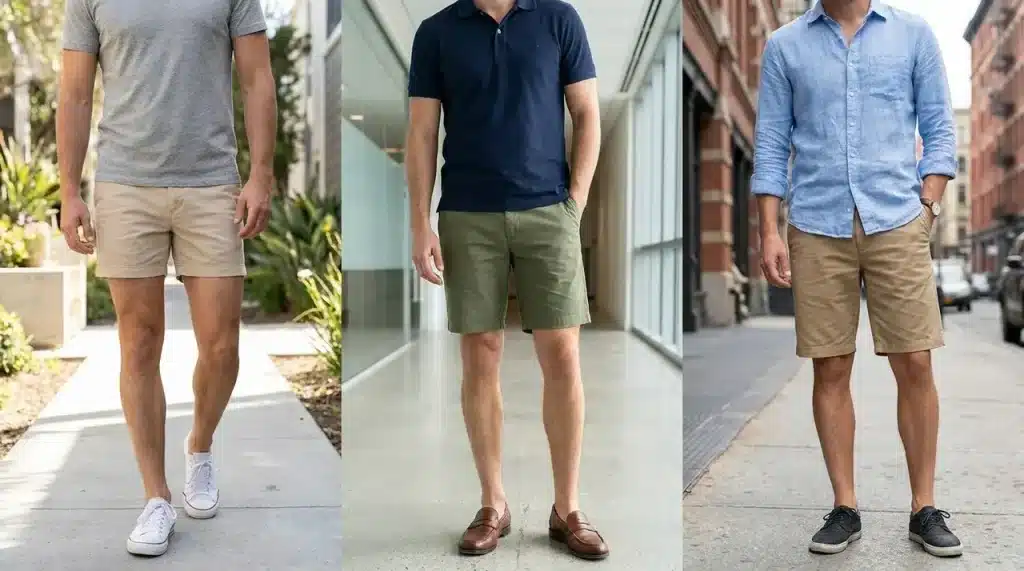
The same rules apply once you cut the leg short, just with a few standard lengths to choose from.
- Short: 17 to 18 inches, for the most leg
- Medium: 19 to 20 inches, a middle-ground length
- Long: 21 to 22 inches, for more coverage
With the style options mapped out, it’s worth pausing on where all these variations actually came from.
Key Characteristics of Chino Pants
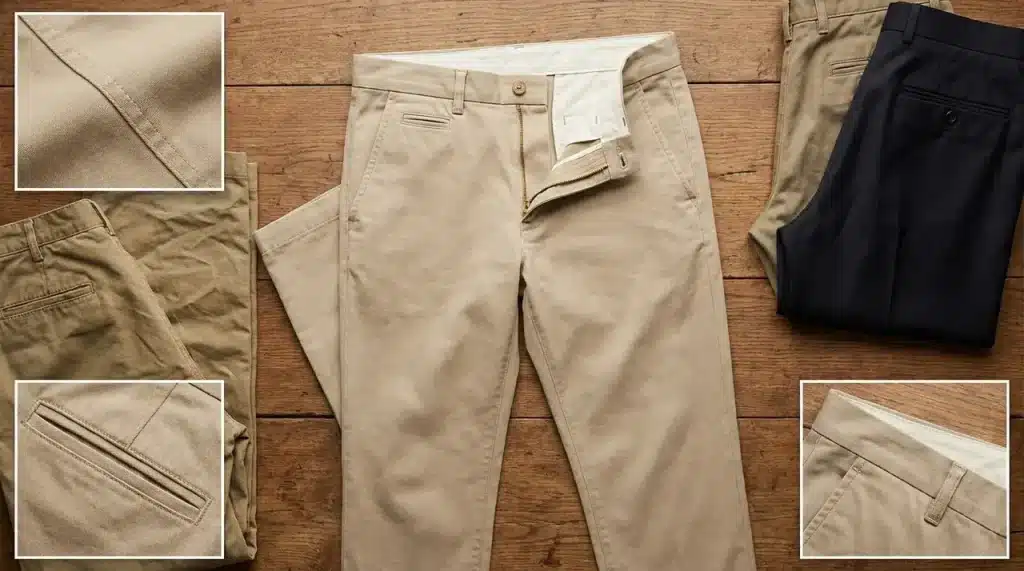
A true pair has a flat front with no pleats, and either a five-pocket design (two side, two back, one coin pocket) or slanted side pockets.
The waistband is fixed with belt loops, the fly is a zip with a button closure, and the fabric itself is a smooth cotton twill weave.
Many pairs also use a besom, or welt, back pocket: a narrow slit rather than a bulky patch pocket. It’s a small detail, but it’s what keeps the back of a chino sitting flat and clean when you tuck in a shirt.
Miss any one of these, and you’re probably looking at khakis or dress slacks instead.
| Feature | Chinos | Khakis | Dress Slacks |
|---|---|---|---|
| Fit | Slim to relaxed | Looser, often roomier | Structured, tapered |
| Pleats | Rarely | Sometimes | Often |
| Fabric weight | Light to mid | Heavier | Dressier, structured |
| Formality | Smart-casual | Casual | Formal |
The easiest way I explain it to friends: khakis are the looser, heavier cousin, dress slacks are the formal older sibling, and chinos sit right in the middle, doing double duty for almost any occasion.
Now that you can spot a proper pair, let’s talk about how to actually wear them well.
How to Style Chino Pants
Chinos are one of the few pants that move easily between a desk, a dinner, and a Saturday errand run, if you style them right.
Dress It Up: Pair chinos with a button-down and a blazer for business casual. Skip the sneakers here; leather loafers or Oxfords finish the look properly.
Keep It Casual: A plain T-shirt and clean white sneakers are my go-to combination. Roll the cuff slightly for a relaxed, off-duty finish.
Weekend to Work Transition: Chinos earn their keep here. Swap a morning polo and loafers for an Oxford shirt and blazer by afternoon, same pants, two completely different registers.
Seasonal Styling: Lighter shades like stone or khaki work best for warm months. Darker shades like navy, olive, or black layer well with knits once it cools down.
Mind the Details: Cuff the hem so it breaks just above the shoe, and match your belt or watch metal to the shade of your chinos. It’s a small habit that keeps the whole outfit looking intentional.
A Few Styling Rules I Follow
- Never wear chinos with dress shoes that are too formal for the fabric (think patent leather or wingtips); it throws off the balance
- Cuff or hem chinos so they break just above the shoe; a puddle of extra fabric at the ankle reads sloppy
- Match metals: silver watch or belt buckle with cooler tones like navy or gray, gold or brass with warmer tones like stone or olive
- Keep one dressier pair in a neutral color on hand for last-minute business casual events
With the fabric, fit, history, and styling covered, here’s the short version to keep in your back pocket.
Conclusion
Chinos earned their spot in my closet because they solve a problem jeans and dress pants can’t quite manage. They flex between dressed-up and dressed-down without ever missing a beat.
Knowing the fabric, the fit, and a bit of the backstory answers the real question: what are chino pants, in a way no tag on a rack ever will.
So next time you’re standing in front of that rack, trust what you now know. Grab a pair that fits the life you actually live, and let it earn its place in your closet the way mine did.
Frequently Asked Questions
Can I Wear Chinos Instead of Jeans?
Yes, chinos work in more settings than jeans, especially offices with a business casual dress code.
Are Chinos Business Casual?
Yes. Chinos are one of the safest business casual picks, especially in neutral colors like khaki, navy, or gray, paired with a button-down and blazer.
What Shirts Look Best With Chinos?
Oxford button-downs, polos, and lightweight knits all pair well, depending on how dressed up you want to look.
Is Chino the Same as Khaki?
Not quite. Khaki refers to a color and heavier weave, while chino means lighter cotton twill. Retailers use both terms interchangeably, though chinos run lighter.
Are Chinos Still in Fashion in 2026?
Yes. Chinos remain a menswear and womenswear staple in 2026, with their smart-casual versatility keeping them a steady presence in workwear and off-duty style guides.