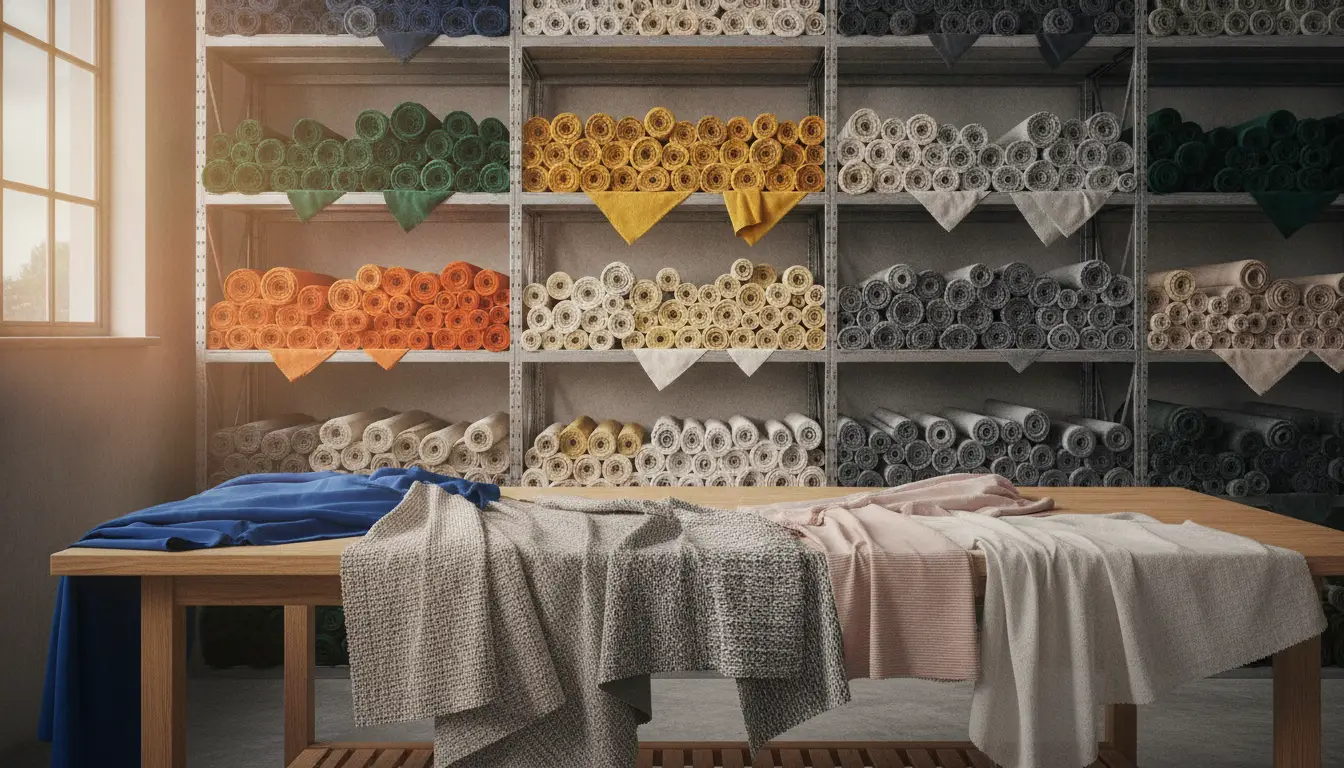
Buying wholesale fabric online gives you access that once required a trip to a trade show or a long-distance call with a sales rep. Today, garment manufacturers, independent designers, and apparel brands of all sizes can source high-quality fabric by the yard directly from their laptops.
The challenge is knowing where to start, what to look for, and how to avoid the pitfalls that can cost you time and real money before a single stitch is sewn.
This guide covers everything you need to know about buying wholesale fabric online. You’ll learn what to look for and how to avoid pitfalls that can cost you time and money.
What Wholesale Fabric Means and How Online Fabric Buying Works
At its core, wholesale fabric buying means purchasing fabric directly from a manufacturer or distributor at a lower per-yard cost, typically by meeting a minimum order quantity.
Online wholesale fabric platforms have made this accessible to a much wider range of buyers, including small independent labels and large apparel manufacturers sourcing fabric by the yard for full production runs.
Domestic Wholesale Fabric Distributors
Domestic wholesale fabric distributors maintain inventory locally and sell directly to buyers within the United States. Because the fabric is already in stock, lead times are shorter and minimum order quantities are often more manageable for independent designers, small brands, and low-volume manufacturers.
Working with a domestic distributor also makes sourcing easy. Fabric specifications are easier to verify, communication is faster, and pricing is usually displayed per yard. This makes it easier for you to estimate upfront. You can also request free swatches, confirm availability, and place orders without the longer timelines associated with overseas sourcing or custom mill production.
Pros:
- Fast shipping, often within a few business days
- Low or no import fees
- Low MOQs accessible to smaller operations
- Easy communication and dispute resolution
Cons:
- Per-yard pricing is higher than overseas sourcing
- Fabric range may be narrower than international mills
International Wholesale Platforms
Platforms like Alibaba and Global Sources connect buyers directly with overseas mills and fabric manufacturers, most of them based in China, India, South Korea, and Turkey. Per-yard pricing runs lower than domestic options, especially for synthetic fabrics and high-volume commodity textiles.
Pros:
- Lowest per-yard pricing for high-volume orders
- Access to a wide range of mill-direct fabrics
- Strong for synthetic and commodity textile categories
Cons:
- High MOQs make it impractical for smaller buyers
- Long lead times reduce production flexibility
- Quality consistency requires careful vetting
- Import fees and freight add significantly to the landed cost
Online Fabric Trade Directories
Directories like Maker’s Row and Kompass don’t sell fabric directly. They index and vet suppliers across the textile industry, making them useful research tools at the shortlisting stage. Maker’s Row focuses on U.S.-based manufacturers and distributors, with searchable filters by fabric type, location, and production capacity. Kompass covers a broader international range.
These directories work best when you’re building a list of potential suppliers to contact directly. Suppliers listed have at least passed a basic vetting process, which reduces the cold-search guesswork that comes with searching general e-commerce platforms.
Pros:
- Pre-vetted supplier lists reduce research time
- Useful filters by fabric type, location, and capacity
- Good starting point for building a long-term supplier shortlist
Cons:
- Directories don’t facilitate the transaction directly
- Listings can be incomplete or out of date
- Still requires independent vetting before placing an order
Trade Show
Major textile trade shows, including Texworld USA and Première Vision New York, bring mills and distributors together in one place. Many exhibitors now maintain online catalogs and order portals, so the sourcing relationship that starts at a show can continue entirely online.
If you need to feel the fabric before committing, trade shows offer the chance to assess hand feel, drape, and construction in person before taking the relationship digital. Collect samples and supplier contacts at the show, then use their online platforms for ongoing orders.
Pros:
- Let’s you assess hand feel and quality in person before ordering online
- Direct access to mill representatives and decision-makers
- Strong for building long-term supplier relationships
Cons:
- Shows are infrequent and require travel investment
- Not practical as a sole sourcing strategy
- Online follow-up still requires the same supplier vetting process
Fabric Buying Agents and Sourcing Services
Fabric buying agents act as intermediaries between the buyer and overseas mills. They handle supplier vetting, sampling, quality inspection, and logistics. Some charge a flat fee, and others, a percentage of the order value.
Several sourcing agencies maintain online portals where clients can track orders, review samples, and communicate with the agent team remotely.
Agents are most useful when sourcing from markets where language barriers, time zone differences, or the manufacturing landscape are difficult to manage directly.
Pros:
- Agents handle vetting, inspection, and logistics on your behalf
- Reduces risk when sourcing from unfamiliar international markets
- Online portals allow remote order tracking and communication
Cons:
- Agent fees add to the total cost
- You’re dependent on the agent’s supplier relationships and judgment
- Less direct control over the sourcing process
How to Source Wholesale Fabric Online Step-by-Step
Sourcing fabric online can feel like standing in front of a wall of options with no map. Here are five steps to help you get started:
Step 1: Define Your Fabric Requirements Before You Search
Before you open a single browser tab, get specific about what you need. Know your fiber content (cotton, polyester, rayon, or a blend), the fabric construction (woven, knit, mesh), the weight in GSM, and how much yardage you need per style.
The more specific you are, the faster you can narrow down suppliers and avoid wasting samples on materials that will never work for your project.
Step 2: Research and Compare Multiple Suppliers
Do not commit to the first supplier you find. Compare at least three to five wholesale fabric sources before making any decisions. Look at their:
- Product range
- Minimum order quantities
- Lead times
- Return policies.
You should find all these details on the supplier’s website.
Step 3: Request Fabric Swatches
No photograph substitutes for holding the actual fabric. This is because colors can change under different lighting conditions, and even weights can feel different in person. A fabric that photographs as a crisp, structured cotton can arrive feeling flimsy and off-grain. Most quality wholesale suppliers offer swatches, either free or for a nominal fee. Order swatches for every fabric before you purchase the full yardage.
Step 4: Evaluate the Sample Against Your Production Specs
Once your swatches arrive, test them against real production conditions. Evaluate the hand feel, drape, stretch recovery (for knits), and how the fabric behaves under a sewing machine or industrial needle.
It’s also important to run a wash and care test based on how the final garment will be used. A fabric might look and feel great initially, but if it shrinks, distorts, or pills after a single wash, it’s not suitable for scaling into production.
Step 5: Place a Small Trial Order Before Scaling Up
Even after sampling, place a small trial order before committing to a full production run. This tests the supplier’s fulfillment accuracy, packaging quality, and whether the bulk yardage matches the swatch you approved.
How to Evaluate Fabric Quality When Buying Online
Quality control is harder to do remotely, but it is not impossible. Knowing what to look for and what questions to ask helps you to get quality fabric:
1. Check the GSM (Grams per Square Meter)
GSM is one of the most reliable indicators of fabric weight and density. A lightweight chiffon runs between 30 and 60 GSM, while mid-weight ponte knit sits around 200 to 280 GSM.
A quality wholesale supplier lists GSM in their product descriptions. If they do not, ask. GSM gives you a measurable way to compare fabric weights across suppliers and avoid unpleasant surprises when material arrives thinner or heavier than expected.
2. Look at Fiber Content and Country of Origin
Fiber content affects everything – drape, breathability, care requirements, durability, and cost. The Federal Trade Commission requires that textile products sold in the United States bear accurate fiber-content labels, which provide a baseline protection for buyers. It looks like this:
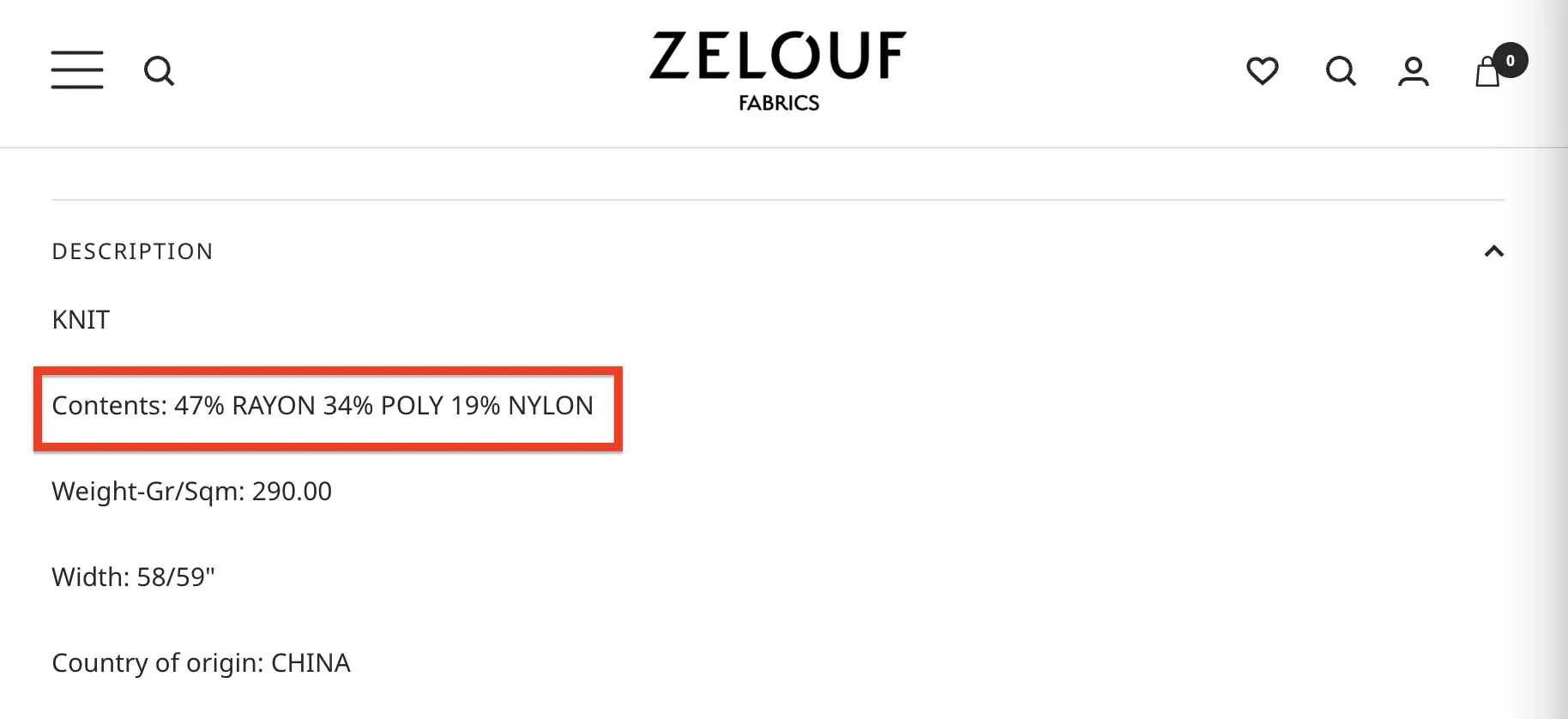
If a supplier didn’t clearly state the fiber content of their fabric, it’s a red flag.
The country of origin also matters for quality benchmarking and supply chain compliance. Premium wovens from Italy, performance knits from South Korea, and cotton jerseys from Turkey each carry different quality associations in the trade. Knowing where the fabric was made helps you set accurate expectations.
3. Read Reviews and Buyer Feedback
Wholesale fabric platforms include buyer reviews and ratings on their website and Google Business Profile. Read them carefully and pay attention to feedback on consistency across multiple orders, not just first-impression comments.
Go through the bad reviews as well, and check the supplier’s response to them. A professional supplier will acknowledge issues, offer solutions, and show evidence of improvement over time. On the other hand, defensive, dismissive, or no responses at all can signal weak customer support and poor accountability.
4. Ask About Fabric Testing and Certifications
If you’re going into fashion retail, then you need suppliers with fabric certifications. For example, the OEKO-TEX Standard 100 certification indicates that a fabric has been tested for harmful substances.
That said, ask suppliers about any certifications they hold before assuming your fabric meets compliance requirements.
5. Request a Strike-Off or Lab Dip for Color-Critical Orders
Color accuracy is one of the biggest variables in online fabric sourcing. If the color of your fabric is central to your design, request a strike-off (for prints) or a lab dip (for solids) before approving a bulk order. This applies to dark or saturated colors, which can vary significantly between a screen image and what comes off the mill.
How to Choose the Right Wholesale Fabric Supplier
The supplier you choose is as important as the fabric itself. A good supplier ships accurately, communicates clearly, and carries inventory that meets your volume needs. Here is how to evaluate them before you place your first order.
1. Look for In-Stock Inventory, Not Just Catalog Listings
Some wholesale suppliers list hundreds of fabric options but carry very little actual inventory. They may be drop-shipping from a mill or acting as a middleman for long-lead items. In-stock inventory means faster shipping, more reliable color and dye lot consistency, and a lower risk of your production timeline being disrupted by a backorder.
2. Check Minimum Order Quantities Against Your Production Scale
Minimum order quantities (MOQs) vary widely across wholesale suppliers. Some require 50-yard minimums per colorway. Others sell fabric by the yard with no minimums. Always match the MOQ to your actual production needs.
3. Evaluate the Breadth of Their Fabric Range
A supplier with a broad, well-organized catalog saves you time on sourcing. If you can find ponte knits, mesh, velvet, and woven shirting from a single trusted supplier, it means fewer vendor relationships to manage, shipping invoices, and quality variables to track across your production. Breadth of range is also a sign of operational scale and longevity in the market. For example, Zelouf Fabrics offers a wide selection of apparel, fashion, and specialty textiles in one place, allowing buyers to consolidate sourcing and simplify vendor management.
4. Assess Their Customer Service Responsiveness
Send an inquiry before you buy. How quickly do they respond? How specific and useful is their answer? A supplier who responds within 24 hours with accurate information shows reliability.
5. Confirm Their Return and Exchange Policy
Things go wrong. Fabric can arrive off-grain, a color may look different from the swatch, or a shipment may be short on yardage. That said, know the supplier’s policy before placing your first order. Reputable wholesale suppliers have a clear and fair policy for addressing fulfillment errors. If a supplier has no stated policy, get it in writing before committing to any volume.
Common Mistakes Beginners Make When Buying Wholesale Fabric Online
Even experienced buyers make sourcing mistakes. For beginners, a few common errors come up repeatedly, and they are almost all avoidable:
Mistake 1: Ordering Without Requesting a Swatch First
Buying wholesale yardage based on product photos alone is one of the most common and costly sourcing mistakes. Screen resolution, color calibration, and lighting all affect how fabric looks in a digital image.
What to do:
Order swatches before committing to any wholesale purchase. Most quality suppliers offer them for free. If a supplier does not provide samples, it’s a red flag.
Mistake 2: Ignoring MOQs Until Checkout
Minimum order quantities can vary across fabric types and suppliers. Some vendors sell fabric by the yard with no minimum purchase requirements, while others require buyers to order a full roll or meet a minimum yardage threshold. Failing to check these requirements early can lead to unexpected costs or delays when you’re ready to place an order.
What to do: Filter by MOQ at the start of your search. Know your production yardage requirements for each style, and research fabrics only from suppliers whose minimums align with your volume.
Mistake 3: Choosing Price Over Quality Consistency
The lowest price per yard is not always the best value. A cheaper fabric may arrive with inconsistencies in color, weight, or texture, or it may develop pilling after a few washes. These quality issues can lead to higher costs through returns, production delays, wasted materials, and potential damage to your brand’s reputation.
What to do: Compare price against quality indicators such as GSM, fiber content, certifications, and reviews. Also, only buy from suppliers with a proven track record.
Mistake 4: Not Accounting for Shrinkage and Yield
Many fabrics, especially natural fibers like cotton and linen, shrink after washing.
What to do: Ask your supplier for shrinkage data before placing your order. For most apparel production, add 5 to 10 percent extra yardage to account for shrinkage, cutting waste, and minor pattern adjustments.
Conclusion
Buying wholesale fabric online is seamless if you know where to start. The more clearly you define your fabric requirements, test samples, and vet suppliers, the smoother your sourcing process becomes.
Frequently Asked Questions
Q: What Is the Typical Minimum Order Quantity for Wholesale Fabric?
Minimum order quantities vary by supplier and fabric type. Many wholesale fabric suppliers set minimums anywhere from 5 yards to 50 yards per colorway or style. Some, including Zelouf Fabrics, offer fabric by the yard with no rigid minimums, making it easier for smaller brands and independent designers to access wholesale pricing without overcommitting on inventory.
Q: Is Buying Fabric by the Yard the Same as Buying Wholesale?
Not always. Buying by the yard simply describes the unit of sale. Retail fabric stores sell by the yard at full price. Wholesale suppliers also sell by the yard, but at lower prices, typically tied to volume or trade-buyer status. The key distinction lies in the pricing structure and the buyer relationship, not in the unit of sale itself.
Q: How Do I Know if a Wholesale Fabric Supplier Is Reputable?
Look for clear product descriptions that include fiber content, GSM, and country of origin. Check for buyer reviews, a transparent return policy, and responsive customer service. In-stock inventory, realistic lead times, and swatch availability are strong indicators of a well-run wholesale operation. Suppliers who have been in the market for years have generally earned their position through consistency, not luck.