Roughly 4,500 people have rated PROVEN Skincare on Trustpilot, and the average sits at 4.6 to 4.7 stars, numbers most beauty brands would envy.
A scan of the Better Business Bureau tells a different story: multiple filings document subscription charges after attempted cancellation, a pattern distinct from how the products actually perform on skin.
Both are real. PROVEN built its name on an AI quiz that promises a formula matched to skin type, climate, and lifestyle.
Here we check if that promise holds up, what customers actually experience, and where the fine print gets complicated. If you have run into similar cancellation friction elsewhere, this legitimacy check covers a comparable subscription brand.
| These findings draw on PROVEN’s published clinical data, more than 4,400 Trustpilot and BBB customer reports, and independent testing from Geeky Posh, The Quality Edit, and Cremes Come True to compare what the brand claims with what customers experience. |
What is PROVEN Skincare?
That backstory matters because it shapes how the products actually work. Here’s what PROVEN is built on, what it’s won recognition for, and what you actually get in the box.
-
PROVEN was founded in 2017 by Ming Zhao, previously in private equity with a Harvard MBA, and Dr. Amy Yuan, a computational physicist affiliated with Stanford. Dr. Yuan built the company’s foundational database after struggling with her own atopic dermatitis.
-
The brand is built on what the company calls the Skin Genome Project, a database that analyzes more than 47 personal and environmental factors. That covers everything from skin type and heritage to local water hardness, humidity, and UV index. PROVEN’s own materials have cited the review corpus behind it at different sizes over the years, ranging from roughly 8 million to 28 million consumer reviews and testimonials, plus more than 4,000 scientific publications and over 20,000 ingredients.
-
Recognition includes the 2018 MIT Artificial Intelligence Award and Best Use of Technology at the 2022 Glossy Beauty Awards, plus two U.S. patents covering its personalization method, including one specific to using geographic, environmental, and seasonal data.
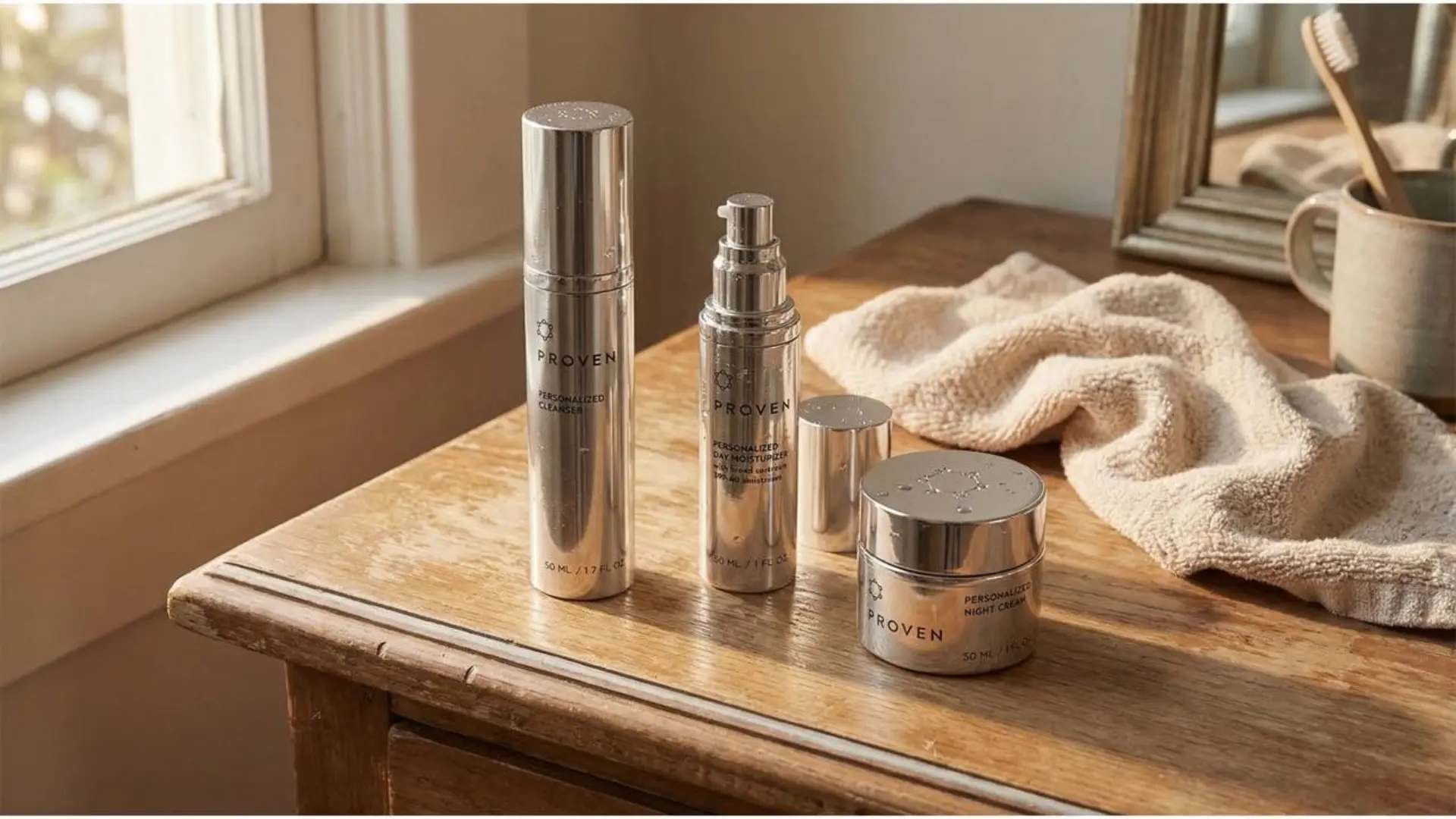
- The core lineup covers a cleanser, day moisturizer with SPF, night cream, and an eye cream duo, all built around the same personalization quiz.
How the PROVEN Skin Genome Quiz Works, and Whether It’s Actually Personalized
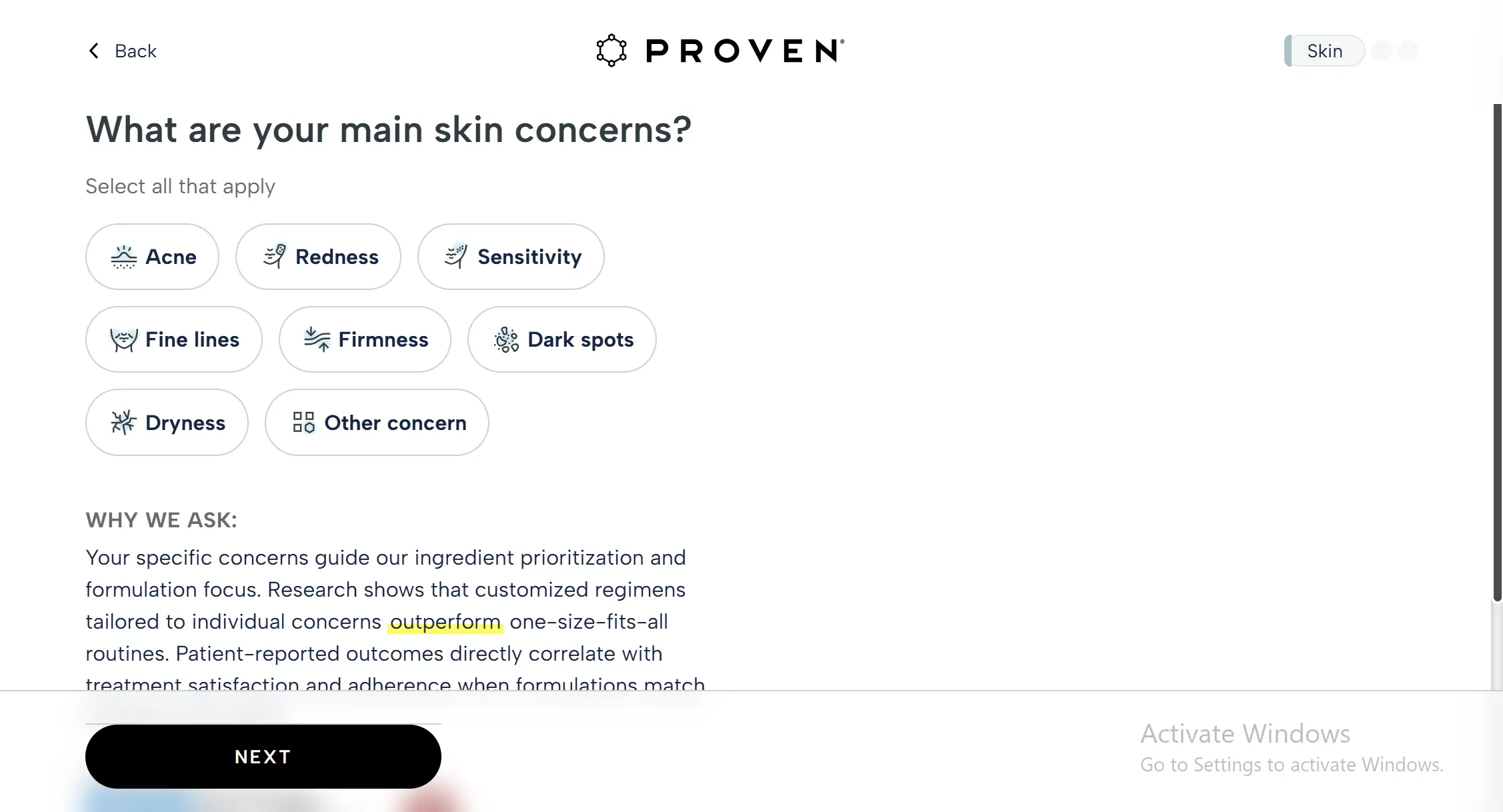
The quiz itself takes about three minutes and expands its next questions based on earlier answers rather than running through a fixed script.
It asks about skin type, tone, sensitivity, and specific concerns, then layers in a zip code (used for UV and climate data) and lifestyle details like stress and screen time.
Once it’s done, the system shows the exact active ingredients selected and their percentages, along with the reasoning behind each one, a level of transparency most quiz-based skincare brands skip entirely.
Beauty writer Jenny Wu of Geeky Posh ran a six-week sponsored test (the post discloses that PROVEN provided the products) and flagged one practical tip for anyone taking the quiz. Narrowing your stated concerns down to just a few, three in the reviewer’s case, tends to produce a more focused formula than selecting every option that applies.
The Quality Edit’s independent test of the quiz flow raised a related point worth knowing before you start. Some questions felt easy to answer, while others required a level of familiarity with your own skin that not every first-time quiz taker will have going in.
There’s also a practical wrinkle in the flow itself: the quiz doesn’t offer a way to opt out of SPF in the day moisturizer, and removing it requires emailing customer support directly.
Anyone still deciding between a personalized system and a straightforward routine might find this simple skincare routine useful for comparison.
PROVEN Skincare Ingredients: What’s Actually in the Formulas
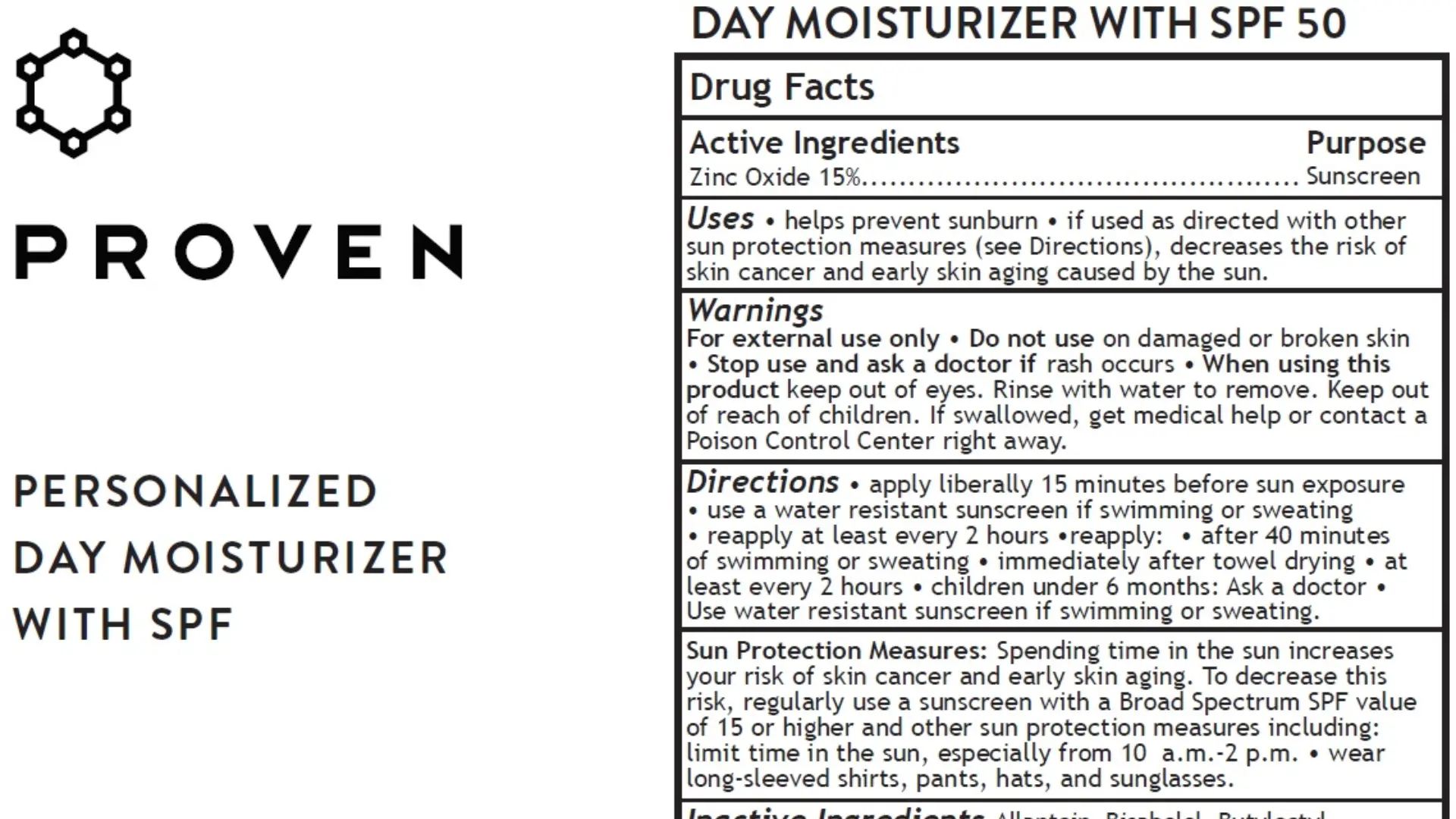
The most detailed public list of ingredient percentages comes from Geeky Posh’s six-week sponsored test, which disclosed the exact percentages in one personalized formula:
- 1% turmeric root extract for sebum regulation and antioxidant support
- Pomegranate extract to help counter UV damage and support collagen
- Tamanu oil for barrier support and its fatty acid content
- 1.62% ginseng extract for firmness and hyperpigmentation
- 1.2% green tea extract for barrier protection and antioxidant support
- 4% azelaic acid for gentle exfoliation and brightening
- Rose oil for radiance, though it’s a fragrance-containing ingredient worth flagging for anyone with reactive or sensitive skin
That same reviewer noted a real limitation: her formula skipped vitamin C and niacinamide entirely, ingredients many dermatology-focused writers treat as staples.
If you want to know why that gap matters, vitamin C in skincare explains the benefits those two actives bring on their own.
It’s a legitimate gap, not a dealbreaker, since PROVEN’s approach leans on the ingredients working together across a formula rather than any single hero active.
PROVEN Skincare Reviews: What the Ratings Actually Show
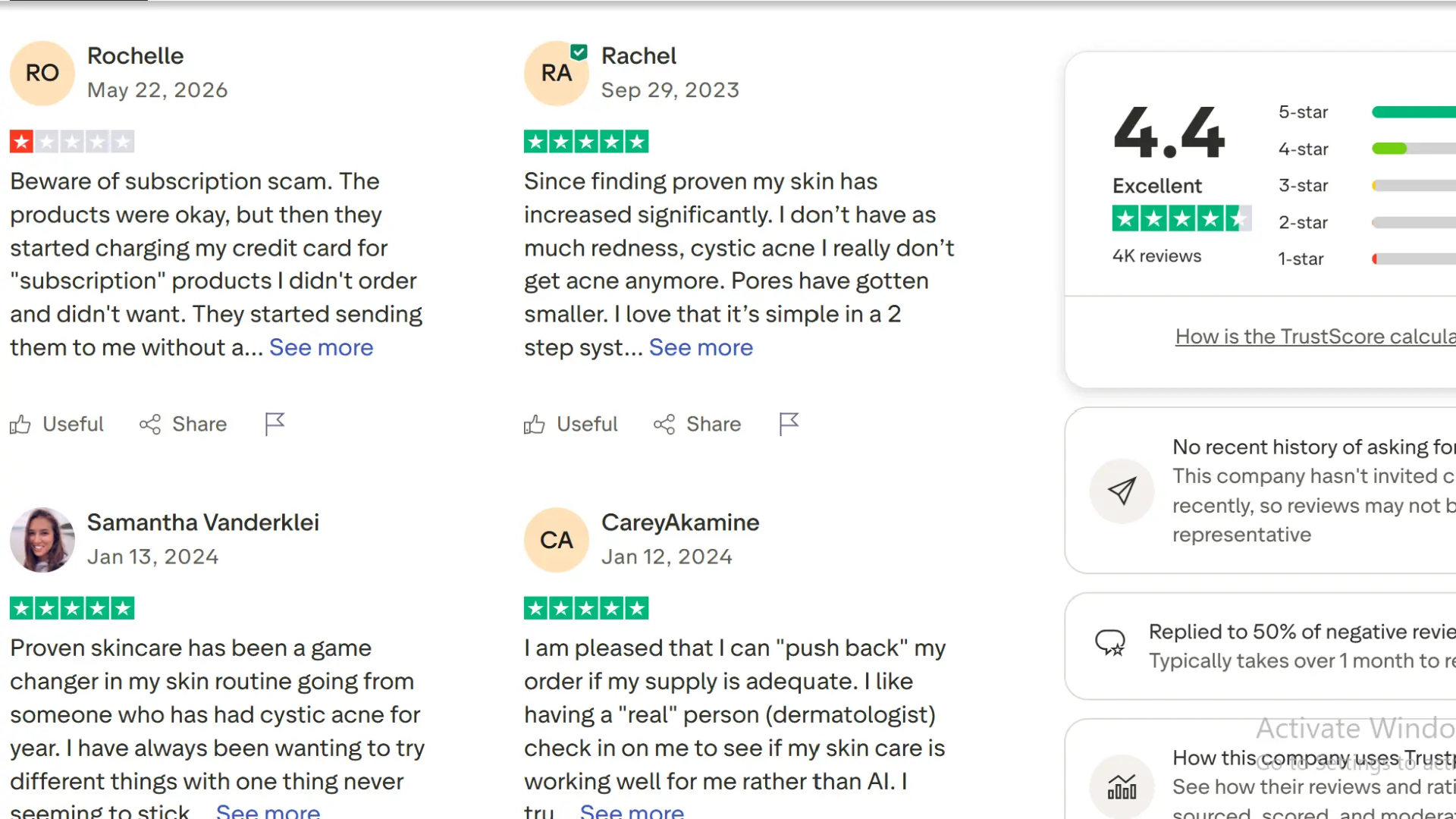
The headline number is real: PROVEN holds roughly 4.6 to 4.7 stars across more than 4,477 verified Trustpilot ratings, a rating that’s held steady across 2023 through 2026 snapshots.
That’s a strong average for a subscription beauty brand, and the five-star reviews cluster around a few consistent themes: reduced redness, fewer cystic breakouts, smaller-looking pores, and the simplicity of a two- to three-step routine that people actually stick with.
The complaints tell a narrower story than the star rating alone suggests. Reading through Better Business Bureau filings, the negative pattern isn’t random dissatisfaction with the products themselves.
It clusters around three specific, recurring issues: skin reactions in the first few days for some users, the SPF’s white cast or perceived underprotection, and difficulty canceling subscriptions before another shipment bills. Several filers describe a harder version of this problem too, including refunds granted and then reversed, and one customer billed roughly a year after canceling with no active resubscription on their end.
PROVEN’s own cancellation policy states that a payment method is charged once an order enters fulfillment, not on the renewal date itself. Canceling after that point won’t stop a shipment already in motion, so it’s worth checking the account dashboard before assuming a cancellation went through.
That’s a useful way to frame the brand for anyone deciding whether to try it: the ratings are high, and the negative minority isn’t scattered across every possible complaint; it’s concentrated in three identifiable, avoidable issues.
Real Before and After Results From Independent Reviewers
Marketing claims are one thing, but real results from people who actually used the products tell a fuller story. Here’s what independent testers and reviewers experienced, including gifted products, sponsorships, and all.
- Cremes Come True, in a gifted, disclosed comparison against Rodan + Fields Redefine, reported reduced redness and firmer, more even-toned skin, describing fine lines as refreshed rather than eliminated. Since PROVEN gifted the products for this comparison, keep that context in mind alongside the results.
- Geeky Posh’s six-week sponsored trial reported no breakouts or allergic reactions over the full test period. The cleanser and night cream were rated highly; the SPF day moisturizer was the clear weak point, and the reviewer ended up reintroducing a separate exfoliator and sunscreen alongside the PROVEN set.
- The Quality Edit’s independent review found the personalized cleanser gentle yet effective for daily use, while noting the $129.99 system runs on the pricier side even though it typically stretches past the promised two-month supply.
- Multiple verified Trustpilot reviewers with rosacea and sensitive skin reported no flare-ups, and others described clearer skin within a few weeks of starting.
- PROVEN’s own reviews page cites a 28-day clinical study of 33 participants ages 35 to 55, reporting that 94% saw smoother, softer skin and 84% said they’d recommend the brand. Most customers reportedly notice texture and hydration changes within 2 to 4 weeks, with pigmentation and fine line improvements compounding over 8 to 16 weeks.
Since this is brand-reported data rather than an independently published study, treat the numbers as a starting point, not a guarantee.
Results genuinely vary by skin type and concern, the same way results vary for anyone testing a new routine, as covered in this six-week skincare test from a different personalized brand.
PROVEN Skincare Pricing: Is It Worth the Cost?
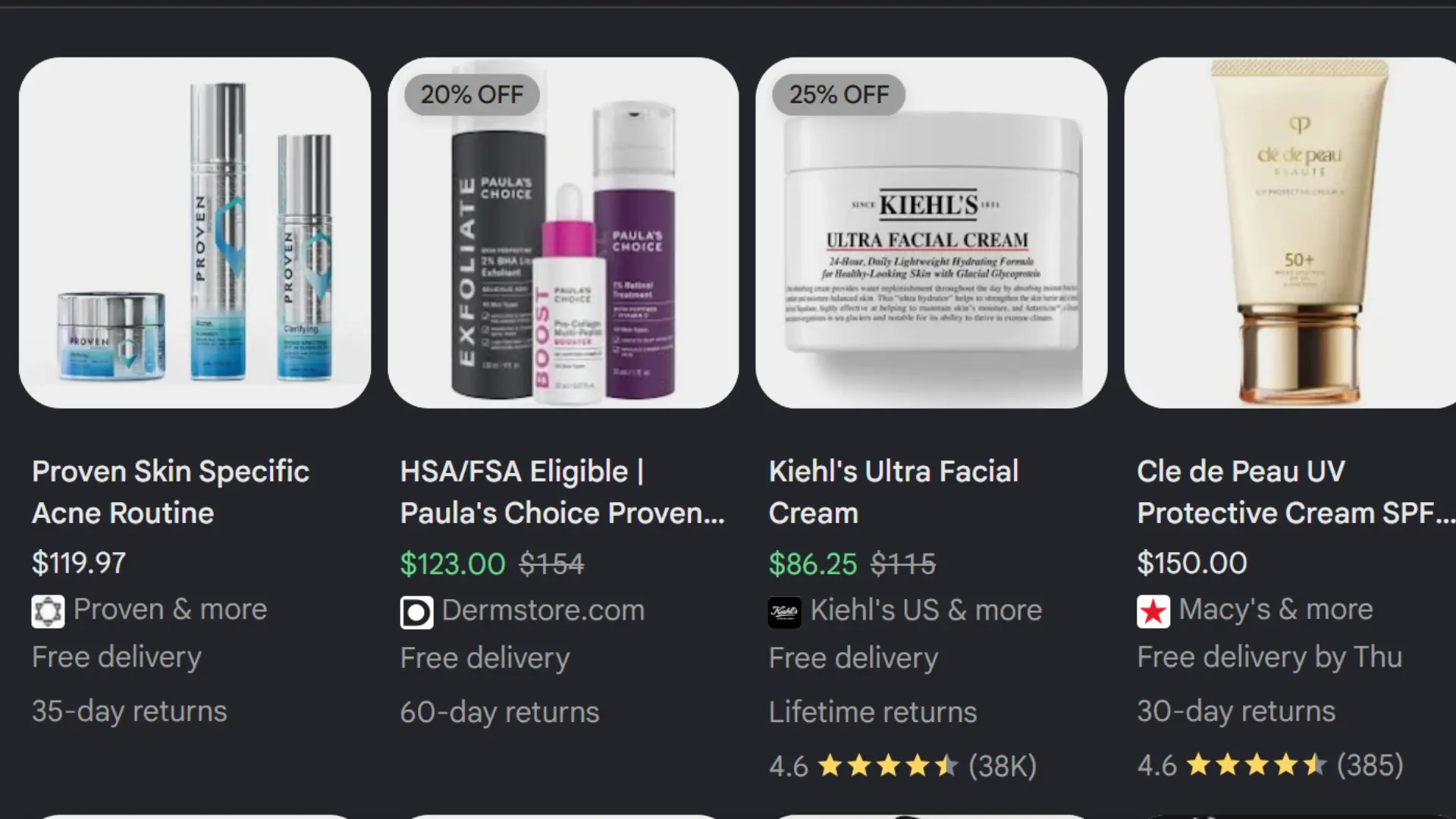
The 3-step system runs $129.99 for roughly an 8-week supply at full price, with individual products priced separately: the cleanser around $30 to $40, the day moisturizer around $45 to $60, and the night cream around $85 to $100, depending on subscribe and save versus a one-time purchase.
Against the broader personalized skincare category, that’s a mid-to-premium price point.
Atolla, an MIT-born competitor that once ran a serum plus testing kit subscription around $45 a month, was acquired by Function of Beauty in 2021 and no longer operates as a standalone brand, so any price comparison should use Function of Beauty’s current line rather than Atolla’s old rates.
Function of Beauty’s own personalized skincare line is the more current comparison point in that same price tier, priced in a broadly similar range, which makes it the more useful benchmark for anyone shopping on price today.
Reviewers are split on value. Several call PROVEN’s system a fair trade for people who don’t want to research ingredients themselves, since the personalization and simplicity do the work a longer routine normally requires.
Others push back specifically on the eye cream, arguing the results don’t clearly justify the price compared to the rest of the lineup.
Pros and Cons of PROVEN Skincare
No skincare system is perfect, and PROVEN is no exception. Here’s a side-by-side look at where it delivers and where it still falls short.
| Pros | Cons |
|---|---|
| Quiz-driven formulas with visible ingredient percentages and reasoning | SPF in the day moisturizer measured lower than standalone sunscreens, and can’t be removed during the quiz itself |
| Simple 2 to 3 step routine that’s easy to stick with daily | No vitamin C or niacinamide by default in most formulas |
| Strong average ratings (4.6+) across a large review volume | Subscription cancellation and billing complaints appear repeatedly in BBB and Trustpilot filings |
| Option to reformulate if the first set underperforms | Higher price point than most drugstore or basic personalized adjacent brands |
| Previously sold in Sephora locations (partnership ended in 2024) and still ships internationally (EU/UK) | Independent, non-sponsored long-form reviews are scarce; much of the glowing coverage is affiliate or gifted content |
Who Should (and Shouldn’t) Try PROVEN Skincare
Personalized skincare isn’t a fit for everyone, and that’s by design. Here’s how to tell quickly whether PROVEN lines up with your skin, routine, and priorities.
A good fit if you:
Want to stop researching ingredients and follow a formula built for you
Prefer a minimal routine over a ten-step regimen
Have combination or mildly sensitive skin with concerns around tone, occasional breakouts, or early fine lines
Worth reconsidering if you:
Already rely on a dedicated high SPF sunscreen and don’t want a second product layered on top every morning,
since sun protection habits matter well beyond the products in your routine, as cumulative UV damage research shows
Specifically want vitamin C or niacinamide in your routine
Have had past issues with subscription-based billing from other companies and want to avoid that friction entirely
Conclusion
PROVEN Skincare isn’t a scam, and it isn’t a miracle either. The quiz produces real formulas with disclosed percentages, the ratings reflect satisfied customers, and people with rosacea and cystic acne have reported calmer, clearer skin within weeks.
But the SPF needs backup, the eye cream skips vitamin C and niacinamide, and the billing complaints are frequent enough to plan around.
For someone who wants a simple routine without researching ingredients alone, PROVEN is worth trying, with a calendar reminder set before the next subscription cycle bills.
Set that reminder for a few days before your original order date rather than the renewal date itself, since PROVEN charges a payment method as soon as an order enters fulfillment, not when the subscription technically renews. And if breakouts show up in the meantime, it helps to rule out other causes first, since makeup can trigger breakouts just as easily as a new skincare formula can.
Frequently asked questions
Is PROVEN Skincare a scam?
No. It’s a patented, funded company that ships real, formulated products. A subset of Trustpilot and BBB reviews describe billing and cancellation friction that reads as scam like to the customers affected, but that’s a customer service pattern, not evidence of a fraudulent business model.
How long does it take to see results from PROVEN Skincare?
Per the brand’s own reporting, texture and hydration changes typically show up within 2 to 4 weeks, with pigmentation and fine line improvements compounding over 8 to 16 weeks.
Does PROVEN Skincare work for acne or rosacea?
Several verified Trustpilot reviewers with rosacea and sensitive skin reported no flare ups and reduced redness, and others with cystic acne reported fewer breakouts.