It’s surprisingly easy to lose track of how long your makeup has been sitting in your bag.
Months turn into years, favorite products get used a little at a time, and before you know it, you’re wondering if they’re still safe to apply.
As a makeup artist, it’s a question I hear all the time. Does makeup expire?
It does, but the real challenge is knowing which products need replacing, which ones still have life left, and the warning signs you should never ignore.
Why Makeup Expiration Confuses So Many People
Part of the confusion comes down to regulation. The U.S. Food and Drug Administration doesn’t require cosmetics to carry an expiration date the way food does, so brands decide on their own whether to print one.
Some do, especially for sun care and lip products, but plenty leave it up to the PAO symbol instead.
I used to guess too. Early on, I hated the idea of tossing anything I’d paid for, so I kept using things well past when I should have.
What actually determines shelf life is a mix of ingredients, packaging, and how the product gets used day to day. A liquid foundation in a pump bottle behaves differently than the same formula in a jar you dip fingers into.
Air exposure, warmth, and repeated touching all speed up the clock. That’s the part most people miss when they ask if makeup expires.
How Can You Tell If Your Makeup Has Expired
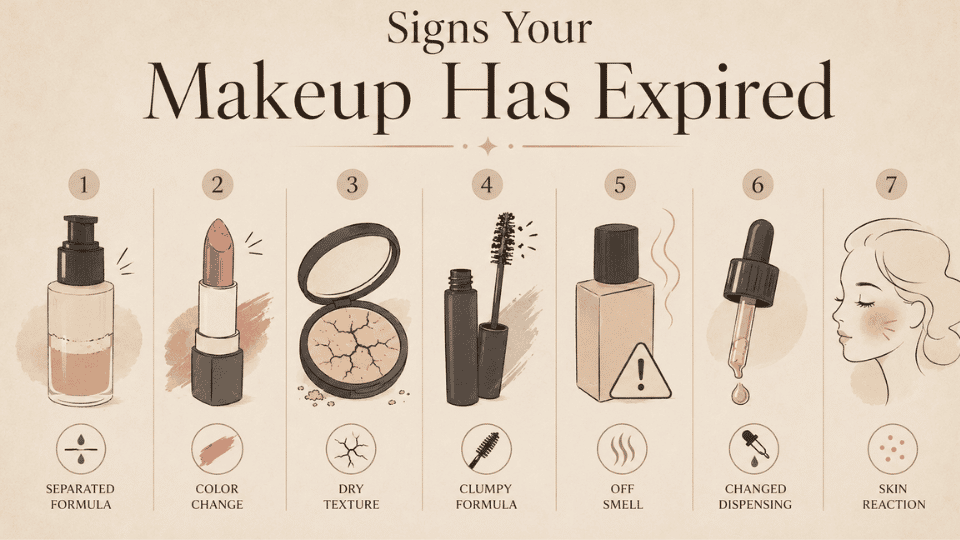
Most expired products give you a warning before they cause a problem; you just have to know what to look for. Here are the signs I check for before I trust a product on my face.
- Off smell: A faint sourness or chemical note that wasn’t there when you bought it is usually the first clue.
- Grainy or clumped texture: A formula that no longer glides on smoothly has likely broken down past its usable life.
- Color shift: A concealer turning slightly orange or a lipstick going dull points to oxidation happening inside the tube.
- Dry or crumbly powder: Pressed powders that feel oddly hard or flake apart have dried out past their prime.
- Separated liquid: Foundation or liquid liner that’s split into layers is past the point of reliable use.
- Sputtering pump or dropper: A sudden change in how a product dispenses can mean the formula inside has thickened or changed.
- Skin reaction: Stinging, redness, or a breakout after months of trouble-free use is a signal on its own, even without a visible change.
None of these signs need a lab test to spot, just a few seconds of paying attention before you apply anything.
How Long Does Makeup Last
Here’s a quick reference for the products I get asked about most, based on standard industry shelf life guidance once a product is opened.
| Product | Average Shelf Life (After Opening) |
|---|---|
| Liquid foundation | 12 months |
| Powder foundation | 18 to 24 months |
| Concealer | 12 months |
| Cream blush or bronzer | 12 months |
| Powder blush or bronzer | 18 to 24 months |
| Powder eyeshadow | 18 to 24 months |
| Liquid eyeshadow | 6 to 12 months |
| Eyeliner pencil | 12 months |
| Liquid eyeliner | 3 to 6 months |
| Mascara | 3 to 6 months |
| Lipstick | 12 to 18 months |
| Lip gloss | 12 months |
| Lip balm | 12 to 18 months |
| Nail polish | 12 to 24 months |
| SPF-containing makeup | 6 months |
Treat these ranges as a starting point, not a guarantee, since storage habits and how often a product is used will always shift the timeline slightly.
Makeup Expiration Dates by Product Type
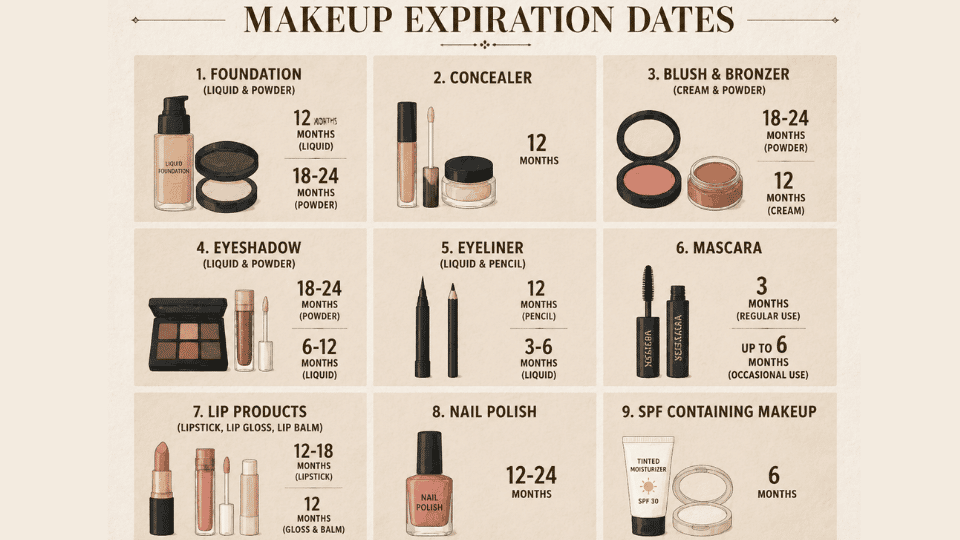
Every category in my kit ages differently, and the reasons come down to formula, packaging, and how often air and fingers get involved.
1. Foundation (Liquid and Powder)
Liquid foundation typically lasts around 12 months once opened, sometimes less if it comes in a jar rather than a pump. Powder foundation holds up longer, generally 18 to 24 months, since its dry formula resists bacteria better than a liquid base.
- Average Shelf Life: 12 months for liquid, 18 to 24 months for powder.
- Replace Sooner If: The formula separates, smells off, or no longer blends evenly on your skin.
2. Concealer
Most concealers last about 12 months after opening, close to the timeline for liquid foundation since the formulas are similar. Creamier versions in small pots tend to expire faster than click pens or doe-foot applicators that limit air exposure.
- Average Shelf Life: 12 months after opening.
- Replace Sooner If: It starts pulling into fine lines or oxidizes to a noticeably different shade.
3. Blush and Bronzer (Cream and Powder)
Powder blush and bronzer typically last 18 to 24 months with proper storage, similar to other pressed powder products. Cream versions expire faster, usually within 12 months, since the oils in the formula break down more quickly once exposed to air.
- Average Shelf Life: 18 to 24 months for powder, 12 months for cream.
- Replace Sooner If: The powder looks patchy or the cream formula separates or smells rancid.
4. Eyeshadow (Liquid and Powder)
Powder eyeshadow generally lasts 18 to 24 months, making it one of the longer-lasting categories in your whole kit. Liquid or cream eyeshadow lasts closer to 6 to 12 months because the higher moisture content invites bacteria sooner.
- Average Shelf Life: 18 to 24 months for powder, 6 to 12 months for liquid.
- Replace Sooner If: Pigment fades, texture turns cakey, or application starts pulling at your lid.
5. Eyeliner (Liquid and Pencil)
Pencil eyeliner can last around 12 months, and regular sharpening actually extends its usable life by removing exposed product. Liquid eyeliner has a shorter run, typically 3 to 6 months, since the brush repeatedly contacts your skin and lash line.
- Average Shelf Life: 12 months for pencil, 3 to 6 months for liquid.
- Replace Sooner If: The tip dries out, flakes, or the formula starts to skip while applying.
6. Mascara
Mascara has the shortest shelf life of anything in your bag. Most dermatologists recommend replacing it after 3 months of regular use, with 6 months as the outer limit if you only reach for it occasionally.
- Average Shelf Life: 3 to 6 months, depending on how often it’s used.
- Replace Sooner If: It clumps, smells different, or starts to dry out and flake under your eyes.
7. Lip Products (Lipstick, Lip Gloss, Lip Balm)
Lipstick generally lasts 12 to 18 months, while gloss and balm tend to run closer to 12 months once opened. Balms with natural oils or added SPF often break down faster than fully synthetic formulas without those ingredients.
- Average Shelf Life: 12 to 18 months for lipstick, 12 months for gloss and balm.
- Replace Sooner If: Texture turns waxy and dry, or the color no longer matches how it looked when new, since tracking lipstick’s shelf life often comes down to exactly these two changes.
8. Nail Polish
Nail polish can last 12 to 24 months, longer than most color cosmetics on this list thanks to its solvent-based formula. The formula thickens over time as the solvent slowly evaporates, even when the cap stays tightly closed.
- Average Shelf Life: 12 to 24 months after opening.
- Replace Sooner If: It separates permanently, smells strongly of acetone, or clumps on the brush.
9. SPF Containing Makeup
SPF makeup, including tinted moisturizers and setting powders, generally lasts about 6 months once opened and in regular use.
Sunscreen ingredients are classified as over-the-counter drugs by the FDA, not cosmetics, which is why they’re legally required to carry a printed expiration date rather than relying on the PAO symbol alone.
- Average Shelf Life: 6 months after opening.
- Replace Sooner If: You want reliable protection, since faded SPF won’t give you any visual warning.
Keep this list nearby the next time you’re cleaning out a makeup bag, since a quick glance tells you what’s genuinely still safe.
How to Check Makeup Expiration Date
Most products actually tell you their shelf life; you just have to know where to look on the packaging. Here’s how I check whether the product is brand new or something I’ve had for a while.
- Look for the PAO symbol: A small open jar icon with a number and the letter M means months after opening.
- Note your opening date: The PAO clock starts the day you first use the product, not the day you bought it.
- Check for a batch code: If there’s no PAO symbol, a manufacturer or batch code on the packaging can help you estimate age.
- Search the code online: Most brand websites let you decode a batch number if you can’t read it directly.
- Use your senses as a backup: Smell and texture often signal a problem before any printed date catches up.
- Set a phone reminder: For anything short-lived, like mascara or liquid eyeliner, those dates slip past me too.
I still miss the occasional PAO date buried in tiny print, honestly, which is exactly what the sniff test is for.
Can Unopened Makeup Expire?
Yes, unopened makeup can expire, just on a longer timeline than anything you’ve already opened and started using.
Most sealed products are generally considered stable for two to three years, though this varies by formula and how the product was stored before you bought it; it’s a common guideline, not a guarantee.
Heat, sunlight, and humidity all speed up degradation, even inside a sealed package. I never store backup products near a window or on a bathroom shelf.
A product that sat in a hot car or a sunny store display for weeks may have less life left than the general timeline suggests.
Mascara is the exception worth knowing. An unopened tube can last 2 to 3 years, but that number drops fast the moment you break the seal, which is why the opened and unopened timelines for mascara look nothing alike.
Why Using Expired Makeup Can Be Risky
Expired makeup isn’t just a performance issue; it can genuinely affect your skin and, in rare cases, your health. Here’s what’s actually happening once a product passes its safe window.
Preservatives break down: Once they do, bacteria and fungi can grow freely inside the product itself. A UK study on used cosmetics found that 70 to 90 percent of tested products, including lipstick, mascara, and beauty blenders, were contaminated with bacteria such as E. coli and staph.
Eye products carry the highest risk: Mascara wands move in and out of the tube constantly, and a resulting eye infection can escalate fast if it isn’t caught early.
Skin reactions are the common outcome: Irritation, breakouts, or redness can appear out of nowhere and get blamed on the wrong product entirely.
Lip products spread easily: They’re used near the mouth and often shared without a second thought, expired or not.
Active infections shorten the clock: If you get a cold sore, stop using lip products on it and start fresh once it clears. The same goes for mascara and other eye products if you’re dealing with pink eye or another eye infection, since reusing them can reinfect you even after the illness is gone.
I once spent a week blaming a new moisturizer for a breakout before realizing my concealer was the actual problem.
|
When Should You Throw Away Makeup?
|
How to Make Makeup Last Longer
A few small habits can genuinely stretch how long your products stay usable, without changing how they perform. These are the ones I actually stick to in my own routine.
- Wash your hands first: Do this before touching any product, especially anything applied with fingers.
- Use a spatula for jars: A disposable applicator or spatula keeps fingers from introducing bacteria directly into the product.
- Clean brushes weekly: Dirty tools transfer bacteria straight back into whatever you’re applying next, so washing your makeup brushes on a regular schedule matters just as much as tracking product expiration dates.
- Store in a cool, dry spot: A drawer works better than a humid bathroom cabinet near the shower.
- Keep lids tightly closed: This slows air exposure and keeps formulas from drying out between uses.
- Twist mascara wands, don’t pump: Pumping pushes air into the tube and speeds up drying and bacterial growth.
- Write the opening date: A fine tip marker on the bottom of new products means you’re never guessing later.
None of this is complicated. It’s just the difference between a mascara that lasts eight weeks and one that lasts four months.
Final Thoughts
Does makeup expire? It absolutely does, but there’s no reason to stress over every product in your collection.
Once you know the average shelf life of each type of makeup, recognize the warning signs, and store products properly, deciding what to keep and what to replace becomes much easier.
A quick makeup cleanout every few months is a small habit that can protect your skin, your eyes, and the performance of every product you use.
Frequently Asked Questions
Can Expired Makeup Make You Sick Beyond Skin Irritation?
Yes, expired makeup, especially eye products, can sometimes lead to bacterial infections. Replacing eye makeup on time helps lower this risk.
Does Storing Makeup in the Fridge Extend Its Shelf Life?
It can slightly slow product breakdown, but it will not make expired makeup safe to use. Always follow the product’s recommended shelf life.
Is It Safe to Use Makeup Testers at a Store Counter?
It’s best to avoid applying testers directly to your face. Use a disposable applicator or ask for a sample whenever possible.
Do Natural or Organic Makeup Products Expire Faster?
Often, yes. Products with fewer preservatives may have a shorter shelf life and should be replaced according to the manufacturer’s recommendations.
Can You Tell if Powder Makeup Has Expired Just by Looking at It?
Not always. Changes in smell, texture, or performance are often better signs that it’s time to replace the product.