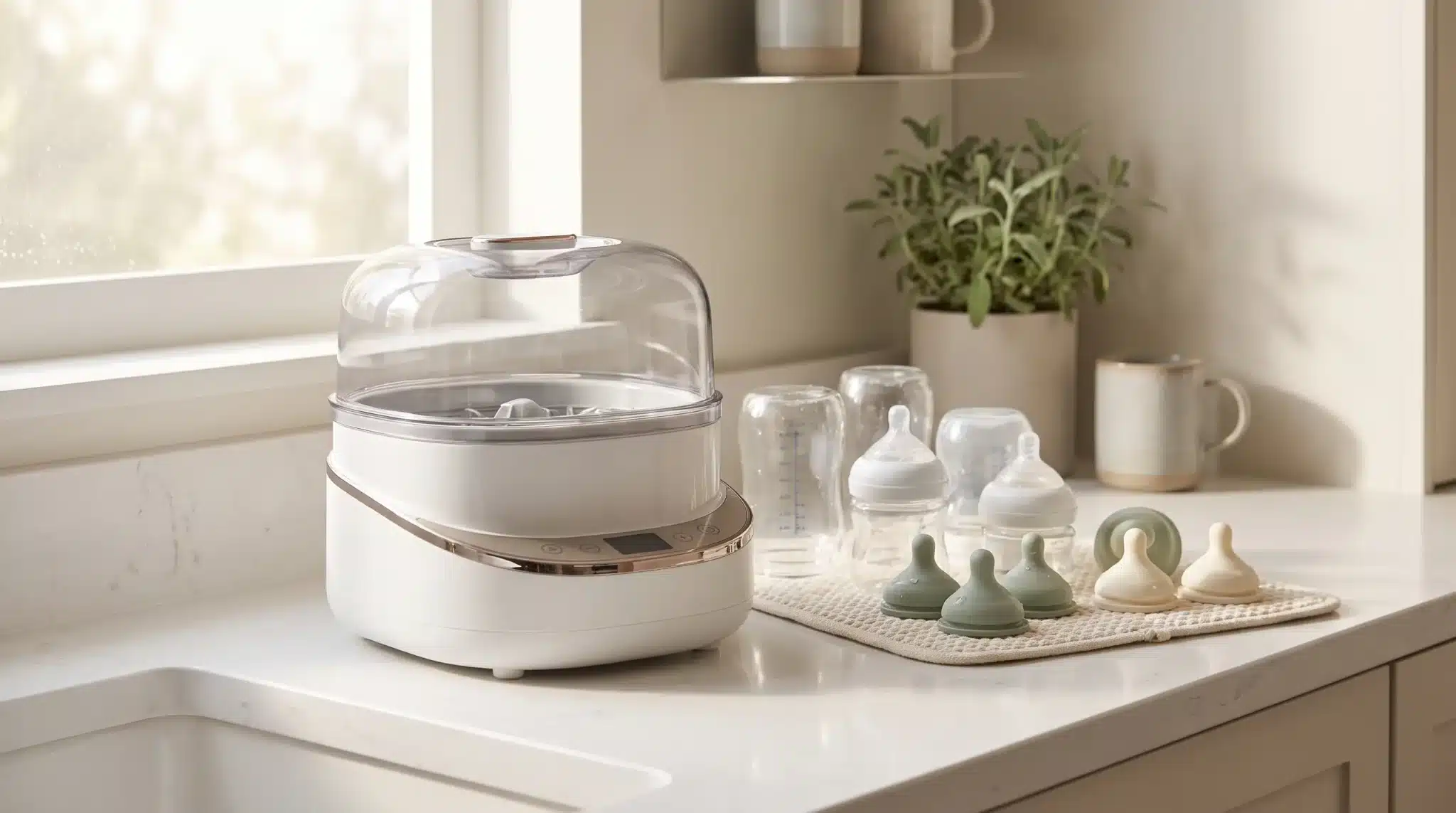
In the fourth trimester, bottles, nipples, and pump parts often pile up faster than you can dry them. If you are searching for the best bottle washer for newborns, the practical answer is not another brush. It is a closed-cycle machine that washes, sterilizes, and dries feeding gear so narrow nipples and valve pieces get the same attention as the bottle body.
That does not mean you failed if you hand-wash. Many families start there. But when feeds happen every two to three hours and the sink never quite clears, a purpose-built washer can return minutes you actually notice—especially during postpartum recovery when standing at the counter is the last thing your body needs.
How Much Time Does Hand-Washing Newborn Bottles Really Take?
Hand-washing looks simple until you count each round. Take apart the bottle, scrub with a brush, clean the nipple and ring, rinse, and dry. Most parents report roughly 8 to 12 minutes per thorough round. On a heavy day—exclusive pumping, combo feeding, or cluster feeding—that can mean four to eight rounds before you add sterilizing or boiling.
That hour or more at the sink is real recovery time you are not using to eat, rest, or hold your baby without a timer in your head. Skip a valve once, and dried milk becomes tomorrow’s stubborn film. Consistency matters as much as intention in the early weeks.
Why Sink Scrubbing and the Dishwasher Fall Short
Hand-Washing at the Sink
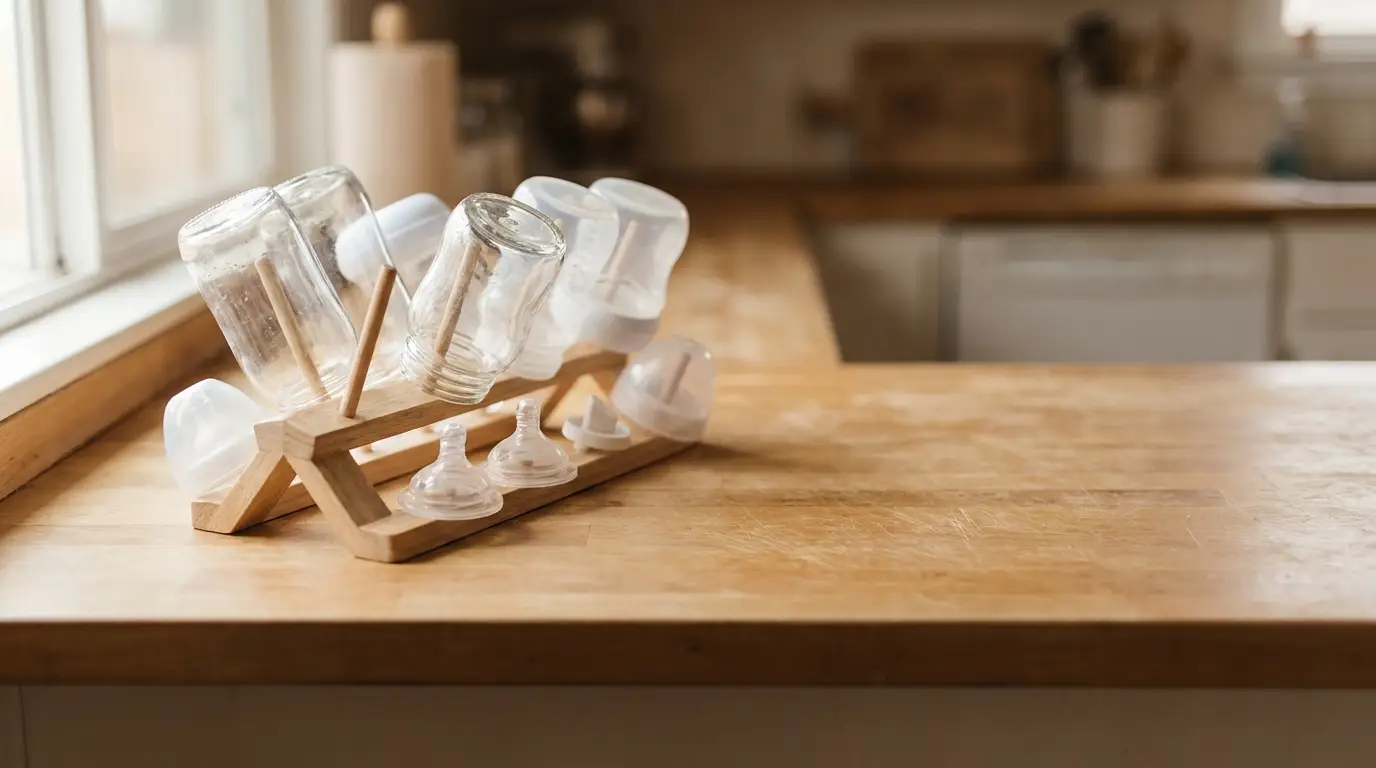
Sink washing works anywhere and respects hand-wash-only labels. You control every piece, which helps when you travel or when instructions say a part should not go in a machine. The trade-off is volume. When wet parts outnumber rack space, items sit longer, and the quick rinse you planned becomes another half-finished chore.
Using a Kitchen Dishwasher
Many families run baby bottles on the top rack with acceptable results on a hot or sanitize program. But dishwashers are built for flat plates, not threaded nipples or pump flanges. Spray arms may miss narrow openings, and mixed loads can leave odors on silicone. High heat can stress silicone nipples and some pump parts over time. Check each label before assuming the dishwasher replaces sterilizing small pieces on its own.
What Should You Look for in a Bottle Washer for Newborns?
Look for high-pressure jets into inverted bottles, separate zones for nipples and accessories, high-temperature sterilizing, and active drying. Capacity matters early: if the unit holds only two or three bottles, you still run multiple cycles while the pile grows. Wide- and narrow-neck compatibility across glass, plastic, and silicone covers most brands. Plan for counter space, a drain connection, and detergent made for milk residue—not just the feature list on the box.
How the Momcozy DeepClean D8 Fits a Newborn Feeding Routine
One option built for that full workflow is the Momcozy DeepClean Baby Bottle Washer (D8). Momcozy is widely known for wearable breast pumps and postpartum feeding gear; the D8 carries the same time-back philosophy into bottle cleanup. It is appliance-style motherhood tech that treats feeding hygiene as a daily system, not a one-off sink task—and it shows how the brand has moved beyond pumps alone, with dedicated bottle care as one of the clearest examples.
On the counter, the D8 fits up to eight bottles—or a full pump kit—in one load, per Momcozy’s product page. The HydroJet360 system uses 64 spray nozzles at 112,000 Pa, with a 154°F hot-water rinse. Momcozy lists TÜV SÜD S-grade cleaning performance, and the sterilize step uses 212°F steam with 99.99% germ reduction associated with milk residue when used as directed. Add a detergent tablet, choose from 22 mode combinations, and run. Rapid Wash completes in as little as 19 minutes. A drain hose sends wastewater to the sink so you are not emptying a tank after every cycle.
What We Like
- Targeted spray for small parts: TargetWash jets and Pump360 rotary assemblies are designed for nipples, valves, and pump components—not just bottle bodies.
- All-in-one rhythm: Wash, steam sterilize, dry, and store in one unit reduces the hop from sink to sterilizer to drying rack during exhausting weeks.
- Documented capacity: Up to eight bottles per cycle, or up to two full sets of breast pump parts per Momcozy’s FAQ, matches high-frequency newborn days.
- Storage window: After drying, Momcozy lists up to 72 hours of hygienic storage with an H13 medical-grade HEPA filter—helpful between cluster feeds when counter space is tight.
Worth Noting
- Footprint: At 270 × 350 × 390 mm, the D8 needs dedicated counter space and a stable surface near a drain.
- Water and power: Momcozy recommends purified water for best results and strongly recommends distilled water to limit mineral buildup. The US model is built for 120V; peak draw reaches about 560W during heat-and-spray cycles.
- Supplies: The unit ships with 60 detergent tablets and 4 descaling tablets, but refills are part of the ongoing routine.
- Not a medical device: Steam sterilization supports everyday hygiene; it does not replace guidance from your pediatrician or care team for premature or medically fragile infants.
Hand-Washing vs Dishwasher vs Dedicated Bottle Washer
|
Factor |
Hand-washing |
Kitchen dishwasher |
Dedicated bottle washer |
|---|---|---|---|
|
Best for |
Travel, single bottles, hand-wash-only parts |
Batch cleaning dishwasher-safe items |
Daily newborn volume, pump parts, narrow crevices |
|
Time per day (heavy use) |
Often 60–90+ minutes across multiple rounds |
Active loading plus long cycle waits |
One load can cover 8 bottles; Rapid Wash ~19 min |
|
Nipples & valves |
Full control if you scrub every crevice |
Easy to miss threads and vents |
Targeted jets for small parts |
|
Sterilize + dry |
Separate boiling or sterilizer step |
Varies by model; silicone heat limits |
Integrated steam sterilize and forced-air dry |
|
Upfront cost |
Low (brush + rack) |
None if you already own one |
Counter appliance + tablets |
Can the DeepClean D8 Wash Pump Parts Too?
Yes—with caveats. Momcozy states the D8 cleans pump parts and small accessories using TubeWash, Pump360 rotational spray, and an Anti-Flip Lock design. Tubing, nipples, valves, and similar parts are listed on the product page. That matters for parents who pump several times a day and want one loaded cycle instead of a separate scrub routine for every flange.
Still check your pump manufacturer’s instructions before loading parts. The D8 covers daily volume; it does not replace reading labels or replacing worn silicone on schedule.
Is a Bottle Washer Worth It During the Newborn Stage?
For occasional bottle use, a brush and rack may be enough. For exclusive pumping, combo feeding, or multiples, a single closed cycle that washes, sterilizes, and dries often beats four to eight sink rounds before noon. The best bottle washer for newborns is one you will actually run: enough capacity, spray that reaches nipple holes, and a dry cycle that leaves parts ready—not dripping while the next feed countdown starts.
Think of it as a recovery-friendly shift, not a perfection standard. You are allowed to make feeding cleanup easier without earning it first.
FAQ
What Is the Best Bottle Washer for Newborns if I Pump and Bottle-Feed?
Prioritize six to eight bottles per load, dedicated small-part spray, and integrated sterilize-and-dry so flanges load with bottles—not a separate scrub between sessions.
Can I use regular dish soap in a bottle washer?
Most units need dedicated tablets for milk residue. Momcozy recommends official cleaning tablets placed in the washing chamber. Regular dish soap can foam excessively or scent silicone.
Do Newborns Need Sterilized Bottles After Every Wash?
Guidance varies by age and health. Many sources relax full sterilization after the early weeks for healthy full-term babies. Ask your care team for premature or immunocompromised infants.
Is Momcozy a good maternal and baby care brand?
Momcozy is widely used in wearable pumping and postpartum feeding gear, with verifiable details on products like the D8—TÜV SÜD-listed cleaning grade and published spray-pressure specs on the product page. Match the product to your routine rather than assuming one brand fits every household.
What Are the Best Momcozy Products for Working Moms?
Working parents often favor tools that cut repeat tasks: wearable pumps for hands-free sessions, travel-friendly feeding gear, and the DeepClean D8 for batch-washing bottles and pump parts after a long day. You do not need the full catalog—pick what matches your pump schedule and kitchen setup.
How soon after a feed should I wash newborn bottles?
Rinse or wash soon after feeding so milk does not dry in threads. Many parents run one full sanitize-and-dry load daily, with quick rinses between feeds.
Bottom line: High-frequency newborn feeding makes a dedicated bottle washer a practical recovery tool—not a luxury flex. The Momcozy DeepClean D8 handles wash, sterilize, dry, and storage in one pass for up to eight bottles or two full pump part sets; pair it with your pump and bottle labels, and adjust sterilize frequency with your pediatrician’s guidance.