I used to think there was no real trick to make makeup last all day, that some people were just born with skin it clung to.
By lunchtime, my foundation looked patchy, my concealer had settled into fine lines, and my blush had almost disappeared.
It turned out the problem was not the makeup itself.
A few small changes in the way I prepped my skin and layered my products completely changed the result.
Now, making makeup last all day feels less like luck and more like following a routine that actually works.
How to Make Makeup Last All Day at a Glance
If you only have a minute, here is the routine I follow every single time.
- Cleanse and lightly moisturize the skin.
- Let skincare and sunscreen settle for a few minutes.
- Apply primer where you actually need it.
- Build foundation in thin layers instead of one heavy coat.
- Set crease-prone areas with powder.
- Finish with a setting spray suited to your skin.
- Blot oil before touching up instead of adding more product.
Each step earns its place for a reason, and the why matters just as much as the order.
Setting Powder vs Setting Spray for All Day Makeup
Both products do different jobs, and I use them together rather than picking one over the other.
| Feature | Setting Powder | Setting Spray |
|---|---|---|
| Main job | Absorbs oil and locks liquid products in place | Melds every layer together into one finish |
| Best applied | Right after foundation and concealer, before eye or lip products | As the final step, once everything else is done |
| Best for | T-zone, under eyes, chin, any spot that shines by midday | Full face, to lock the whole look at once |
| Watch out for | Overuse can look chalky or emphasize dry patches | Holding it too close can pool and disturb your base |
I use both on most faces I work on, powder first to control oil, spray last to blend it all together.
Why Does Makeup Fade, Crease, or Melt?
Before fixing the problem, it helps to know what is actually happening under your foundation.
- Your skin keeps producing oil all day, and that oil breaks down pigment and slides product around.
- Sweat does something similar, especially around the hairline, nose, and any area that runs warm.
- Humidity adds a separate problem on top of heat. It keeps sweat from evaporating off the skin, so product sits in moisture longer and is more likely to slide rather than set.
- Skin naturally pulls moisture from whatever is nearby, including your foundation. Dry, dehydrated patches do this fastest, which is part of why they end up looking cakey rather than flawless.
- Skipping primer removes the grip layer that helps makeup hold onto skin instead of sitting loose on top of it.
- Heavy layering without drying time traps product unevenly, so it creases into fine lines instead of sitting flat.
- Touching your face all day transfers oil and product, which is a habit I see undo a good morning routine constantly.
Once you know what is actually causing the breakdown, fixing it stops feeling like guesswork.
How to Make Makeup Last All Day
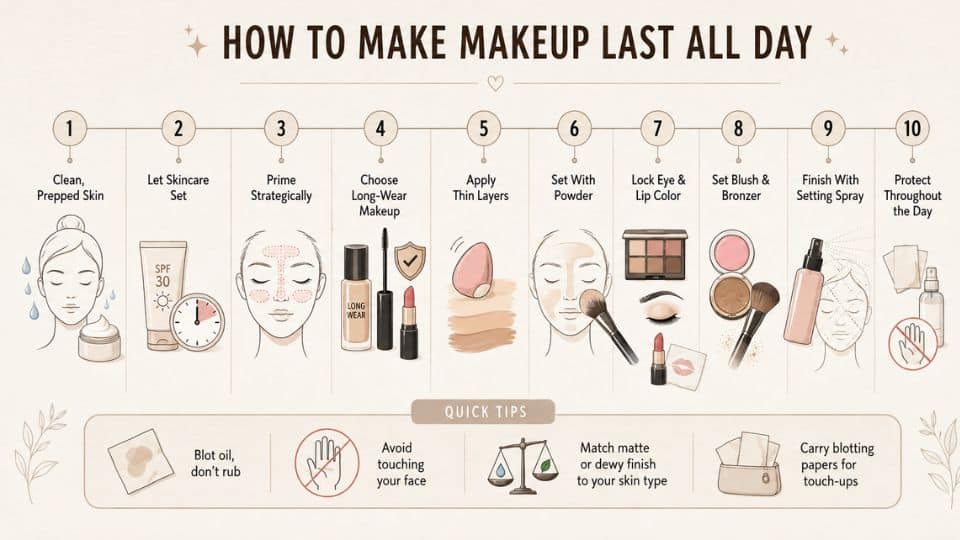
Once you understand why makeup fades, the fix comes down to nine habits I build into every routine, mine included.
1. Start With Clean, Prepped Skin
I never apply makeup to skin straight out of the shower or fresh off a cleanse. Pat your face fully dry first, since damp skin creates a slippery, unstable base.
Follow with a lightweight moisturizer and give it two to three minutes to sink in. Hydrated skin holds foundation instead of pulling moisture from it later in the day.
2. Let Skincare and Sunscreen Fully Settle
I learned to build in wait time after watching foundation pill on skin that was still absorbing sunscreen. Give every skincare step a full minute or two before moving on.
Sunscreen especially needs to set, since a wet SPF layer under foundation is one of the fastest ways to end up with a patchy, sliding base by midmorning.
3. Apply Primer Only Where You Need It
I do not primer an entire face out of habit anymore. I focus mattifying primer on the T-zone, since that is where oil breaks down foundation first.
Dry areas get a hydrating primer instead, and combination skin often does best with two formulas applied correctly in different zones rather than one all-over product.
4. Choose Long Wear, Transfer Resistant Formulas
Foundation labeled long wear or transfer resistant is built with polymers that resist oil, so it holds up far longer than a standard formula. I reach for these on any day I know I cannot touch up until lunch.
Waterproof mascara and eyeliner earn their place the same way, particularly if your day involves heat, humidity, or genuine tears at a wedding.
Long-wear formulas use polymers that form a light film resisting oil and sweat, which is why they hold up so much longer than a standard formula.
Tubing mascara works similarly, wrapping lashes in a thin tube that only removes with warm water. Test new formulas a few days before big events.
5. Build Foundation in Thin Layers
One thick coat of foundation is the fastest route to a cakey finish by afternoon, in my experience with almost every client. Thin layers, applied with a damp sponge, let each pass set before the next goes on.
It takes a few extra minutes. But that is usually the gap between skin that still looks like skin at 3 pm and a face that has gone flat and mask-like.
6. Set Crease Prone Zones With Powder
I dust translucent powder specifically where creasing starts: the under eye area, nose, chin, and forehead, rather than the whole face at once. A fluffy brush in light patting motions works best here.
For oily zones, pressing powder in with a damp sponge gives a stronger hold than brushing it on, especially through midday heat.
7. Lock In Eye and Lip Color Separately
Eyelids produce their own oil, so I always run a thin layer of eyeshadow primer from lash line to brow bone before any color goes on. Skip it, and you will likely see creasing by early afternoon, no matter how good the eyeshadow itself is.
For lips, I apply color, blot with tissue, dust translucent powder through that same tissue, then reapply. It is a small extra step that noticeably outlasts a single swipe of lipstick.
8. Lock In Blush and Bronzer
Cream blush gives the most natural flush, but it is also one of the first things to shift by early afternoon if it is left unset.
I apply cream blush first, then press a translucent powder over it with a small brush to anchor the color in place. This keeps the flush looking fresh without flattening it into a powdery finish.
Bronzer holds up a little longer on its own, but running the same translucent powder over high-touch zones like the cheekbones and jaw keeps both products from sliding together by the time you reach a mirror at 4 pm.
9. Finish With the Right Setting Spray
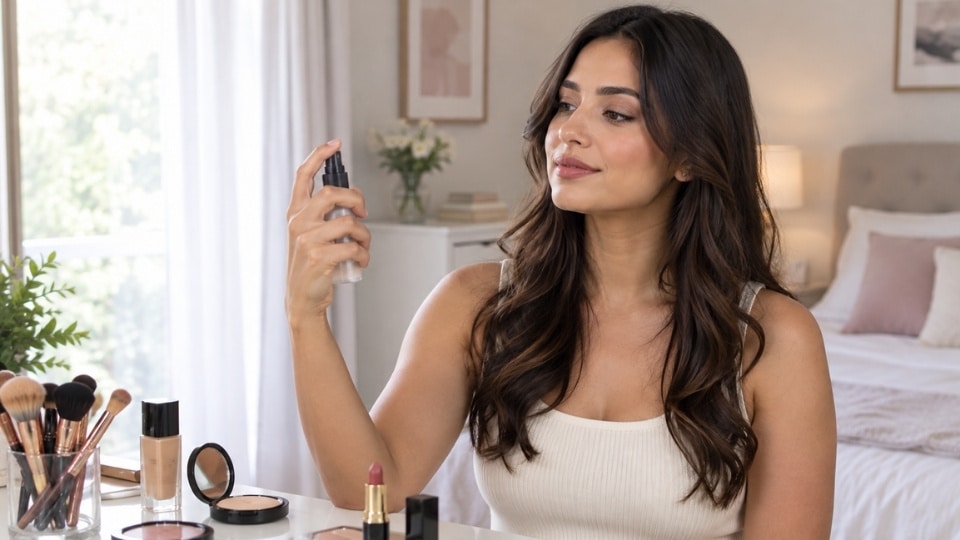
Setting spray is the step that melds every layer into one finish instead of several separate ones. I hold it six to eight inches away and mist in a loose X and T pattern, then let it air dry completely.
Matte formulas suit oily skin and hot weather, while a dewy spray works better on dry skin or in air-conditioned spaces where moisture disappears fast.
Matte sprays typically rely on ingredients that absorb oil as they dry, while dewy sprays lean on humectants that pull in moisture and sit slightly damp on the skin. That difference is why the wrong pick fights your skin type instead of working with it.
10. Protect the Look All Day
The habits between application and evening matter as much as the routine itself. Avoid touching your face, since hands transfer oil that breaks down everything underneath.
If your skin runs dry through the day, a hydrating facial mist works better than more setting spray, since spray locks a look in place rather than adding moisture back.
Keep a tissue or blotting paper in reach, so your hands have somewhere else to go instead of touching your face out of habit.
On hot or humid days, I lean matte over dewy from the start, since dewy formulas have less room to work with once real heat and sweat get involved.
Best Long Lasting Makeup Products to Try
I keep a short list of product categories I reach for personally when longevity is the priority, along with a few specific products that consistently deliver.
| Product Type | What to Look For | Popular Pick | Why It Works |
|---|---|---|---|
| Primer | Mattifying for oily skin, hydrating for dry skin | Milk Makeup Hydro Grip Primer | Creates the grip layer foundation needs to hold |
| Foundation | Long wear, transfer-resistant, oil-free | Estée Lauder Double Wear Stay-in-Place Foundation | Holds up against oil and sweat for longer coverage |
| Setting powder | Translucent, finely milled | Laura Mercier Translucent Loose Setting Powder | Absorbs oil without adding visible texture or color shift |
| Setting spray | Matte or dewy depending on skin type | Urban Decay All Nighter Setting Spray | Melds every layer into one finish that resists movement |
| Waterproof mascara and liner | Labeled waterproof or smudge-proof | Too Faced Better Than Sex Waterproof Mascara | Holds through humidity, heat, and long hours |
| Long wear lip color | Liquid lipstick or lip stain formulas | Maybelline SuperStay Matte Ink | Outlasts traditional lipstick through meals and drinks |
None of these products do much without the prep work covered. Pair the right formula with the right technique, and that is where the real staying power comes from.
How to Touch Up Makeup Without Making It Cakey
Touch-ups go wrong the moment you add more product on top of what is already there.
- Blot before you reapply anything: Oil is usually the actual problem by midday, not a lack of product, so pressing a blotting paper against shine solves more than powder ever will.
- Go light on pressed powder: A quick dust over shine works. Piling on more just builds thickness, and thickness is what reads as cakey.
- Setting spray can revive a look faster than foundation can: A light mist over a tired face often does more than another layer of base underneath it.
- Spot fix rather than redo the whole face: Nine times out of ten, concealer under the eyes or fresh lip color fixes the actual problem faster than starting over.
A real touch-up should take under a minute. If it is taking longer than that, you are probably adding product when what you actually need is to remove oil.
Long Lasting Makeup Tips for Every Skin Type
Your skin type changes almost everything about how long your makeup holds up. I have learned to treat oily, dry, and combination skin as three completely different routines.
| Skin Type | Priority | Product Choices |
|---|---|---|
| Oily skin | Oil control at every stage | Mattifying primer, oil-free foundation, translucent powder, matte setting spray |
| Dry skin | Hydration without heavy powder | Hydrating primer, dewy or satin foundation, minimal powder, hydrating setting spray |
| Combination skin | Zone-specific products | Mattifying primer on the T zone, hydrating primer elsewhere, powder only where needed |
| Sensitive skin | Fewer ingredients, gentle formulas | Fragrance-free primer and foundation, mineral setting powder, alcohol free setting spray |
| Mature skin | Hydration to avoid settling into lines | Hydrating primer, luminous foundation, powder used sparingly around fine lines |
Once your routine matches your skin type, everything else you do to extend wear time works better. The products you reach for next should build on that same foundation.
|
What to Carry for Midday Makeup Touch Ups I keep the same small pouch in my bag for every long day, and it rarely needs more than this.
|
Common Mistakes That Make Makeup Wear Off Faster
Most makeup problems I see come down to a handful of repeated habits, not bad products.
- Skipping moisturizer: Dehydrated skin pulls moisture straight out of your foundation later in the day, which is part of why it can look patchy by afternoon even on a good makeup day.
- Layering onto skincare that has not absorbed yet: Give every product a minute or two, or the layer on top slides instead of gripping the skin underneath it.
- One thick coat instead of thin, built-up layers: This is probably the single fastest way to end up creasing and looking cakey by early afternoon.
- Touching your face: Hands carry oil and bacteria, and that breaks down a good base faster than almost anything else on this list.
- Adding foundation as a touch-up: It builds thickness instead of solving the real issue, which is nearly always oil, not a lack of coverage.
- Wrong formula for your skin type: A dewy foundation on very oily skin, or a matte one on very dry skin, is fighting itself before the day even starts.
Fixing two or three of these at once tends to change how a look wears by evening more than any single product swap does.
Final Thoughts
Learning how to make makeup last all day really comes down to a handful of habits, done in the right order, not one miracle product.
Prep your skin properly, build your base in thin layers, choose formulas suited to your skin type, and set with intention rather than habit.
That combination is what actually keeps a look from fading, creasing, or sliding by the afternoon.
I still test new products against this same routine before I trust them for a long day.
If you try it, I would love to hear which step made the biggest difference for you, so drop a comment once you have given it a go.
Frequently Asked Questions
Does the Order I Apply My Skincare in Actually Affect Makeup Longevity?
Yes, applying skincare from thinnest to thickest helps each product absorb properly. This creates a smoother base and helps makeup last longer.
Can Weather Change Which Routine I Should Use?
Yes, humid weather calls for lighter, oil-controlling products, while cold weather benefits from extra hydration and less powder.
How Often Should I Actually Touch Up During a Long Day?
One touch-up is enough for most people if the makeup is applied well. Frequent touch-ups often mean your skin prep needs adjusting.
Does Exercising or Sweating During the Day Ruin a Morning Makeup Routine?
Not necessarily. Waterproof products and blotting sweat instead of wiping help keep makeup in place during and after exercise.
Is It Bad to Sleep in Setting Spray or Powder Residue Overnight?
Yes, leaving makeup on overnight can clog pores and lead to breakouts. Always remove your makeup before bed.
Does the Type of Foundation I Use Affect How Long My Makeup Lasts?
Yes, powder foundations usually last longer on oily skin, while liquid and cream formulas need to be set properly for longer wear.